15 Summer Flower Garden Ideas That Add Instant Color to Any Outdoor Space
Summer is the season when a garden either delivers or it does not.
The days are long. The light is generous. The conditions are as good as they are going to get. And either your outdoor space is a place you genuinely want to be every morning with your coffee and every evening with a glass of something cold, or it is a flat expanse of green that you walk past on the way to somewhere else.
The difference between those two outcomes is almost always flowers.
Not a complete garden redesign. Not a professional landscaper. Not a budget that would make a reasonable person nervous. Just the right flowers in the right places doing what summer flowers do, which is transform an outdoor space from a lawn with some edges into somewhere that looks alive, colourful, and genuinely worth spending time in.
Here are 15 ideas that deliver that transformation faster than you would believe possible.
Why Summer Flowers Make Such a Difference to an Outdoor Space
Colour in a garden does something that colour in an interior cannot fully replicate.
It moves. It grows. It changes from week to week and sometimes from hour to hour as flowers open in morning light and close in evening heat. It attracts bees and butterflies, and hoverflies that bring additional movement and life into the space. It produces a scent that drifts across a garden on a still afternoon in a way that no candle or diffuser can honestly match.
A garden with generous summer colour is not just visually different from one without it. It is experientially different. You sit in it differently. You notice more. You stay longer. The garden becomes something that rewards being in it rather than just looking acceptable from a kitchen window.
The other thing summer flowers do is forgive. They cover bare soil. They disguise the edges of borders that are not quite right. They fill gaps between shrubs that have not yet reached their final size. They make a garden that is still in progress look finished and intentional right now, this summer, while everything else develops.
1. Sunflowers for Instant Height and Drama
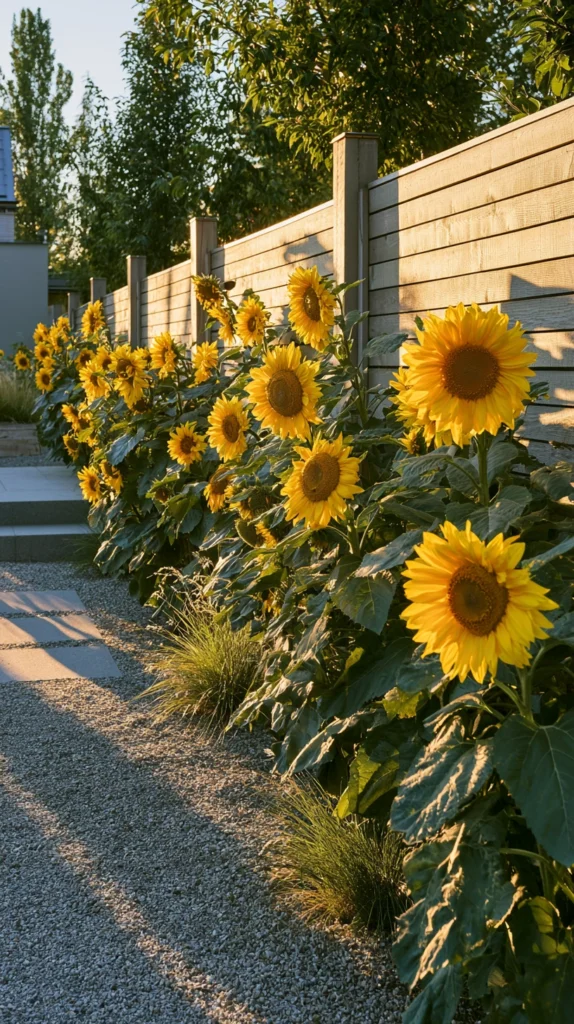
Sunflowers are the fastest route from bare soil to spectacular in any summer garden.
Sow directly into the ground in late spring after the last frost, and within ten to twelve weeks, you have plants of two metres or more, each topped with a flower head of extraordinary scale and colour. No other annual produces this transformation as quickly or as dramatically.
The classic tall yellow sunflower is still one of the most beautiful plants in any garden. But the range available now extends far beyond the standard. Deep burgundy and chocolate varieties like Moulin Rouge and Claret. Bi-coloured varieties with dark centres and pale ray petals. Multi-headed branching varieties that produce dozens of smaller flowers rather than one giant bloom.
Plant in blocks rather than single rows for the most impact. A block of twenty sunflowers in a sunny border creates a wall of colour that is visible from every part of the garden. Stagger the sowing by two weeks twice over, and the display extends across a longer period rather than peaking and finishing all at once.
The height of sunflowers is as important as the colour. They lift the eye upward and create a vertical element in borders and beds that most summer flowers cannot match. Against a fence, along a wall, or at the back of a deep border, sunflowers change the entire silhouette of the garden.
Why sunflowers belong in every summer garden:
- Direct-sow to flowering in ten to twelve weeks, faster than almost any other annual
- Heights from sixty centimetres to over three metres, depending on variety
- Colour range from pale cream through yellow, orange, red, and near-black
- Prolific nectar and pollen source for bees and other pollinators
- Seed heads in autumn provide food for birds through the winter months
- Grow in almost any soil in a sunny position with no specialist knowledge required
2. Zinnias in Bold Saturated Colour
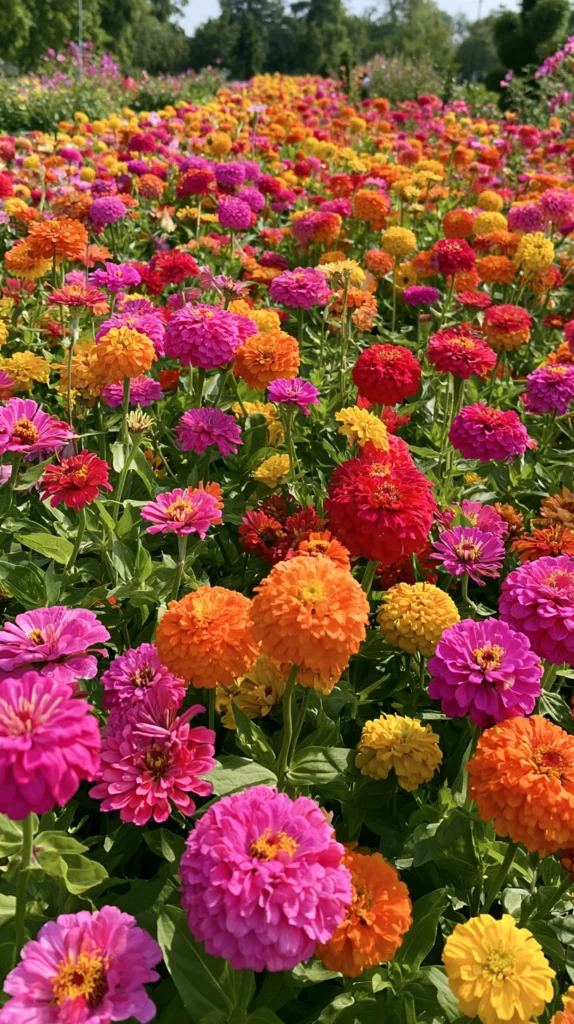
Zinnias are the summer flower that delivers the most colour per square metre of any annual you can grow.
They are native to Mexico, and they bring a Mexican festival quality to any planting. Hot orange. Electric pink. Cadmium yellow. Deep scarlet. Acid lime. Colours so saturated and vivid that they read clearly from the other side of the garden.
They are also among the easiest summer annuals to grow from seed. Direct sow after the last frost in a sunny position with reasonable soil, and they germinate within a week and flower within eight to ten weeks. Cut them regularly, and they branch and produce more flowers continuously from July through the first frost.
The cutting habit is critical. Zinnias grown without regular cutting tend to become single-stemmed and decline after the first flush. Zinnias cut to the ground repeatedly produce bushy plants with dozens of flower stems over the course of the summer. The more you cut, the more they flower. It is one of the most rewarding feedback loops in the summer garden.
Plant in large drifts of mixed colours or choose a single saturated tone for maximum impact. A mono-coloured drift of hot orange zinnias is a stronger garden statement than a mixed selection of the same size. The colour reads as a block rather than as scattered dots.
3. Cosmos for Elegant, Airy Movement
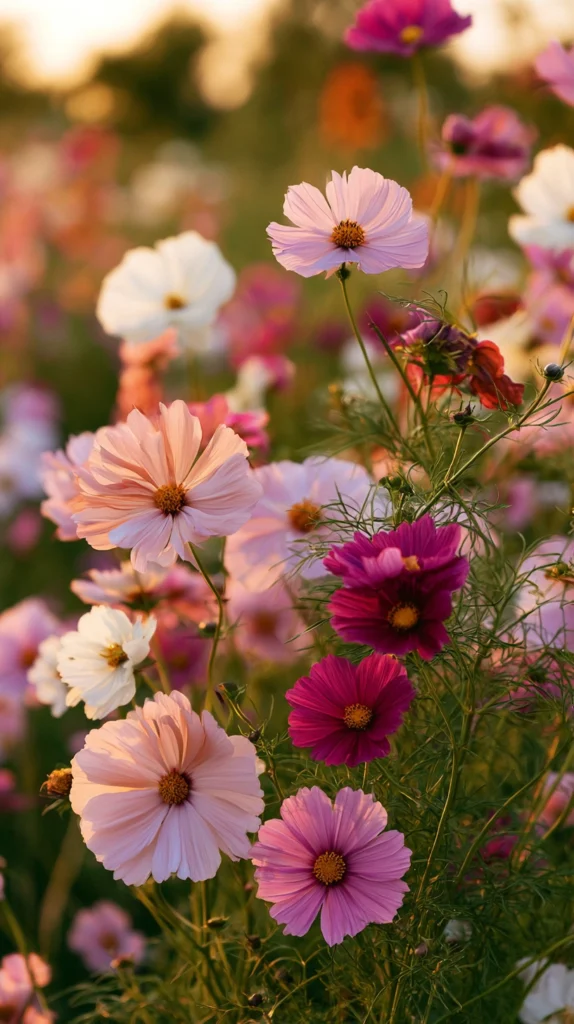
Where zinnias are bold and saturated, cosmos are the opposite.
Feathery, fine-leaved foliage on tall stems topped with simple daisy-like flowers in pink, white, and deep magenta. They move in any breeze, which means a planting of cosmos is never static. The whole mass shifts and nods in a way that adds a dynamic quality to the garden that stiff, heavy-headed flowers cannot provide.
Cosmos is also one of the most forgiving and productive summer annuals available. It genuinely prefers poor soil. In a rich, fertile border, cosmos produces excessive leafy growth at the expense of flowers. In average or even slightly impoverished soil, it flowers prolifically and continuously from July through October.
The height of cosmos, typically one to one and a half metres in most conditions, makes it ideal for the middle ground of a border. Tall enough to create presence without the wall-like quality of sunflowers. Airy enough to see through rather than being visually blocked by.
Cosmos Sensation is the classic white and pink variety that has been grown in summer gardens for generations. Cosmos Purity is pure white, one of the most elegant flowers in any summer border. The Chocolate Cosmos, C. atrosanguineus, is near-black with a genuine chocolate scent that is extraordinary on warm evenings.
4. Dahlias From Midsummer to Frost
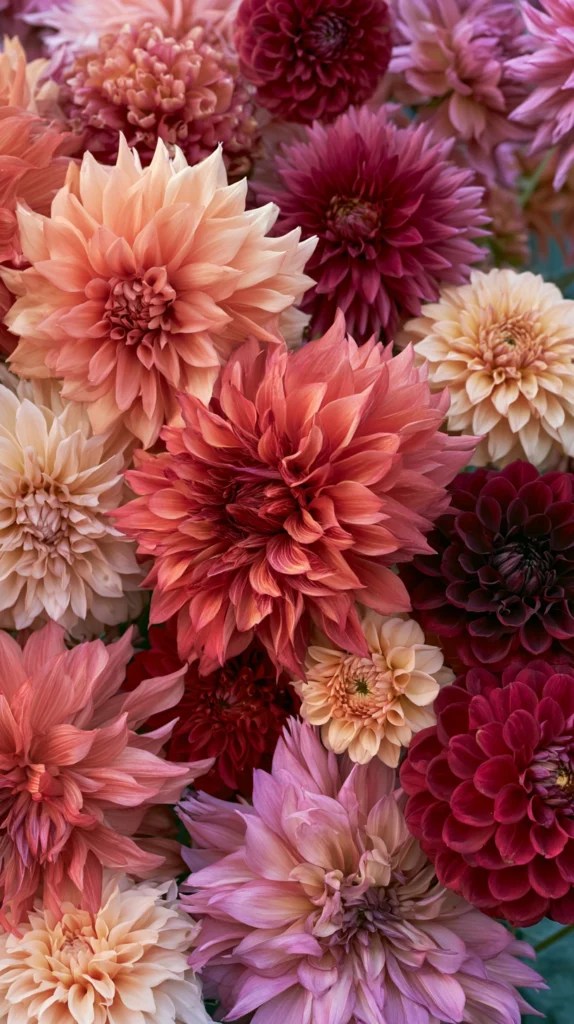
Dahlias are the summer flowers that start when other summer flowers begin to tire.
While spring bulbs are long finished and early summer annuals are into their second month, dahlias are just beginning. They come into their own in August and continue flowering with extraordinary generosity through September, October, and right up to the first hard frost.
This timing makes them invaluable. The summer garden often loses energy in August when early perennials have finished, and the first annuals are becoming tired. Dahlias arrive exactly when that energy is needed and sustain the colour and vibrancy of the garden through what would otherwise be a declining period.
The range of dahlias is overwhelming in the best possible way. Dinner plate dahlias with single blooms of thirty centimetres across. Pompon dahlias with perfect spherical heads the size of golf balls. Cactus dahlias have spiky, twisted petals that have a structural quality unlike any other flower. Decorative dahlias in the full spectrum of colour from pure white through every shade of pink, red, orange, and yellow to near-black.
Start tubers in pots in early spring and plant out after the last frost. The extra weeks of indoor growing give the tubers a head start and bring forward the flowering date by three to four weeks compared to planting directly into the ground.
5. Lavender for Colour, Scent, and Structure
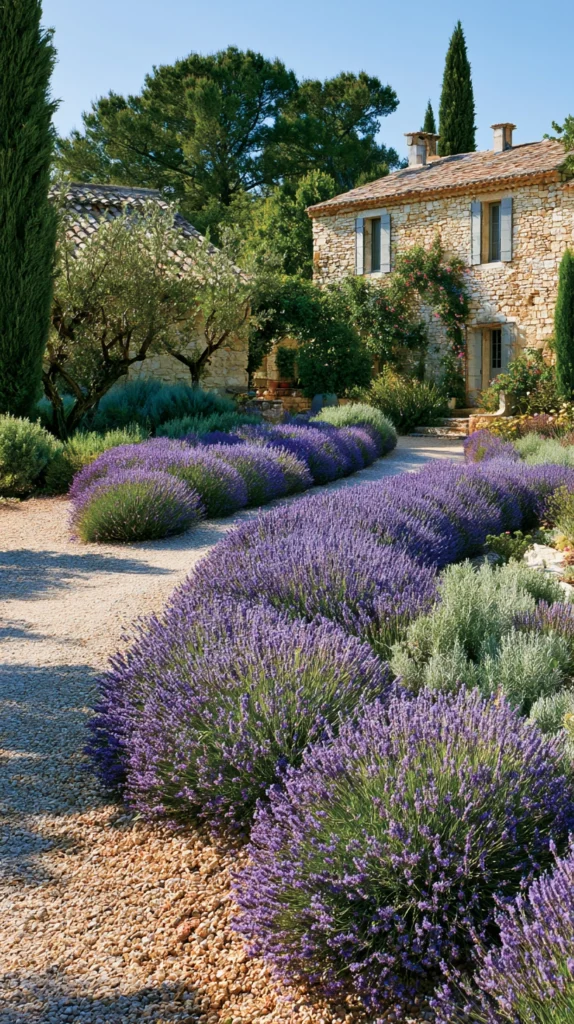
Lavender does something in a summer garden that most flowers cannot.
It provides colour. It provides scent. It provides a permanent structure that gives the garden shape and definition before and after the flowering season. And it does all three simultaneously while requiring almost no maintenance beyond a single annual trim.
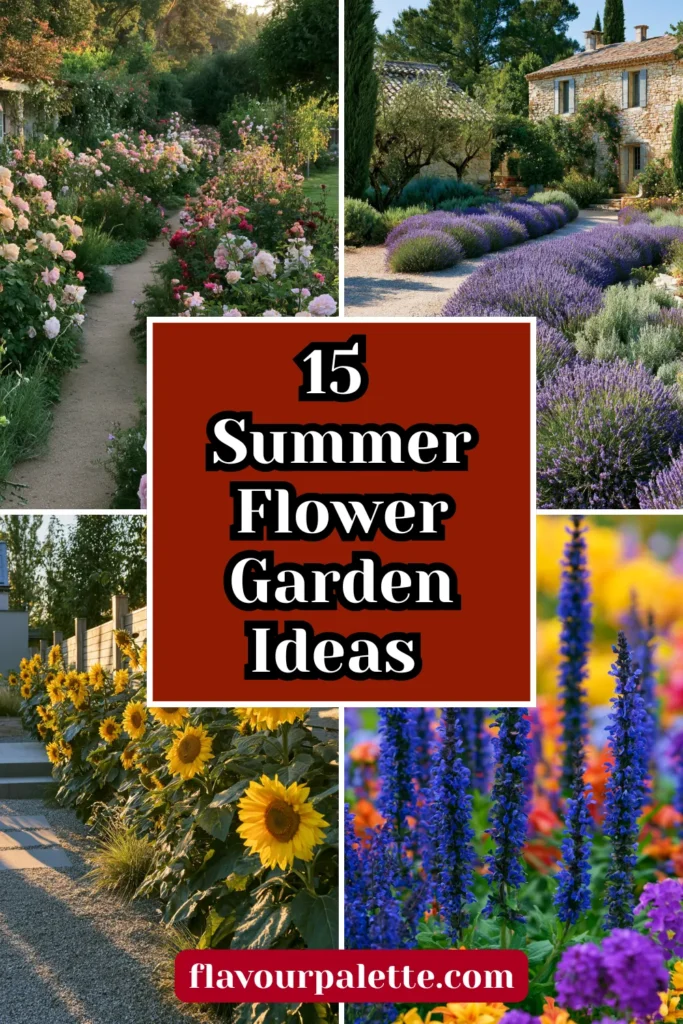
A generous planting of English lavender, Lavandula angustifolia, in full flower in July is one of the great sights of the summer garden. The grey-green foliage provides a calm base. The purple flower spikes rise above it in a dense mass. The scent on a warm afternoon is genuinely extraordinary.
Plant in groups rather than singles for maximum visual impact. A line of lavender along a path edge is beautiful. A mass planting of five or seven, or nine plants along a sunny border creates something far more impactful.
Lavender thrives in exactly the conditions that challenge other plants. Poor, dry, well-drained soil. Full sun. Exposed positions. The conditions that defeat more demanding plants are precisely what lavender prefers.
After flowering, trim the spent flower stems back to the foliage to keep the plant compact and to encourage fresh growth. Plants left untrimmed become woody and open in the centre within three to four years. A yearly trim adds years to their productive life.
6. Sweet Peas on a Wigwam or Arch
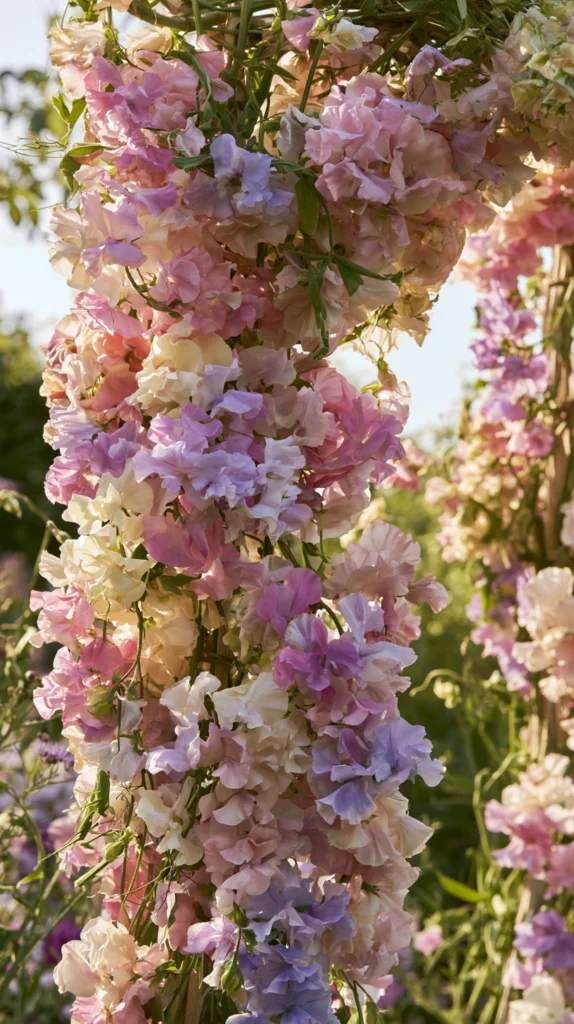
Sweet peas are the summer flowers that people describe most often with the word love.
They are, in the opinion of many gardeners, the most beautiful summer annual that can be grown in a temperate climate. The flowers are delicate, intricate, and impossibly elegant on their climbing stems. The range of colours is extraordinary. And the scent is the defining summer garden fragrance for anyone who has encountered it.
The scent is the essential element. There are sweet pea varieties that produce more flowers, larger flowers, and more unusual colours. But the old-fashioned, highly scented varieties, Spencer types and heritage strains, have a fragrance that the large-flowered modern varieties have traded away for size and colour. Grow for scent. The flowers follow.
Sweet peas climb and need support. A wigwam of bamboo canes or hazel sticks in a large pot. An arch over a path. A frame of canes against a wall or fence. The support structure is an opportunity as well as a necessity. A sweet pea arch in full flower is one of the most spectacular garden features possible in a small garden.
Like zinnias, sweet peas respond to cutting by producing more flowers. Do not leave flowers to set seed. Cut them every few days, as many as possible, and the plant continues to flower for weeks longer than one left to develop seed pods.
7. Rudbeckia or Black-Eyed Susans
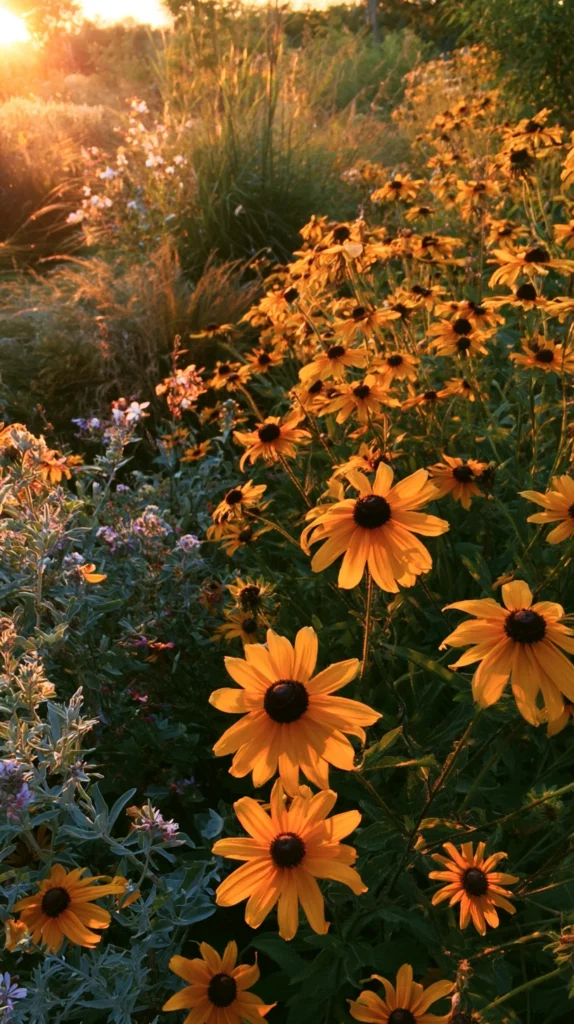
Rudbeckia is the summer flower that makes August feel like the most generous month in the garden.
The classic black-eyed Susan, Rudbeckia fulgida var. sullivantii Goldsturm, produces a mass of golden-yellow daisy flowers with dark chocolate centres from July through September. The flower colour has a warmth and richness that reads as the embodiment of late summer.
It is also one of the most reliable and lowest-maintenance plants in any summer garden. Rudbeckia asks very little. Average soil. A reasonably sunny position. It does not need staking, deadheading, or special attention. It simply flowers with extraordinary consistency year after year.
The tall annual forms of rudbeckia, varieties like Cherry Brandy in warm orange and bronze tones, and Prairie Sun in pure gold, add this colour to new plantings immediately, without the wait for an established perennial.
Leave the seed heads standing through autumn and winter. They provide food for finches and other seed-eating birds, and the architectural quality of the seed heads adds genuine interest to the border in the months when flowers are absent.
8. Echinacea or Coneflowers in the Midsummer Border
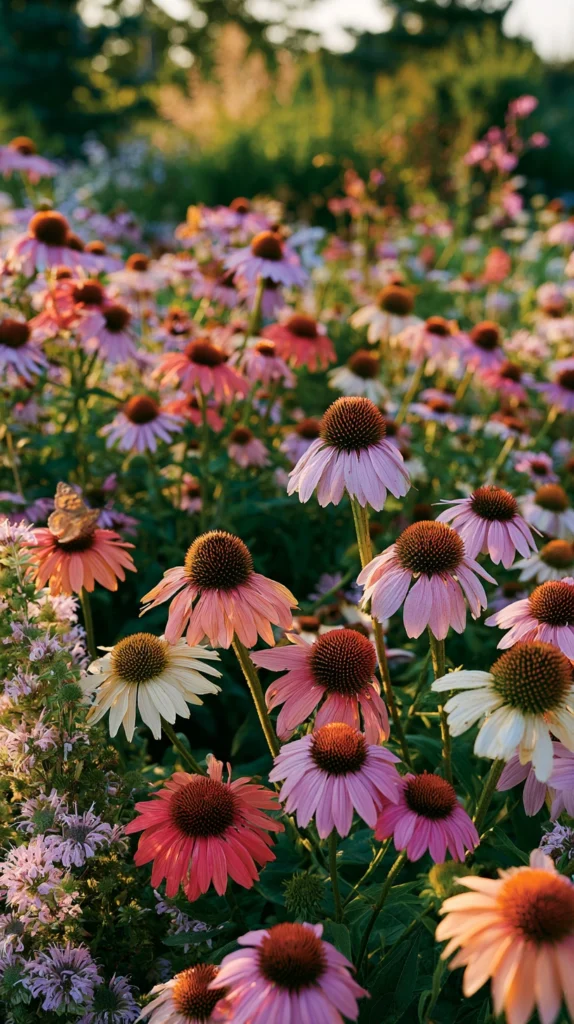
Echinacea has moved from a marginal cottage garden plant to one of the most popular and widely cultivated summer perennials available.
The reason is simple. The variety available now is extraordinary. Where once there was only the basic pink Echinacea purpurea, now there are varieties in white, cream, pale yellow, deep orange, coral, burgundy, and near-red. The petal form has diversified, too. Classic reflexed petals that sweep back from the central cone. Double varieties with dense layers of petals. Quilled varieties with tubular petals give the flower a different texture.
All of them flower from July through September, and all of them are magnets for butterflies. A sunny border with a generous planting of echinacea in late summer will have Red Admirals, Painted Ladies, and Small Tortoiseshells visiting continuously on good days. The wildlife value of echinacea is as high as its ornamental value.
The cone centres that give echinacea its common name persist after the petals drop and provide food for goldfinches through autumn and winter. A border of echinacea is productive for wildlife well beyond its flowering season.
9. Salvia for Vertical Blue and Purple Spikes
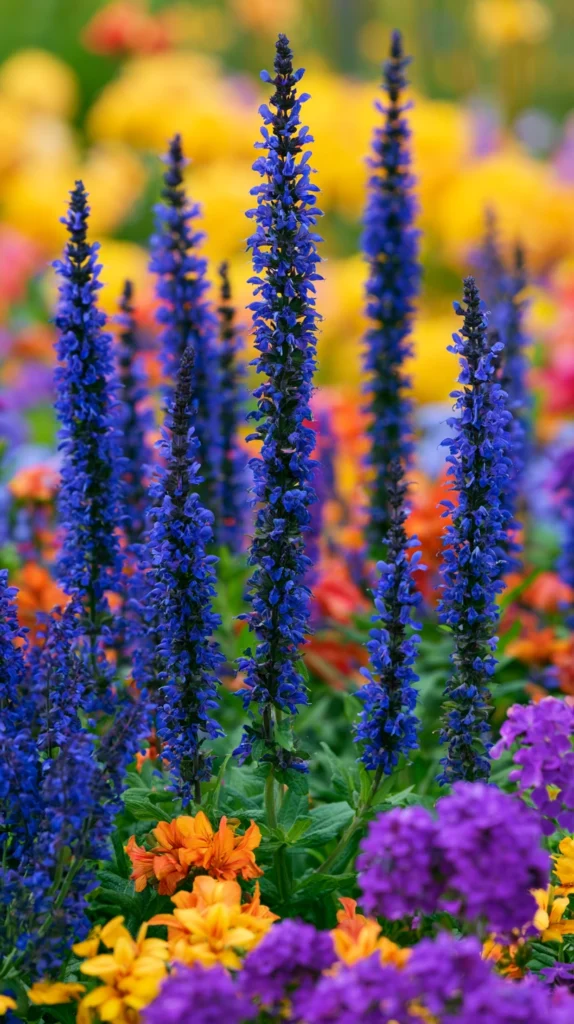
Blue is one of the hardest colours to find in the summer garden.
Most summer flowers occupy the warm end of the spectrum. Yellow, orange, red, pink, and white dominate. True blue is relatively rare and enormously useful as a contrast to the warm tones that might otherwise make a summer border feel relentlessly hot.
Salvia delivers blue in its most intense and useful form.
Salvia nemorosa, the hardy perennial meadow sage, produces dense spikes of deep blue-purple flowers from June through August. The flower spikes are vertical and structural in a way that loose, open flowers are not. They add an architectural quality to a border that contrasts beautifully with the round heads of rudbeckia, echinacea, and zinnia.
Annual salvias in brilliant true blue, Salvia farinacea Victoria and similar varieties, carry this colour from planting to the first frost with almost no attention. They are ideal for containers, front of border, and filling gaps in any planting where blue is needed.
The combination of blue salvia spikes with orange and yellow rudbeckia is a classic summer colour combination that works because it is genuinely complementary. Blue and orange are opposite each other on the colour wheel, and each makes the other look more intense.
10. Verbena Bonariensis for an Airy, See-Through Effect
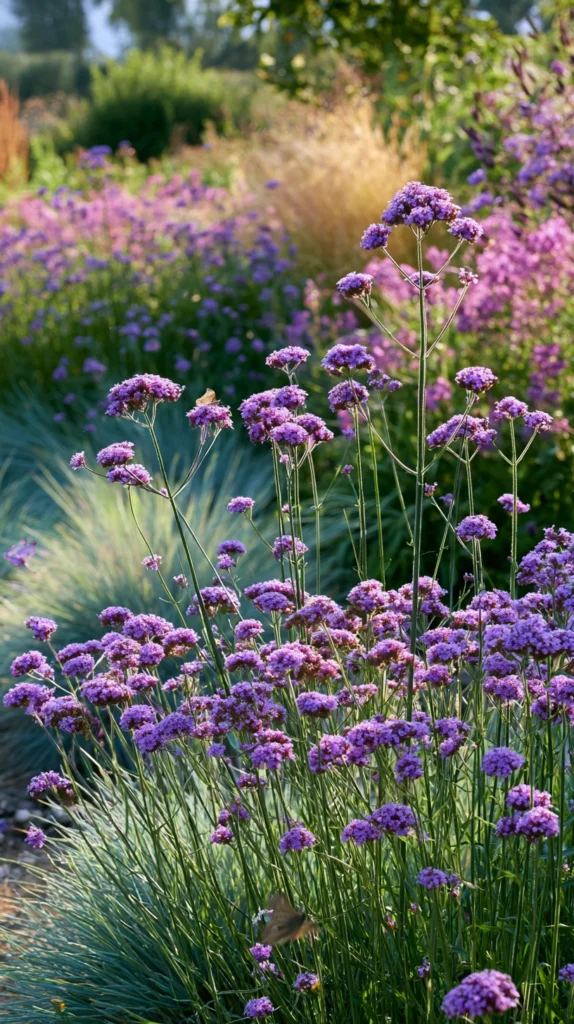
Verbena bonariensis is the plant that goes everywhere because everywhere suits it.
Tall, thin, branching stems of one to two metres topped with tiny clusters of brilliant purple flowers. The stems are narrow enough to see through. The plant occupies its vertical space without blocking what is behind it. A border planted with Verbena bonariensis looks more complex and layered than one without it because the plant literally adds a floating layer of colour above everything else.
It self-seeds with extraordinary enthusiasm. Plant it once, and it will populate any area with suitable conditions for years without any further intervention. The seedlings are easy to identify and easy to move when they appear somewhere inconvenient.
Butterflies find it irresistible. The dense flower clusters of Verbena bonariensis are among the most visited nectar sources in any summer garden. On a warm August afternoon, a group of these plants in full flower will have multiple butterfly species feeding simultaneously.
Use it in gaps between taller perennials. Let it seed into gravel paths and paving joints. Allow it to push through the skirts of larger shrubs. Its willingness to grow in improbable places and its ability to add colour and movement above everything else make it one of the most useful plants in any summer garden.
11. A Cutting Garden Patch for Fresh Flowers Indoors
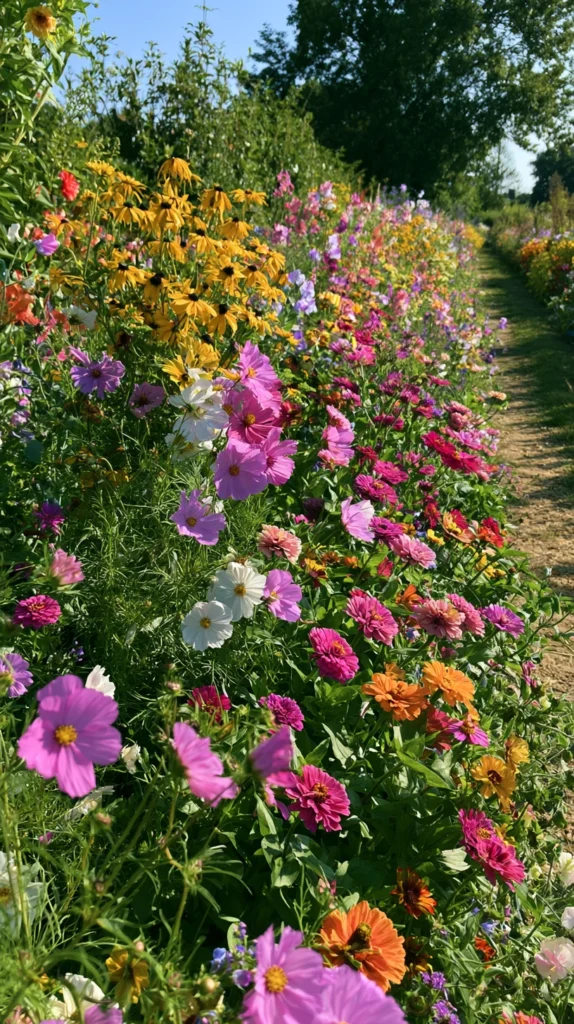
The cutting garden is the summer garden idea that rewards you inside the house as well as out.
A dedicated patch of flowers grown specifically for cutting brings the summer garden indoors. The kitchen table. The windowsill. The bathroom. Every room in the house gets a connection to the garden outside through fresh flowers cut that morning and placed in water.
The cutting patch needs to be hidden from the main garden view, or at least accepted as a productive rather than an ornamental area. It is planted in straight rows for easy harvesting rather than in the naturalistic drifts that look best in an ornamental border. It is cut regularly, which means it does not look its best from any particular viewpoint.
The return on a cutting garden is completely disproportionate to the investment. Seeds of zinnia, cosmos, sunflower, sweet pea, scabious, rudbeckia, and ammi cost very little. The flowers they produce, cut and brought inside from July through October, are indistinguishable from expensive florist bundles and genuinely more beautiful for being grown yourself.
Even a two metre by three metre patch in a sunny corner of the garden, planted with five or six cutting varieties, produces more fresh flowers than most households can use across a full summer.
12. Containers and Pots Overflowing With Summer Annuals
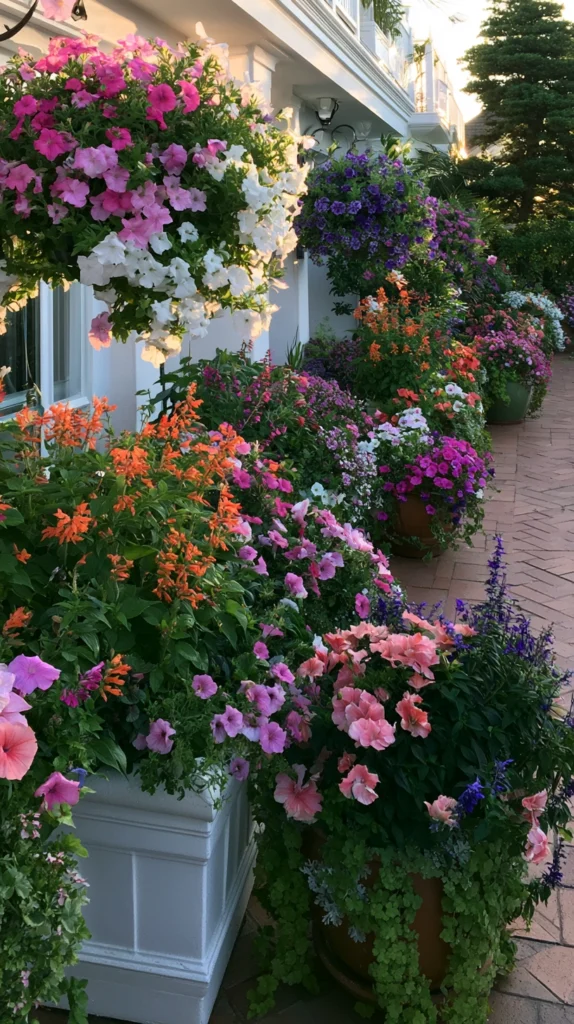
A garden without room for in-ground planting is still a garden that can overflow with summer colour.
Containers packed with summer annuals bring colour to terraces, balconies, doorsteps, and any surface where a pot can stand.
The principle of effective summer container planting is simple. Thrill, fill, and spill. A tall, dramatic central plant, the thriller. Mid-height bushy plants filling the pot around it, the fillers. Trailing plants spilling over the sides and downward, the spillers.
For summer colour, the thriller might be a tall dahlia or a standard-trained fuchsia. The fillers might be zinnias, salvias, and marigolds. The spill might be calibrachoa, verbena, and trailing petunia.
The container itself is a design decision. A large terracotta pot planted up with summer annuals looks genuinely beautiful. A galvanised steel trough planted with a single variety in one saturated colour makes a bold contemporary statement. A collection of mismatched pots in different sizes grouped together creates a cottage quality that a single pot cannot provide.
Water containers every day in hot weather. Every summer container plant failure is ultimately a watering failure. The soil in pots dries completely in hot weather within twenty-four hours and a container plant that goes dry repeatedly never fully recovers.
13. A Wildflower Patch for Instant Meadow Impact
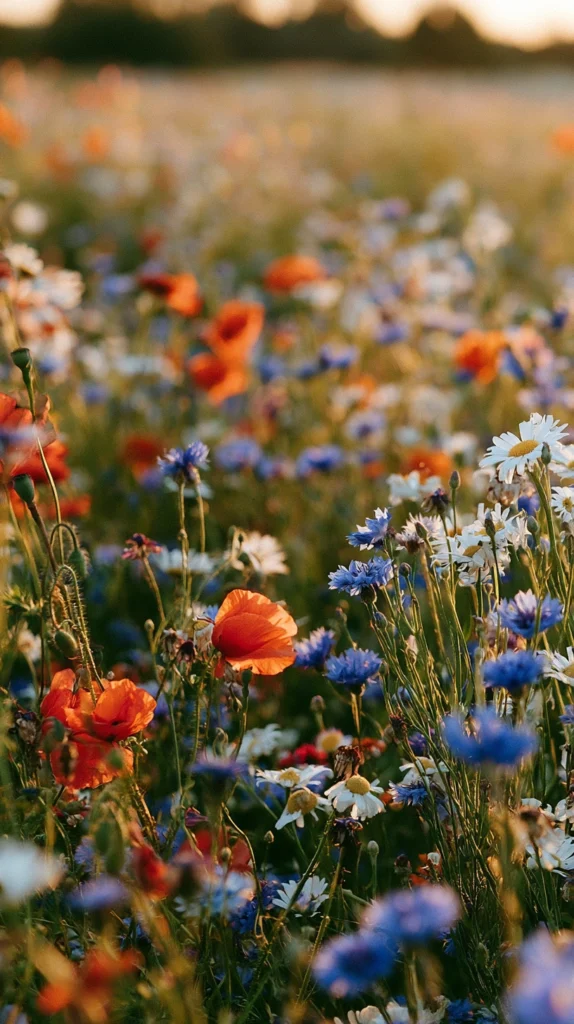
A wildflower patch requires the least effort of any summer flower idea on this list and produces one of the most beautiful results.
Buy a packet of annual wildflower seed mix. Prepare a patch of bare soil by raking it to a fine tilth. Scatter the seed. Rake lightly to make contact between the seed and the soil. Water in dry weather until established.
From late June through September, the patch produces a shifting tapestry of colour in the natural proportions that wildflowers occupy in a meadow. Cornflowers are bright blue. Corn poppies in scarlet. Field scabious in lilac. Ox-eye daisies in white and gold. Phacelia is intense purple-blue. Pot marigolds in orange and yellow.
The effect looks like the edge of a field in midsummer. It looks like something that belongs to this country and this season rather than something designed or planted.
Annual wildflower mixes are ideal for bare soil, building site ground, and any area that has been recently disturbed. The species in the mix are adapted to the disturbed, open soil conditions that follow construction and cultivation.
Let the patch set seed at the end of the season without cutting it down. Scatter the seed heads across the patch in autumn, and the mix will self-seed and return next year spontaneously.
14. A Rose Border for Classic Summer Fragrance and Colour
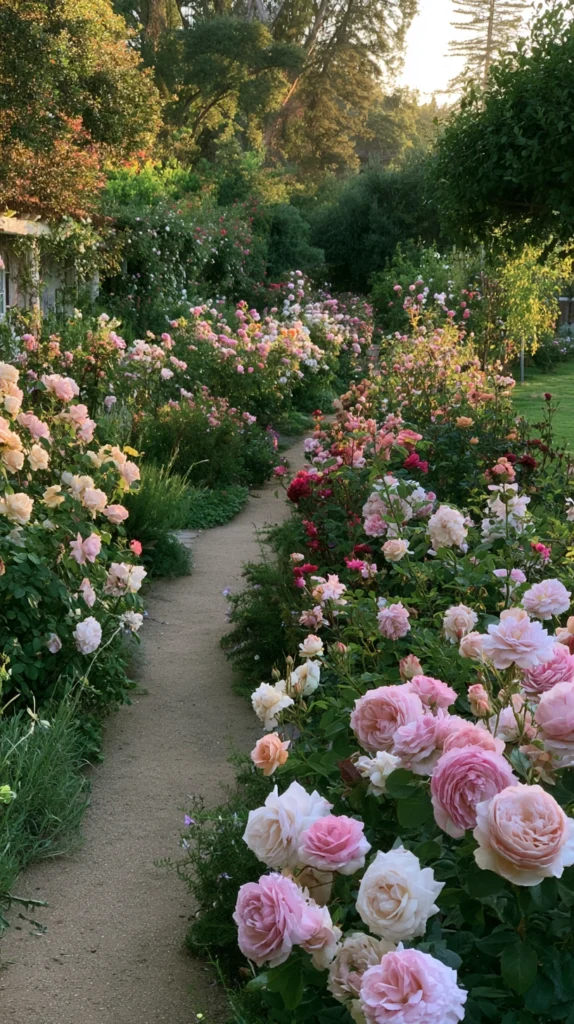
The rose is the oldest cultivated garden flower in the world.
And for very good reason.
No other summer flower combines the form, the scent, the colour range, and the extended flowering period of a well-chosen rose in a garden that suits it.
Modern rose breeding has produced varieties that address the historical limitations of older roses. Many now flower repeatedly from June through October rather than in a single June flush. Many have bred in genuine disease resistance that older varieties lacked. And the colour range extends from the purest white through every tone of pink, red, apricot, yellow, copper, and purple.
Choose shrub roses and English roses bred by David Austin for the combination of old rose flower form, strong fragrance, and repeat flowering that modern hybrid teas cannot match. Varieties like Gertrude Jekyll, the Lady of Shalott, and Olivia Rose Austin are garden roses in the truest sense. They grow into rounded shrubs, flower repeatedly, carry a strong fragrance, and survive without constant intervention.
A rose border underplanted with catmint, lavender, and hardy geraniums is one of the most classically beautiful summer garden combinations. The underplanting suppresses weeds, provides additional colour at the base of the roses, and creates a planting that looks designed and intentional rather than just planted.
15. A Combination Border Designed to Peak in August
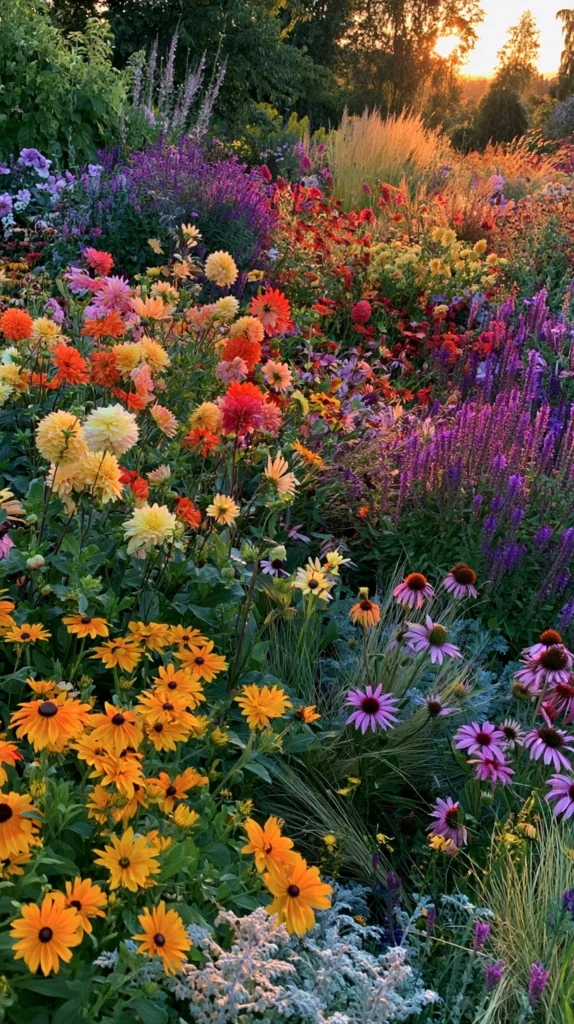
Most gardens peak in June and decline through July into a relatively colourless August.
This is the wrong month to peak.
August is when you are most likely to be in the garden. When the evenings are warmest. When guests come to visit. When outdoor dining is most possible and most frequent. August is when the garden should be at its absolute best.
Designing a combination border specifically to peak in August requires choosing plants that come into their fullest flower in late summer rather than early summer.
Dahlias begin in late July and accelerate through August. Rudbeckia is at its peak from August through September. Echinacea flowers from July through September. Verbena bonariensis is at its most abundant in August. Heleniums, the sneezeweed perennials with their warm orange, bronze, and yellow daisy flowers, peak in August and September. Late-season salvias produce their most prolific flower in August heat.
Combine these late-peaking plants with grasses that come into their own in late summer, Pennisetum, Miscanthus, and Panicum species whose seed heads and autumn colours make them most beautiful in August and September, and the border becomes a late summer spectacle rather than a June-heavy display that leaves the most used months of the garden year looking tired.
This is the summer flower garden idea that requires the most planning and produces the most practical reward.
How to Plan a Summer Flower Garden for Continuous Colour
The gap-free summer garden requires plants that hand colour from one to the next across the entire season.
Early summer needs plants that peak in June and July. Sweet peas, cosmos, and lavender carry this period. Midsummer, from July through August, needs the highest density of colour. Zinnias, dahlias, rudbeckia, salvia, and echinacea all overlap in this central period. Late summer through to the first frost needs the dahlias at their most productive, combined with verbena, rudbeckia, and any annuals that have been kept cut and productive.
Sow in succession rather than all at once. Two sowings of zinnias, three weeks apart, extend the display significantly. A late sowing of sunflowers provides colour when the first planting is finishing.
Plant perennials for reliability and annuals for density and colour. The perennials establish the framework. The annuals fill every gap and push colour into every corner of available space.
Cut regularly and generously. Cutting does not reduce the flowering of most summer annuals. It stimulates it.
Common Mistakes With Summer Flower Gardens
Planting too sparsely. Individual plants scattered in beds rarely create the impact of grouped plantings. Three dahlias have a fraction of the visual effect of nine dahlias in the same space. Plant in groups of odd numbers and allow plants to touch and overlap as they grow.
Growing in too much shade. Almost every summer flower on this list wants a minimum of six hours of direct sunlight per day. A flowering plant in insufficient light becomes a leafy plant with few flowers. The sunniest spot in the garden is always the right spot for summer flowers.
Not deadheading or cutting. Most summer annuals, left to set seed, divert all their energy from flower production to seed production and stop flowering. Regular cutting or deadheading of spent blooms extends the flowering season dramatically.
Watering inconsistently. Summer flowers in hot, dry conditions need consistent moisture. Irregular watering, dry for several days, then a big drink, stresses plants and reduces flower production. Regular light watering is better than infrequent heavy watering.
Giving up after the first flush. Many summer annuals look temporarily bare and tired after their first flush of flowers. This is not the end of their season. It is the rest between acts. Cut back hard, feed with a liquid fertiliser, and within two to three weeks the second flush arrives, often more prolific than the first.
Not staking tall plants early enough. Dahlias, tall sunflowers, and cosmos all benefit from staking before they need it, rather than after they have already toppled in a summer storm. Stake when the plant is half its final height, and the stems grow up through the support naturally.
Quick Summary
- Sunflowers sown directly go from bare soil to two-metre flowering plants in ten to twelve weeks
- Zinnias produce the most saturated, vivid colour per square metre of any summer annual
- Cosmos provides airy, movement-filled colour that stiff, heavy-headed flowers cannot match
- Dahlias begin when other summer flowers are tiring and flower prolifically until the first frost
- Lavender provides colour, scent, and permanent structure simultaneously with almost no maintenance
- Sweet peas grown for scent are the most loved summer flower in the temperate garden
- Rudbeckia produces a warm golden colour reliably from July through September with no specialist care
- Echinacea attracts butterflies and provides food for birds in seed head form through winter
- Salvia provides the true blue that is genuinely rare in the summer garden palette
- Verbena bonariensis adds a floating layer of purple above everything else and self-seeds prolifically
- A cutting garden patch provides fresh flowers for the house from July through October for minimal cost
- Containers packed with thriller, filler, and spiller combinations bring colour to any surface or outdoor space
- A wildflower patch from a seed mix requires the least effort and produces the most naturalistic result
- Roses chosen for repeat flowering, fragrance, and disease resistance provide colour from June through October
- A border designed to peak in August delivers colour when the garden is used most rather than most conveniently
- Plant in groups rather than singles, in full sun, and cut regularly to maximise and extend all summer colour
Summer only comes once a year.
And it does not wait for you to be ready.
Plant the zinnias this weekend. Sow the cosmos now. Order the dahlia tubers before they sell out. Put in the lavender while the soil is still warm enough to get the roots established before autumn.
The most common regret in a summer garden is not doing too much. It is waiting until it is too late to do enough.
Start now. The colour will follow.