
13 Best Full Sun Plants for Hot Weather Gardens in 2026
Hot gardens are getting hotter.
The summers that gardeners managed through in previous decades have shifted. The weeks of genuine heat that once marked out the exceptional summer now arrive more reliably, stay longer, and test plants that previously coped without difficulty.
For full sun positions in hot weather gardens, this shift changes the calculus of plant selection. The plants that simply tolerated heat in previous decades now need to genuinely thrive in it. The plants chosen for south-facing borders, exposed terraces, gravel gardens, and south-side walls need to be genuinely heat-adapted rather than merely heat-tolerant.
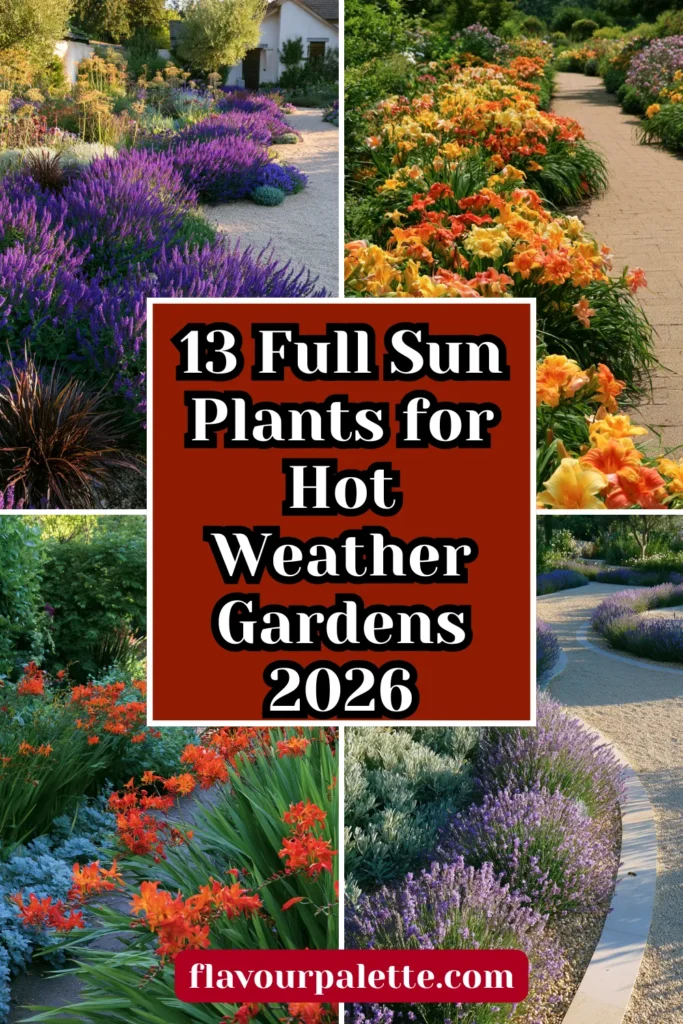
The good news is that the plants adapted for these conditions are some of the most beautiful available in any garden. They evolved in climates that push conditions far beyond what any temperate garden delivers. They arrive in a hot summer garden and perform exactly as they were designed to perform. They flower when everything else is struggling. They hold their structure when their neighbours are wilting. They ask for less water rather than more.
These are the plants that hot gardens need in 2026.
Why Plant Selection for Full Sun Hot Conditions Has Changed
The plant selection advice written ten or fifteen years ago was calibrated for a different climate reality.
Plants described as drought-tolerant for their time are now expected to handle conditions of genuine severity. Plants that needed occasional watering in a dry spell now face sustained periods of high temperatures and minimal rainfall that test their drought adaptation to its real limits.
The plant list for a full sun hot weather garden in 2026 should be selected not for average conditions but for the worst realistic conditions the garden will face across the season. The extended heatwave. The six-week dry period with no meaningful rainfall. The south-facing terrace that adds ten degrees to the ambient air temperature at the height of summer.
Selected for those conditions, the plants that make this list perform beautifully. Selected for milder conditions and then exposed to these extremes, even previously reliable plants fail.
This is not a cause for pessimism. It is a cause for better plant selection. The plants that are genuinely adapted to heat and drought are also among the most beautiful, the most fragrant, the most ecologically valuable, and the most structurally interesting in any garden. The hot garden is not compromised. It is a different garden with a different and genuinely excellent plant palette.
1. Lavender (Lavandula angustifolia and Lavandula x intermedia)
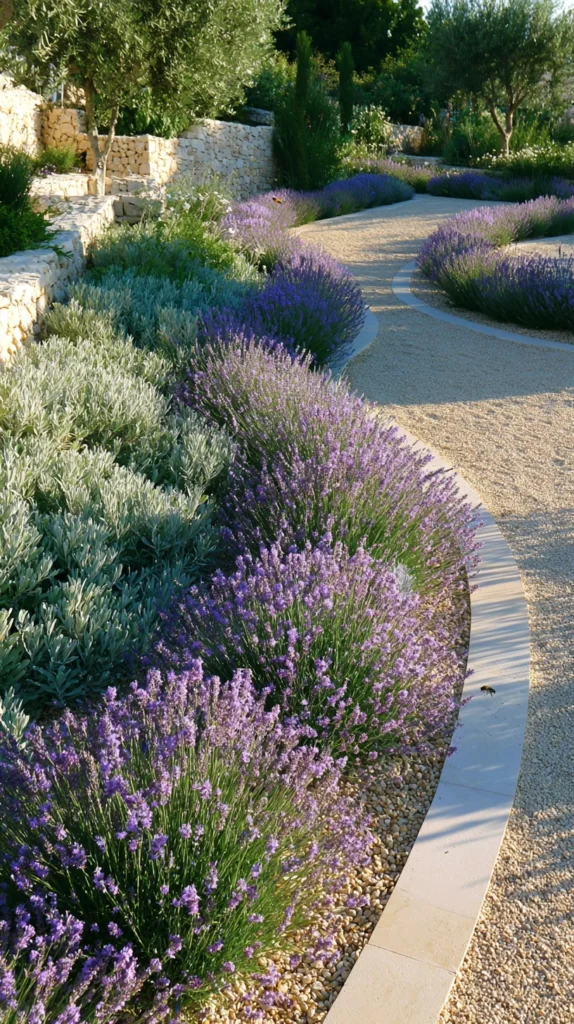
Lavender is the plant that defines the dry, hot garden more completely than any other.
Not because it is the most dramatic or the most colourful, but because it handles sustained heat and drought with such effortless grace that it seems to belong specifically to these conditions. A lavender plant in full sun with poor, dry, free-draining soil in high summer is lavender at its absolute best. It produces more flower stems, more intensely coloured, with a stronger fragrance than the same plant in richer, moister conditions.
Lavandula angustifolia, English lavender, is the hardiest and most reliably evergreen of the commonly grown forms. Varieties including Hidcote, Imperial Gem, and Vera produce compact mounds of grey-green foliage topped with dense purple flower spikes from June through August. The plant is fully hardy through cold winters and returns each spring without any protection in temperate climates.
Lavandula x intermedia, the lavandin hybrids, grow larger and produce taller, showier flower spikes slightly later in the season than English lavender. Grosso, the variety widely grown for commercial lavender oil production, reaches ninety centimetres in height with long purple spikes of strong fragrance. Phenomenal is particularly noted for its heat and humidity tolerance and is the variety most recommended for gardens in genuinely hot climates.
The critical cultural requirement for lavender in any form is drainage. Lavender in wet or waterlogged soil declines and dies regardless of the temperature. In dry, free-draining soil it requires essentially no supplemental watering once established.
Why lavender belongs at the top of every hot garden plant list:
- Thrives in poor, dry, free-draining soil where most plants decline
- Provides continuous flowers from June through August with a single trim extending the season
- Intensely fragrant throughout the flowering period, attracting bees and butterflies continuously
- Evergreen year-round structure that maintains interest outside the flowering season
- Extremely low maintenance beyond the single annual trim after flowering
- Available in a range of sizes from compact dwarf forms to large statement shrubs
2. Agapanthus (Agapanthus africanus and A. praecox)
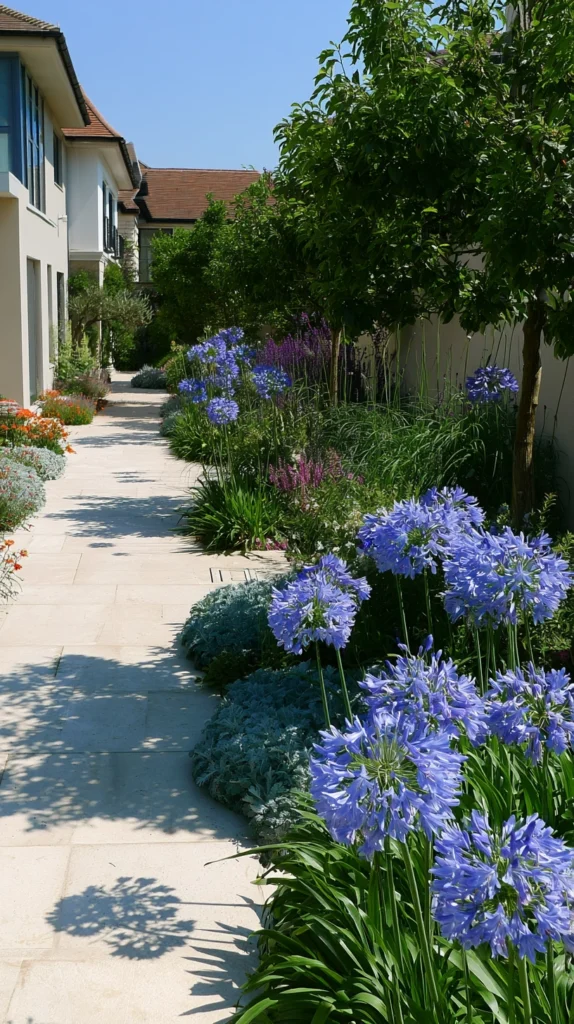
Agapanthus has moved from conservatory exotic to mainstream garden plant over the past two decades and is now one of the most widely planted perennials for full sun positions in warm-climate gardens.
The reasons are straightforward. It is spectacular. The globe-shaped heads of tubular flowers in clear blue, deep purple, or white on strong stems of sixty to one hundred centimetres are among the most striking of any summer-flowering plant. It flowers from July through September when many other plants have finished or are resting. And once established in a well-drained, sunny position, it requires very little supplemental water.
The evergreen varieties, typically sold as Agapanthus africanus or Agapanthus praecox, are not reliably hardy in climates that experience hard winters. In frost-prone gardens, they require protection or winter lifting. The deciduous varieties, hybrids developed specifically for cold hardiness, die back to the ground in autumn and reappear in spring. In borderline climates, the deciduous forms are the practical choice for garden planting.
Headbourne Hybrids, bred for cold hardiness and available in a range of blues and whites, are the most widely planted agapanthus for temperate gardens and perform reliably in full sun with good drainage and occasional watering through the driest periods. They establish slowly, typically taking two to three years to begin flowering prolifically, but once established, they flower more generously with each successive year.
3. Salvia nemorosa and Salvia x sylvestris Varieties
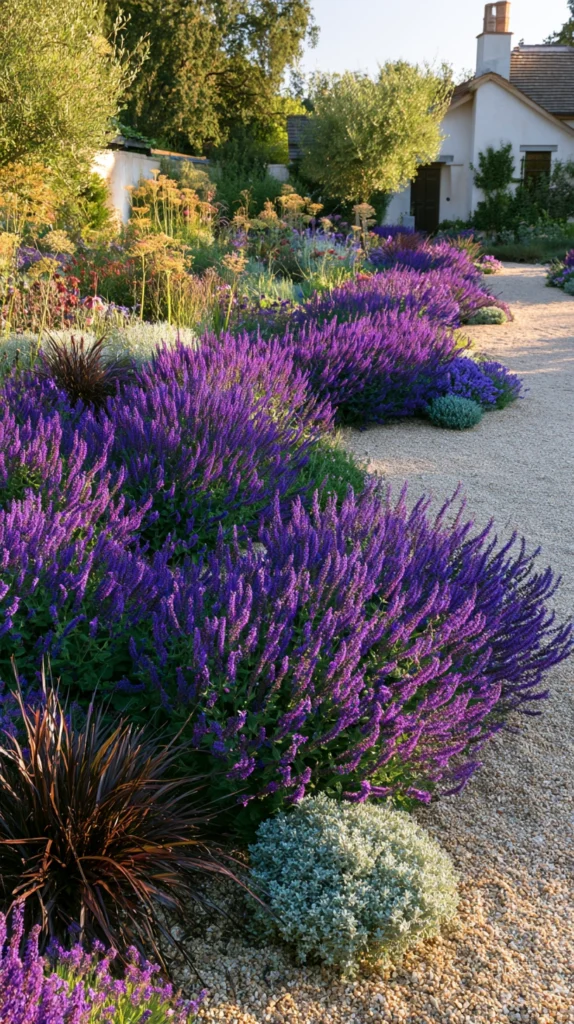
The hardy garden salvias are the plants that most reliably deliver the colour of blue and purple through the height of summer in a full sun garden.
Salvia nemorosa Caradonna is the variety most consistently recommended for its performance in hot, dry conditions. The near-black stems carry dense spikes of deep violet-purple flowers from June through August. Cut back after the first flush, and it flowers again through September. The plant remains compact, self-supporting, and does not require staking even in exposed positions.
Salvia x sylvestris May Night (Mainacht) produces somewhat taller flower spikes in a similar deep indigo-purple from late May through July. Its earlier start extends the blue colour into the period before Caradonna reaches its peak, creating overlapping colour across the whole of the early and midsummer period when combined.
Both varieties require essentially no supplemental watering once established in a well-drained position in full sun. In rich, moist soil, they grow lushly but produce fewer flowers and are more prone to flopping. In poor, dry soil, they remain compact and flower prolifically. The poor-soil, full-sun conditions that test most plants are precisely the conditions under which these salvias perform at their best.
The ecological value of hardy salvias is significant. The dense flower spikes are visited continuously by bumblebees and small butterflies throughout the flowering period. A group of Caradonna in full flower hums with insect activity on any warm day.
4. Echinacea (Coneflower)
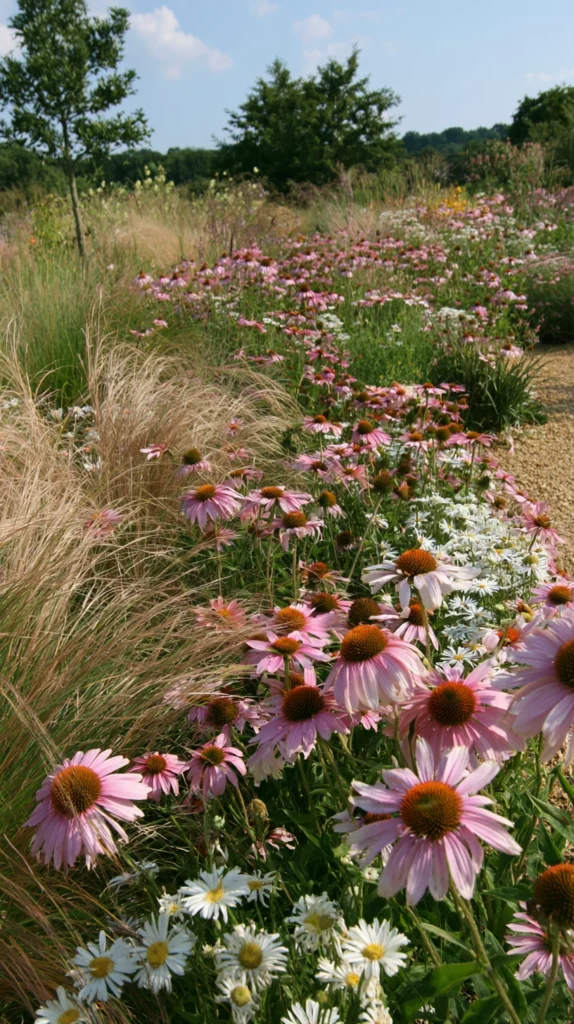
Echinacea comes from the prairies and meadows of North America, where summer temperatures are extreme, summer rainfall is variable, and the plants are expected to perform without irrigation through the full summer period.
These origins make echinacea specifically well-adapted to the hot, dry summer conditions that are increasingly characteristic of gardens at higher latitudes. It does not merely tolerate heat and drought. It was designed for them.
Echinacea purpurea, the standard species, produces the classic reflexed ray petals in pink-purple around a prominent central cone from July through September. The flower form is distinctive and immediately recognisable. The petals reflex downward from the central cone as the flower matures, giving the plant a slightly alien and specifically beautiful quality.
The variety range available in 2026 extends the colour palette well beyond the original pink-purple. Magnus is deep, rosy pink. White Swan is pure white. Prairie Splendor in deep rose. The Hot Papaya series in warm orange and red tones that suit combination with other warm-coloured prairie-style plants.
All echinacea varieties are drought-tolerant once established. All attract butterflies in significant numbers during the flowering period. And all produce seed heads in autumn and winter that provide food for goldfinches and other seed-eating birds. The plant earns its place in a hot garden from July flowers through December seed heads.
5. Hemerocallis (Daylily)
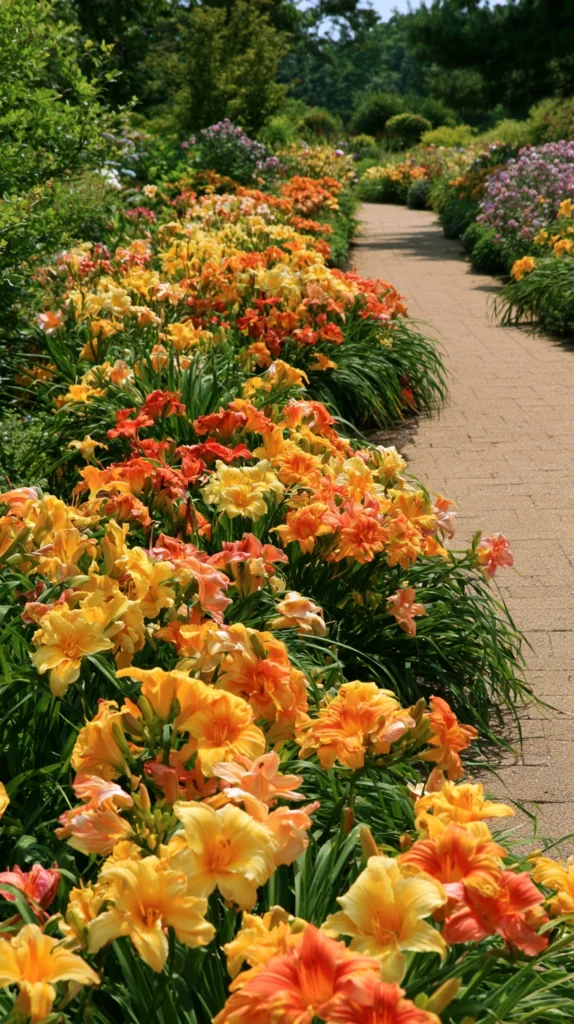
Daylilies are called daylilies because each flower lasts a single day.
This apparent limitation turns out to be irrelevant in practice because a healthy daylily plant in good conditions produces dozens of flower buds on each stem over an extended season, with multiple buds opening simultaneously each day, and multiple stems flowering successively across the flowering period. The overall display from a mature daylily clump in good conditions extends from June through August and often into September.
The heat tolerance of daylilies is exceptional. They evolved across a range of climates in Asia, including regions of significant summer heat, and can handle sustained high temperatures without the wilting and decline that affects many garden plants. In full sun with reasonable soil, most daylily varieties perform through hot summers without supplemental irrigation once established.
The colour range available in 2026 is extraordinary. More than 80,000 registered cultivars exist, and the colour options extend through every shade of yellow, orange, red, pink, and purple, including bicoloured varieties, ruffled varieties, and spider varieties with elongated, narrow petals of specific character.
For the hot garden specifically, the older, tougher varieties often outperform the elaborate modern hybrids in genuine heat and drought. Happy Returns in pale yellow, Stella de Oro in gold, and Chicago Apache in deep red are varieties with decades of proven performance in challenging conditions, rather than varieties selected for showroom appearance under ideal conditions.
6. Rudbeckia (Black-Eyed Susan)
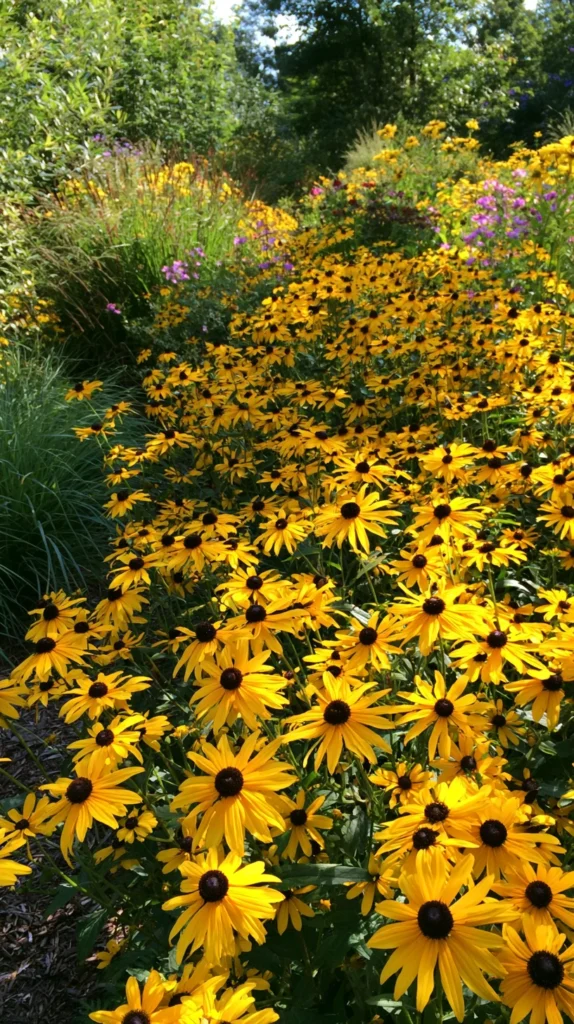
Rudbeckia is the plant that turns August and September in a hot garden golden.
The warm yellow of rudbeckia, the clear, generous, unambiguous yellow of flower petals that appear to store sunlight and release it even on grey days, is one of the most valuable contributions any plant can make to the late summer garden when so many other plants have concluded their display.
Rudbeckia fulgida var. sullivantii Goldsturm is the variety most consistently recommended and most consistently praised. Its compact mounds of dark green foliage produce daisy flowers with golden-yellow ray petals and near-black central cones from July through October. It is fully hardy, reliably perennial, and improves in flower quantity and quality with each successive year as the clump develops.
The prairie and meadow origins of Rudbeckia, native to the central United States, where summer temperatures are consistently high and rainfall is variable, make it genuinely drought-adapted rather than merely drought-tolerant. In hot, dry conditions where irrigated plants show stress, Goldsturm continues flowering without interruption.
The tall annual rudbeckia varieties, Cherry Brandy in warm bronze-orange and Irish Eyes in yellow with green centres rather than black, provide the same genus character at a greater height for the back of the border and the centre of island beds.
7. Verbena bonariensis
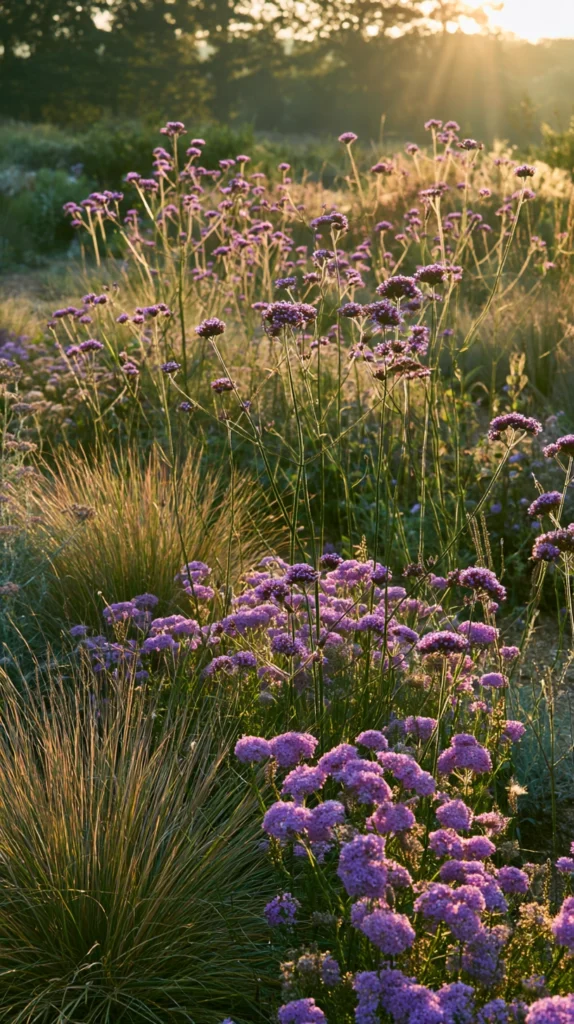
Verbena bonariensis is the plant that earns every inch of space it occupies in a hot, full sun garden through the sheer quantity and persistence of its contribution.
Tall, branching, airy stems of one to two metres topped with clusters of intense violet-purple flowers from July through October. The stems are narrow enough to be transparent. The plant occupies its vertical space without blocking the view of what is planted behind and below it. The flowers are small in individual scale but presented in such quantity and such persistence that the overall effect is one of continuous intense purple across the back and middle of any border it inhabits.
Its ecological value matches its ornamental contribution. Verbena bonariensis is one of the most visited plants in any garden by butterfly species. The dense flower clusters provide a consistent nectar source that attracts Red Admirals, Painted Ladies, Peacocks, and Small Tortoiseshells throughout the long flowering season.
It self-seeds with the enthusiasm of a plant that has evolved to take every available opportunity. In a gravel garden, it appears in the gravel itself. In paving joints. At the base of the walls. Beside paths. Seedlings that appear in inconvenient positions are easily removed while young. The ones that appear where they are wanted are left to contribute.
In a hot garden with good drainage, Verbena bonariensis requires essentially no supplemental watering once established from seed or transplant. It flowers through conditions that stress far more demanding plants.
8. Penstemon
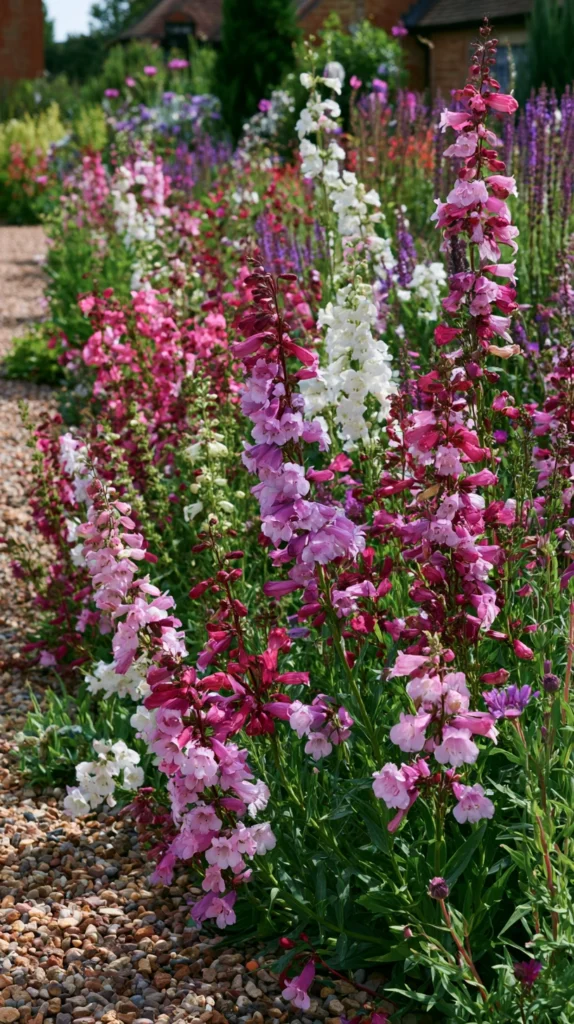
Penstemons are the hot garden perennials that combine cottage garden informality with genuine heat and drought performance.
The tubular flowers in shades of pink, red, purple, white, and bicoloured forms are produced on slender stems of sixty to ninety centimetres from June through October, providing one of the longest flowering seasons of any hardy perennial. The semi-evergreen foliage holds through mild winters and provides year-round ground cover in the spaces between other plants.
Penstemon Garnet, a deep wine-red variety with reliable hardiness and prolific flower production, is the most widely planted variety and remains one of the best. Penstemon Raven in deep purple and Penstemon Apple Blossom in pale pink with white throat are other consistently performing varieties with proven track records in hot summer conditions.
The heat tolerance of penstemons is specific to their drainage requirement. In free-draining soil, full sun, and hot conditions, they perform excellently. In moist, rich soil, they grow lushly but decline in hardiness and may not survive cold winters that they would otherwise handle from a drier position.
The planting position most likely to kill a penstemon is a rich, moist border in partial shade. The position most likely to produce a spectacular penstemon is a poor, free-draining, sunny bank or raised bed that bakes through the summer and dries thoroughly in winter.
9. Sedum spectabile and Hylotelephium (Ice Plant)
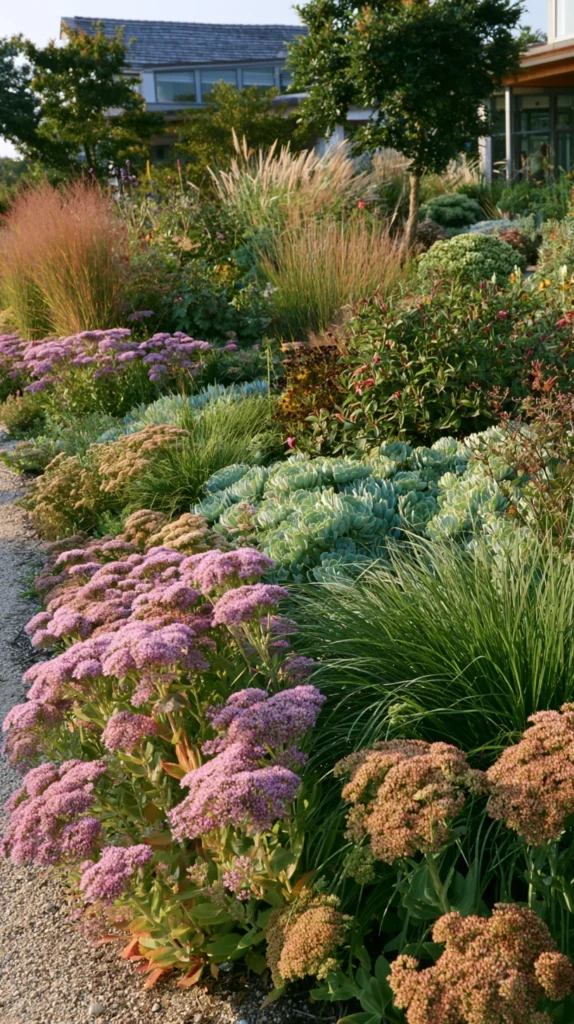
The ice plants, now correctly classified as Hylotelephium but still widely sold and searched for as Sedum spectabile, are the full-sun succulent perennials that provide late-season colour and wildlife value simultaneously.
The flat-headed flower clusters, in shades of pink, deep rose, and red depending on variety, open from August through October and provide a nectar source at the critical late-season period when most other garden flowers have concluded. The attraction to late-season butterflies, peacocks stocking up before hibernation, and red admirals gathering before migration is spectacular and consistent.
Hylotelephium Herbstfreude (Autumn Joy) is the variety most widely grown and most consistently reliable. Its blue-grey succulent foliage provides attractive ground cover from spring through summer before the flower heads develop. The dried flower heads persist through winter as an architectural interest that looks beautiful under frost and snow.
The water storage capacity of the succulent foliage makes ice plants genuinely exceptional in hot, dry conditions. They are physiologically designed to manage their own water budget through extended dry periods in a way that conventional perennials cannot replicate.
Plant in full sun with the driest available soil. In moist, rich conditions, they grow tall, flop by midsummer, and produce a fraction of the flowers they would produce in the poor, dry conditions they actually prefer.
10. Crocosmia
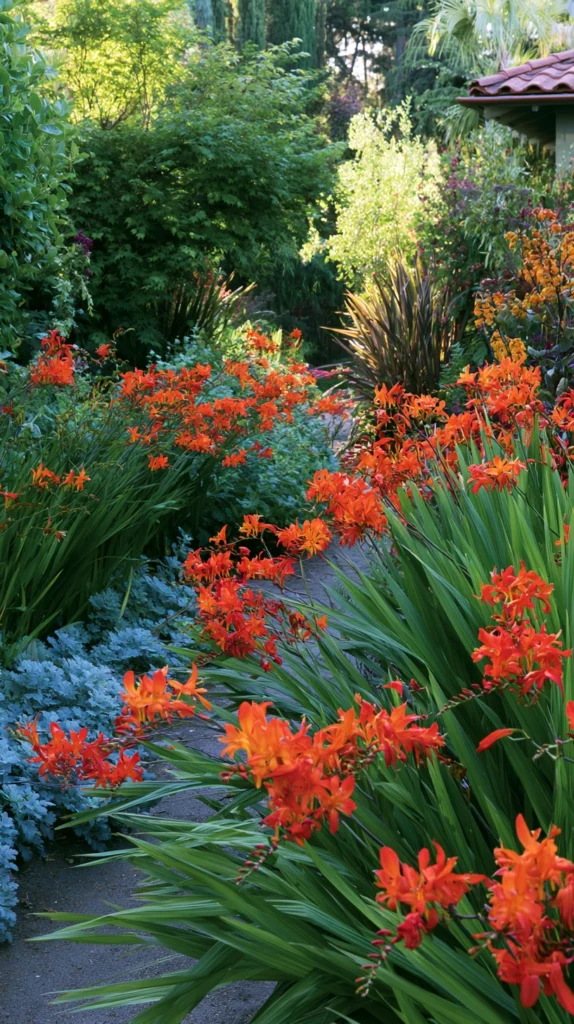
Crocosmia is the hot garden plant that most reliably produces the effect of tropical abundance without the tropical maintenance requirement.
The arching, grass-like foliage forms generous clumps that spread steadily over several years. The flower stems arch upward from the foliage and carry a succession of small tubular flowers in vivid orange, red, and yellow from July through September. The combination of the arching habit, the vivid flower colour, and the sequential opening of individual flowers along the arching stem creates a display of genuine tropical dynamism.
Crocosmia x crocosmiiflora Lucifer is the most dramatic and most widely planted variety. Its large, intense red flowers on stems of one hundred centimetres make a statement in any border, but it spreads aggressively and can become invasive in favourable conditions. Emily McKenzie in warm orange with darker centre marks and Severn Sunrise in soft peach and pink are better-mannered varieties that spread at a more manageable rate.
The corm-based root system stores water and energy reserves that allow crocosmia to handle extended dry periods once established. In full sun with reasonable drainage, it requires supplemental watering only in the most extended dry periods after establishment.
The ecological value of crocosmia in a hot garden is primarily to the pollinator community that finds its tubular red flowers attractive. Long-tongued bumblebees access the nectar that shorter-tongued insects cannot reach.
11. Gaura (Oenothera lindheimeri)
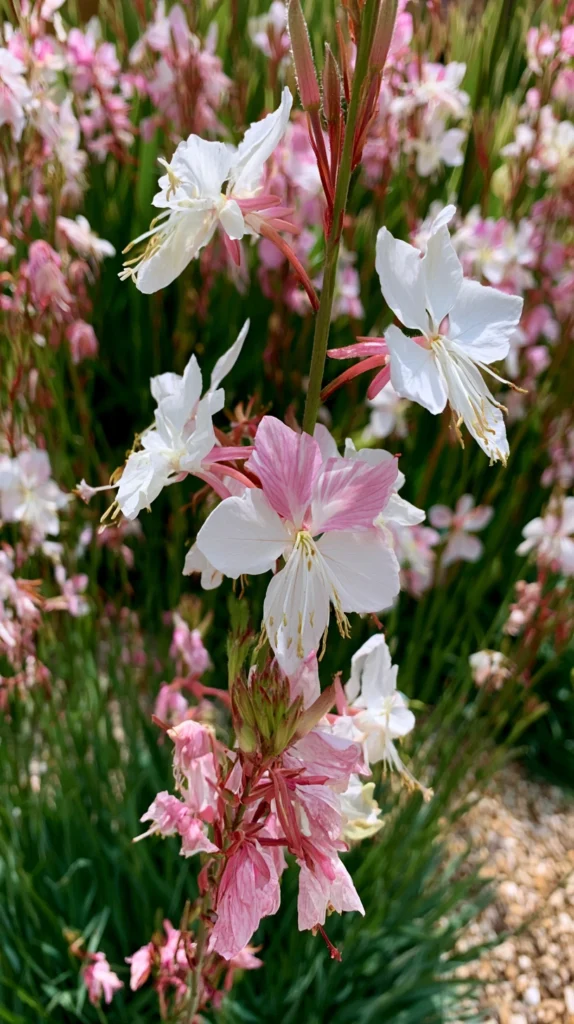
Gaura, now correctly reclassified as Oenothera lindheimeri, is the hot garden plant of extraordinary lightness and persistence.
Slender, wiry stems of sixty to one hundred centimetres carry small, butterfly-shaped white or pink flowers that dance in any breeze from June through October. The individual flowers are delicate. The overall effect of a plant in full flower is one of hundreds of small white or pink butterflies hovering above the planting. The movement of the flowers in wind adds kinetic quality that heavier-headed plants cannot provide.
The native range of gaura is Texas and Louisiana, which places it among the most heat-adapted plants available for temperate hot gardens. Texas summer temperatures exceed what temperate gardens ever produce, and gaura handles them without visible stress.
In good drainage and full sun, gaura requires essentially no supplemental watering once established. Its deep taproot accesses soil moisture at levels beyond the reach of shallower-rooted plants. This taproot also makes it difficult to move once established, which should be factored into its initial positioning.
The variety Whirling Butterflies in pure white is the most widely available and most reliable. Siskiyou Pink in rose-pink and Crimson Butterflies in deep rose-pink provide colour alternatives within the same genus character.
12. Kniphofia (Red Hot Poker)
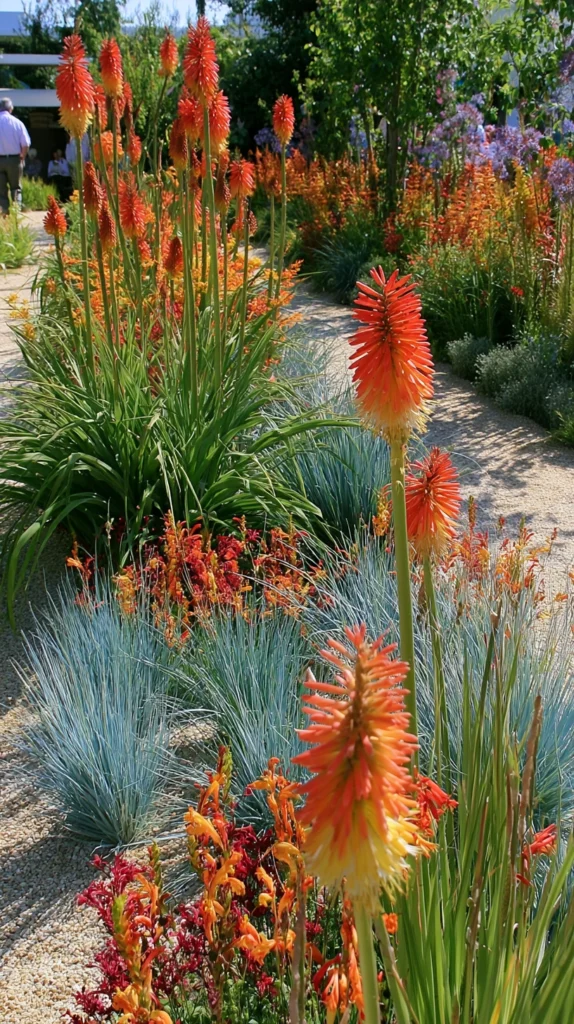
Kniphofia earns its common name honestly.
The flower spikes of red hot pokers, rising from bold clumps of arching, grass-like foliage on stems of seventy to one hundred and twenty centimetres, are genuinely among the most vivid and most striking in any hot summer garden. The classic varieties open orange-red at the top of the spike and yellow at the base, creating the two-tone flame effect that makes the plant instantly recognisable. More recent introductions extend the colour range to pure yellow, cream, and deep coral.
The South African and East African origins of Kniphofia place it in a group of plants specifically adapted to conditions of seasonal drought and high sun intensity. In a hot garden with good drainage and full sun, these conditions are replicated, and the plant responds by performing exactly as it evolved to perform.
Little Maid is a compact variety of sixty centimetres with creamy-white flower spikes that suits smaller gardens and front-of-border positions. Royal Standard in classic orange and yellow is one of the most reliable and most free-flowering mid-size varieties. Alcazar in warm salmon-red is among the most dramatically coloured.
Kniphofia requires essentially no watering once established in well-drained soil. It is the plant for the hottest, driest, most sun-exposed position in the garden where other plants have given up.
13. Ornamental Grasses for Hot Dry Gardens
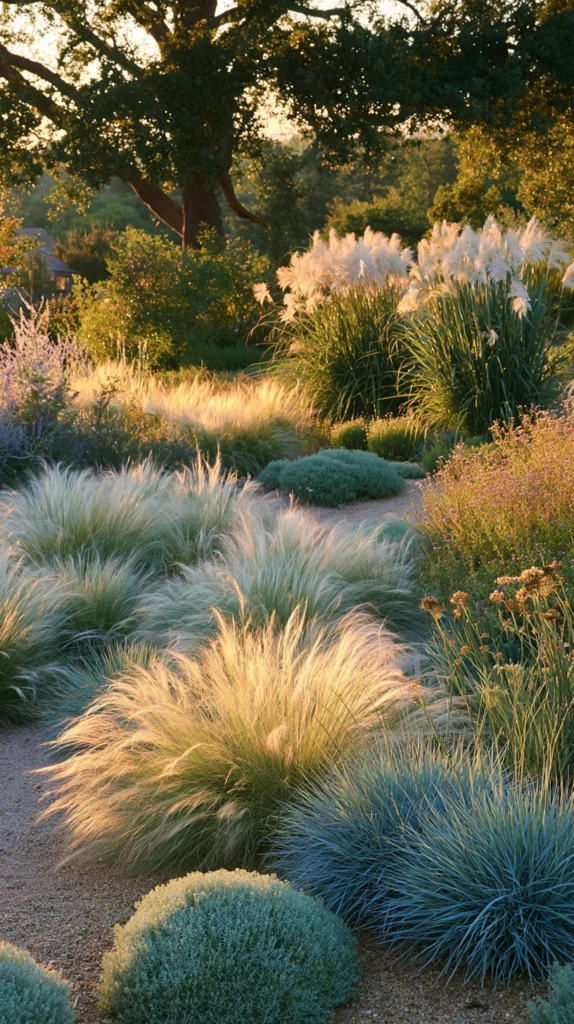
Ornamental grasses are the plants that provide the structural framework and the seasonal transformation of a hot full sun garden across all four seasons, rather than just the flowering months.
Stipa tenuissima, Mexican feather grass, is perhaps the most immediately beautiful grass for a hot, dry position. It’s extremely fine, hair-like foliage forms a mounded cloud of pale green in spring that bleaches to warm blonde through summer and holds its colour and form through winter. The movement in any breeze is extraordinary. No other plant responds to air movement with the same fluid, continuous wave-like motion.
Festuca glauca, blue fescue, provides intense blue-grey colour in a compact mound of fifteen to thirty centimetres that suits the front of a gravel garden or the edge of a border beautifully. The blue-grey foliage colour provides a cool counterpoint to the warm flower colours of other hot garden plants and holds year-round as an evergreen structural element.
Miscanthus sinensis, in its wide varieties, provides the largest-scale ornamental grass structure available for hot garden positions. Varieties reaching one to two metres in height produce dramatic seed heads in late summer that persist through winter as one of the garden’s most beautiful architectural elements. Morning Light has its white-edged, narrow leaves. Gracillimus has fine foliage and an elegant fountain habit. Zebrinus has its distinctive horizontal banding.
All three grasses handle heat and drought with equal ease. Stipa tenuissima tolerates the driest conditions. Festuca requires only reasonable drainage. Miscanthus accepts a broader range of soil moisture conditions while preferring the drier end of the range.
The grasses do not flower in the way that the other plants on this list flower. Their contribution is textural, structural, and seasonal in a way that broadens the palette of the hot garden beyond colour alone.
How to Establish Full Sun Plants in Hot Conditions Successfully
Establishment is the critical period for any plant moving from a container in a nursery to a position in a hot, exposed garden.
The single greatest risk to new plantings in hot garden conditions is establishing a root system that can access soil moisture at depth before the surface soil dries out completely in the first hot spell after planting.
Plant in autumn wherever the climate allows. Autumn planting gives roots a full season of relatively cool, moist conditions to establish before the first summer test arrives. Plants that go into a hot garden in spring or summer face the immediate challenge of establishment in the conditions they were selected to eventually handle. Autumn-planted equivalents have a root system that has had six to eight months to develop before summer arrives.
Water generously for the first season regardless of the plant’s ultimate drought tolerance. A drought-tolerant plant is drought-tolerant once established. Before the establishment, the root system is still confined to the rootball from the nursery container. That small rootball dries out faster than the surrounding soil in hot conditions and needs supplemental watering until the roots have extended beyond it.
Mulch immediately after planting with a five to eight centimetre layer of gravel or crushed stone in a gravel garden context, or organic mulch for border plantings. The mulch suppresses weed competition, reduces soil temperature at the root level, and conserves soil moisture through the first critical growing season.
After the first full year, most of these plants require no supplemental watering in temperate climates even through dry summers. The establishment investment of one season’s watering pays back in decades of genuinely low maintenance performance.
Common Mistakes When Planting for Full Sun Hot Conditions
Planting in improved, moisture-retentive soil. Most hot garden plants perform better in leaner, drier conditions than in enriched border soil. Adding compost and water-retentive material to the planting position of lavender, sedum, or gaura undermines their performance rather than supporting it. Plant into the existing soil with minimal improvement.
Over-watering established plants. A lavender that has been in the ground for three years does not need watering in a dry summer unless the drought is truly extreme. Over-watering established drought-adapted plants promotes soft, vulnerable growth and reduces flower production.
Choosing varieties for their appearance in photographs rather than their proven field performance. The most elaborately coloured new echinacea hybrids and the most unusual penstemon varieties are sometimes less reliable than the simpler, well-tested originals. Research the variety’s track record in conditions similar to your garden before choosing novelty over reliability.
Planting in insufficient sun. Full sun means a minimum of six hours of direct sunlight per day and ideally more. A position that receives four hours of partial shade is suitable for plant selection. All the plants on this list require genuine full sun to perform at the standard described here.
Not cutting back after the first flush. Lavender, salvia, penstemon, and gaura all respond to cutting back after their first flush of flowers by producing a second flush later in the season. Leaving spent flower stems on these plants signals the plant to set seed and conclude its flowering for the season. Cutting back signals it to try again.
Quick Summary
- Lavender, in its English and lavandin forms, thrives in poor, dry, free-draining soil with full sun and minimal water after establishment
- Agapanthus produces spectacular globe-shaped flower heads in blue, purple, and white from July through September in full sun with good drainage
- Salvia nemorosa Caradonna delivers intense violet-purple flower spikes from June through September in dry, poor soil with no supplemental watering
- Echinacea provides prairie-origin drought tolerance with spectacular reflexed daisy flowers in pink, white, and orange from July through September
- Daylilies handle sustained summer heat and produce successive flowers across an extended season in full sun with reasonable soil
- Rudbeckia Goldsturm turns August and September golden with prairie-adapted endurance that requires no supplemental watering once established
- Verbena bonariensis fills the vertical space in a hot border with persistent violet-purple from July through October and attracts every butterfly species in the garden
- Penstemons produce the longest flowering season of any hardy perennial in free-draining, hot, full sun positions from June through October
- Hylotelephium (Sedum) spectabile stores water in its succulent foliage and delivers critical late-season colour and butterfly food from August through October
- Crocosmia provides tropical dynamism in orange, red, and yellow on arching stems from July through September, with minimal maintenance
- Gaura (Oenothera) dances in any breeze with white or pink butterfly-shaped flowers on airy stems from June through October, from its deep, drought-resistant taproot
- Kniphofia earns its position in the hottest, driest spot in the garden with vivid orange, red, and yellow flame flower spikes
- Ornamental grasses, including Stipa, Festuca, and Miscanthus, provide a four-season structural framework and movement that flowering plants cannot replace
- Plant in autumn where possible, water through the first season only, mulch immediately, and trust the plants to handle subsequent summers without intervention
- Lean soil, full sun, and good drainage consistently outperform enriched, moist soil for all plants on this list
The hot garden is not compromised.
It is a different garden with plants that were designed for exactly the conditions it provides.
The lavender that struggles in a cool, damp border and barely flowers here is the same lavender that produces hundreds of flower stems in a hot, dry, poor-soil position in full sun and asks for nothing in return.
Find the plants that belong in your conditions rather than the plants that merely survive them.
These thirteen are a very good place to start.