
15 Heat-Tolerant Flowers for Summer Gardens That Bloom When Everything Else Gives Up
Most summer flowers are underachievers.
They look spectacular in the garden centre in April. They perform adequately through June. And then July arrives with its sustained heat and reduced rainfall, the conditions that midsummer gardeners have always had to manage and that are now longer, hotter, and drier than any previous generation of gardeners experienced, and the flowers that seemed so full of promise in spring begin to wilt, fade, and look defeated.
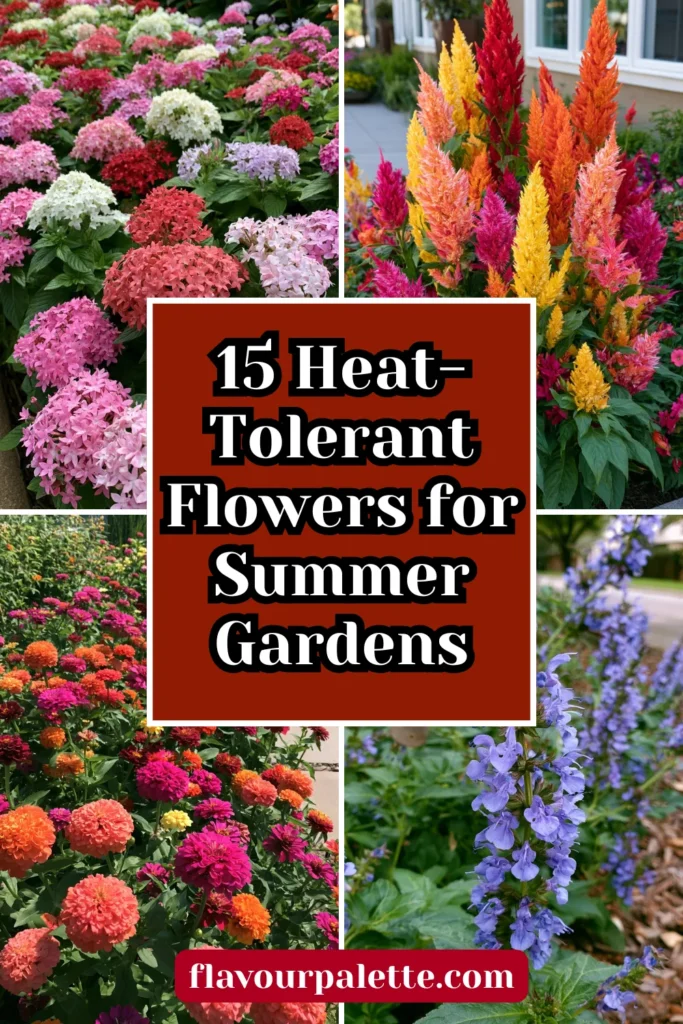
The heat-tolerant flower is a different category of plant entirely.
It does not merely survive heat. It thrives in it. The sustained high temperatures and the reduced water availability that stress other plants are the conditions under which these flowers perform their best. They flower more prolifically in heat. They hold their colour better in strong sun. They continue producing new blooms when their cooler-season neighbours have given up and turned their resources to seed production and survival.
These are the flowers that make a summer garden genuinely beautiful in July, August, and September rather than looking spent and defeated from midsummer onward.
Here are 15 of the best.
Why Heat Tolerance Matters More in Gardens Now Than It Did Ten Years Ago
The summer garden has always had hot periods.
The difference now is duration, intensity, and frequency.
What gardeners in temperate climates once managed as exceptional periods of heat requiring exceptional management are increasingly the norm. Extended heatwaves of a week or more. July and August temperatures that exceed the previous maximum by several degrees. Dry periods of four to six weeks that would have been remarkable weather events in previous decades now arrive reliably in midsummer.
These conditions require a recalibration of which plants belong in the summer garden.
Plants described as heat-tolerant in gardening literature of twenty years ago were calibrated for the heat conditions of twenty years ago. The same description in a plant guide published today should imply significantly more heat resilience because the test conditions have intensified.
The flowers on this list are chosen for their performance in genuine heat. Not simply warm weather that most flowers handle adequately. The specific conditions of a sustained summer heatwave. The week when the temperature does not drop below twenty-five degrees Celsius, even at night. The fortnight with no meaningful rainfall. The position on the south-facing terrace that adds ten additional degrees to the ambient temperature through solar reflection from hard surfaces.
These are the flowers that earn their place in that environment.
1. Zinnia (Zinnia elegans and Z. haageana)
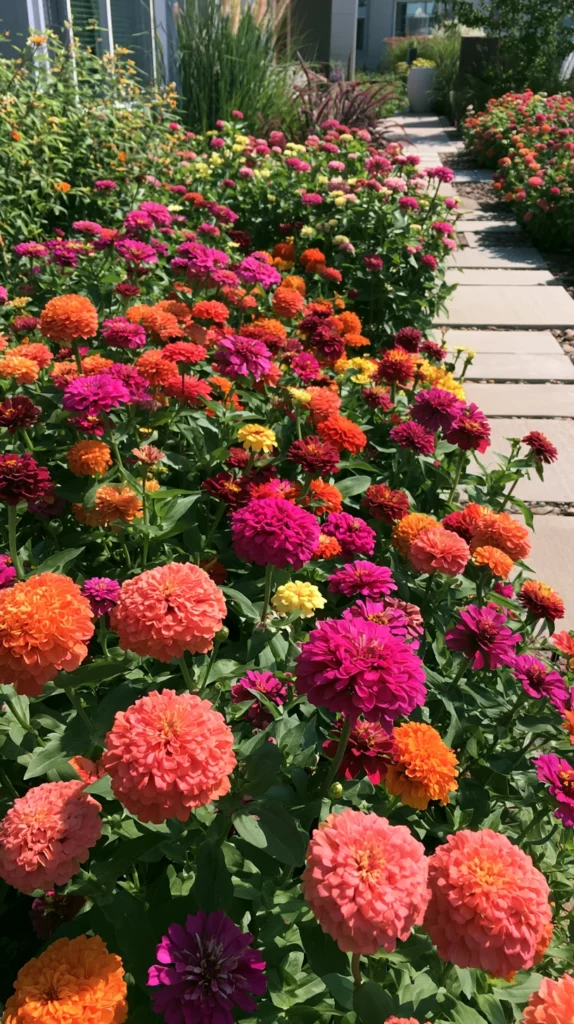
Zinnia is the definitive heat-tolerant summer flower.
Not because it is the most beautiful, though it is among the most colourful and most prolific available. Because its relationship to heat is actively positive rather than merely tolerant. Zinnia grows faster, flowers more prolifically, and holds its colour longer in hot conditions than in cool ones. It is a plant that has found its optimal environment in the summer heat, which defeats other flowers.
Native to the dry, hot habitats of Mexico and Central America, zinnia’s entire evolution has been calibrated for conditions that temperate garden plants find challenging. The intense summer sun that bleaches colour from many flowers makes the zinnia more vivid. The reduced rainfall that stresses moisture-loving plants is the condition zinnia prefers. The heat that causes many flowers to close or wilt accelerates zinnia’s growth and flowering.
The colour range available in zinnia is extraordinary. Pure white to vivid scarlet. Every shade of orange, yellow, pink, and magenta. Near-black and deep burgundy in the Benary’s Giant series. Bi-coloured varieties with contrasting petal tips in the Swizzle and Candy Stripe types. Lime green in the Envy variety that reads as exotic beside the saturated warm colours of other zinnias.
Cut zinnias consistently, and the plant produces more flowers continuously. Leave them to set seed, and the plant diverts its resources from flower production to seed production, and the prolific cutting-garden contribution of the plant is significantly reduced.
Why zinnia belongs at the top of every heat-tolerant flower list:
- Actively thrives rather than merely tolerating heat, producing more and better flowers in hot conditions
- The most diverse colour range of any heat-tolerant annual, covering the full warm spectrum and beyond
- Prolific flower production from July through the first frost when cut consistently
- Directly sown from seed into warm soil and flowering within eight to ten weeks with minimal effort
- Significant pollinator value for bees, butterflies, and hoverflies throughout the long flowering season
- Available in heights from compact thirty-centimetre varieties to tall one-metre cutting garden forms
2. Portulaca (Portulaca grandiflora)
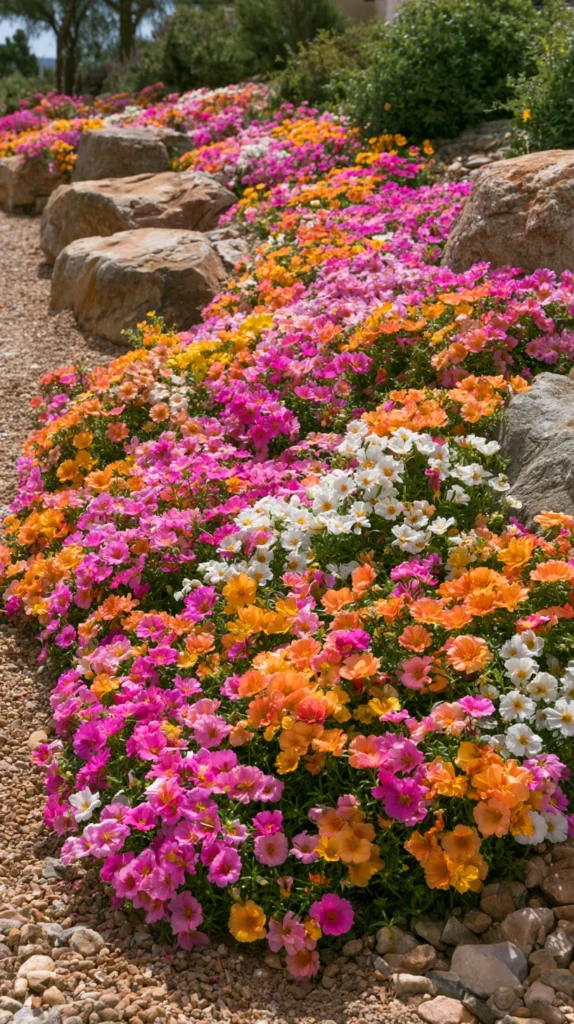
Portulaca is the ground-covering succulent annual that most people overlook, and most hot garden situations need.
Its fleshy, water-storing stems and small succulent leaves are the structural adaptations of a plant that has evolved specifically for hot, dry, exposed conditions. Portulaca thrives in the sandy, thin, infertile soils where rainfall drains away before other plants can use it. In rich, moist border conditions, it grows weakly and flowers poorly.
The flowers of portulaca are disproportionately beautiful for a plant of such modest size and such an undemanding nature. Silky-petalled flowers in vivid magenta, hot orange, yellow, white, and bi-coloured combinations that open in full sun and close in overcast conditions. The flowers close in shade and open in direct sunlight, which makes portulaca the perfect plant for the hottest, most sun-exposed positions in the garden.
As a ground cover for a dry, south-facing slope. As an edging plant for a gravel garden. In a container on a baking terrace with no shade. These are the conditions where portulaca thrives and where few other flowering plants can compete.
Sow directly after the last frost in a sunny, well-drained position. Thin to fifteen centimetres. Water once after sowing and then leave to establish without supplemental watering. The combination of neglect and heat is Portulaca’s ideal cultivation regime.
3. Lantana (Lantana camara)
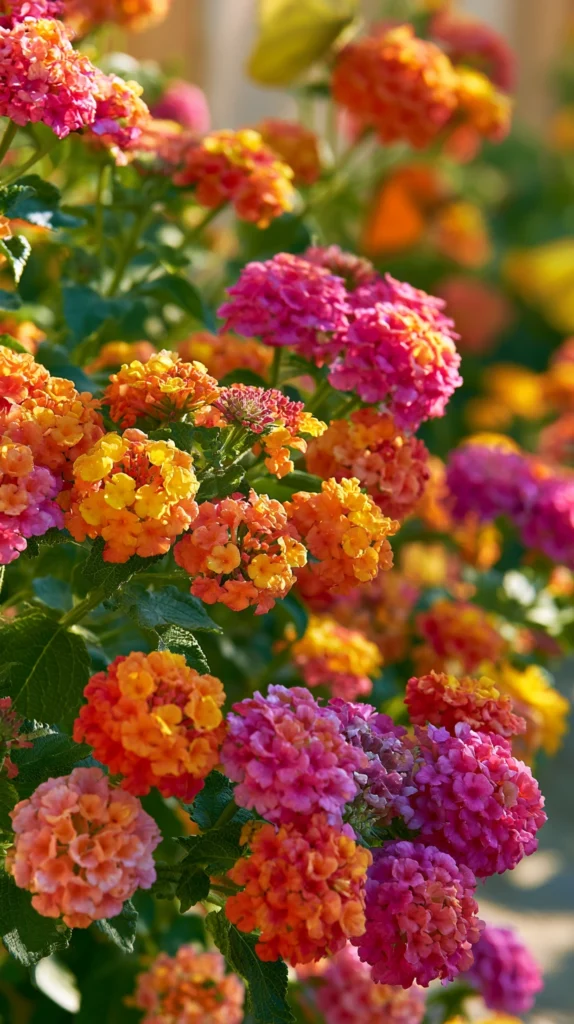
Lantana is a heat-tolerant flowering plant that most reliably produces continuous colour from planting through the first frost without any significant maintenance.
The small, clustered flower heads of lantana shift colour as they mature, opening in one tone and changing through pink, orange, and yellow as each flower ages. A single lantana flower head can contain three different colours simultaneously at different stages of maturity. The colour-changing quality makes each plant visually complex in a way that single-colour plants cannot match.
It is a powerful butterfly attractor. Lantana is among the most consistently visited flowering plants by adult butterflies in any collection. The dense flower clusters provide easy landing surfaces and accessible nectar for butterfly species of all wing spans and foraging styles.
In climates without frost, it is a woody perennial shrub of significant size. In temperate climates with winter frosts, it is grown as a half-hardy annual, started indoors in late winter and planted out after the last frost to provide colour through the summer and autumn. The tropical origins of lantana explain its extraordinary heat performance in summer conditions that challenge more temperate plants.
Position in the hottest, most sun-exposed position available. Lantana in part shade produces significantly fewer flowers than lantana in full sun with heat reflected from surrounding hard surfaces. The heat that makes the terrace uncomfortable for people makes lantana perform at its best.
4. Marigold (Tagetes patula and T. erecta)
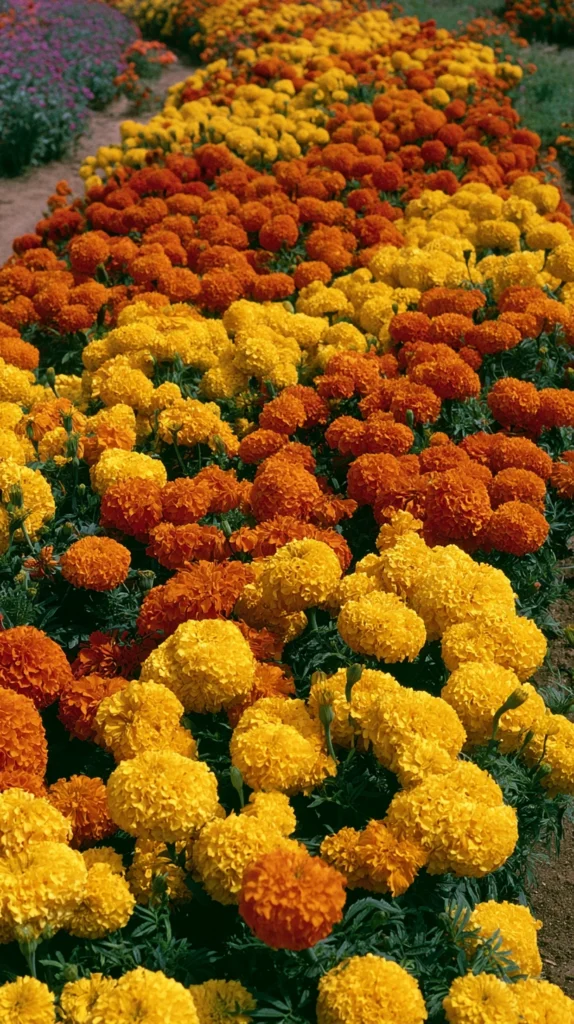
The marigold is the most consistently reliable heat-tolerant annual available to any summer gardener.
Its reliability in hot, sunny conditions has made it a staple of summer bedding in almost every climate where summer gardening is possible. The orange, yellow, and bi-coloured varieties of French and African marigolds provide the warm end of the summer colour spectrum with a flowering continuity that few other plants match.
Marigolds tolerate heat, drought, and poor soil with equal equanimity. They resist the most common garden pests. They deter some soil-borne pests through root exudates that make them useful companions in the vegetable garden as well as the flower border. And they flower continuously from planting through the first frost without deadheading being strictly necessary, though regular deadheading extends the flowering display and maintains the plant’s tidy appearance.
The scent of marigold foliage is a polarising characteristic. Some gardeners find the sharp, resinous scent of crushed marigold leaves pleasant and medicinal. Others find it unpleasant. The scent is an incidental property of the plant’s pest-deterring chemistry rather than a designed feature of its ornamental character.
The African marigold, Tagetes erecta, grows to sixty to ninety centimetres and produces large, globe-shaped flower heads that make a bold impact in a border or a container at that scale. The French marigold, Tagetes patula, is more compact at twenty to thirty centimetres and better suited to edging, container growing, and close-range viewing.
5. Gazania (Gazania rigens)
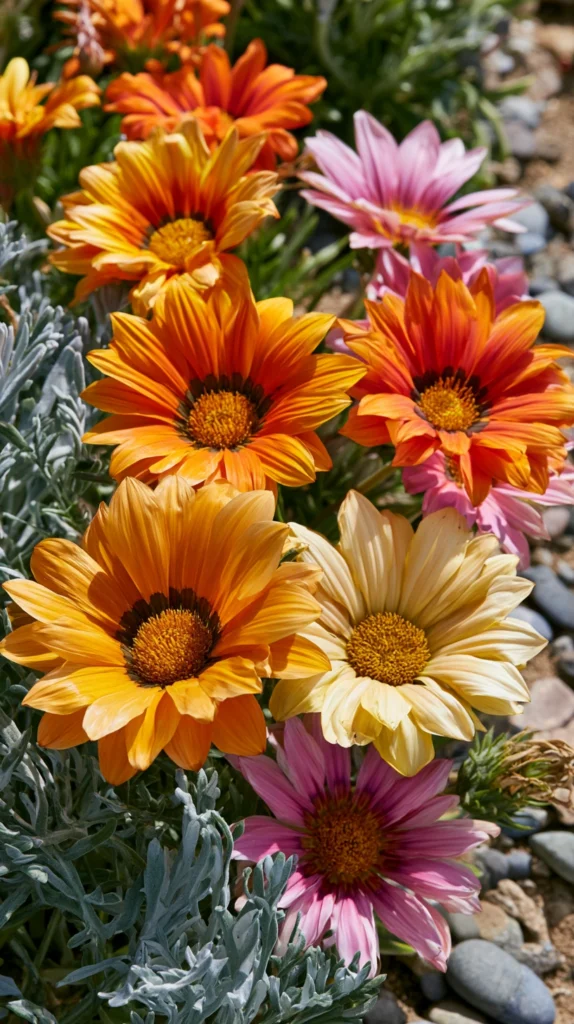
Gazania is the heat-tolerant flower that most gardeners discover later than they should.
Its large, daisy-like flower heads in vivid combinations of orange, yellow, pink, red, and white with contrasting central markings open wide in full sun and close entirely in shade or overcast conditions. The flowers tracking the sun and closing when it is absent is a physiological response that preserves the flower’s resources for the hours when pollinators are active.
In consistently hot, sunny conditions, gazania is one of the most prolific flowering plants available. The silver-grey, slightly felted foliage is specifically adapted for heat and drought, its surface reflecting sunlight and its woolly texture reducing water loss through transpiration in conditions that would stress other plants significantly.
Gazania is grown as a half-hardy annual in temperate climates and as a perennial in frost-free areas. Start from seed indoors in late winter, eight to ten weeks before the last frost date, and plant out into the warmest available position after frost risk has passed.
It does not perform well in poorly drained soil. The one failure condition for gazania is wet, cold soil through winter and wet, poorly drained summer conditions. Well-drained soil in full sun is the cultivation requirement for the full expression of its heat tolerance.
6. Celosia (Celosia argentea)
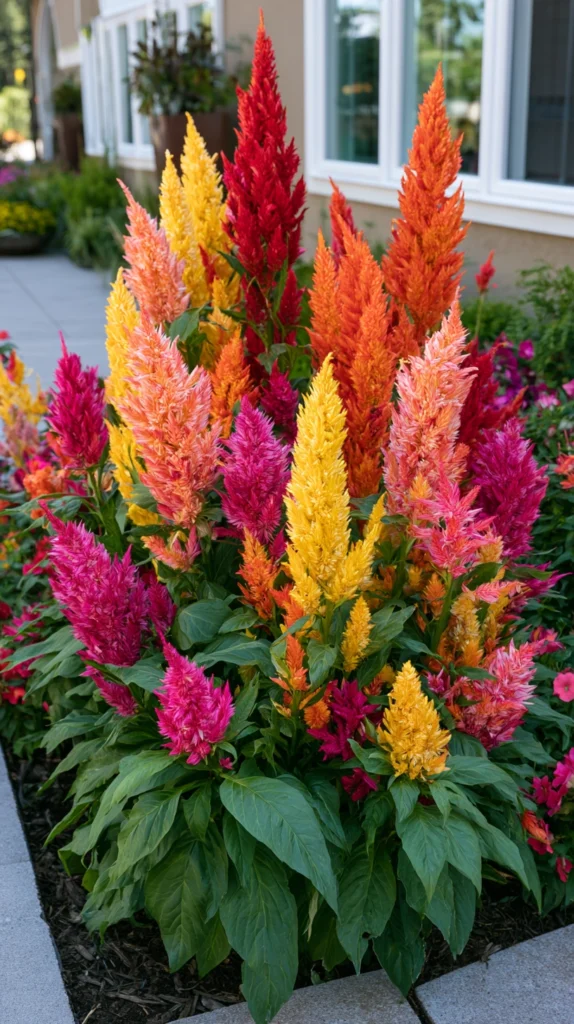
Celosia is the summer flower with the most visually distinctive form of any plant on this list.
The plume types, with their feathery, upright flower spikes in vivid red, orange, yellow, and pink, look like flames above the foliage. The crested cockscomb types, with their brain-textured velvet flower heads in similar colours, have the appearance of a botanical curiosity as much as a garden flower. Both types are genuinely beautiful in the context of a hot summer planting scheme, and both are exceptional in their heat tolerance.
Celosia is native to tropical Africa and Asia, where the combination of high temperature and high humidity, which challenges temperate garden plants, is the ambient condition of its natural habitat. The conditions that stress northern garden plants are the conditions to which Celosia is precisely adapted.
The intense colours of celosia are specifically suited to the strong light of a full summer sun position. In lower light conditions, the colours appear muddy rather than vivid. In full sun they are among the most saturated and most striking flower colours in the summer garden.
The dried flower heads of Celosia are as beautiful as the fresh ones. Plume and cockscomb types dried at the end of the season for use in dried arrangements maintain their colour for months and provide an ornamental resource beyond the growing season.
7. Salvia (Salvia splendens and tender annual salvias)
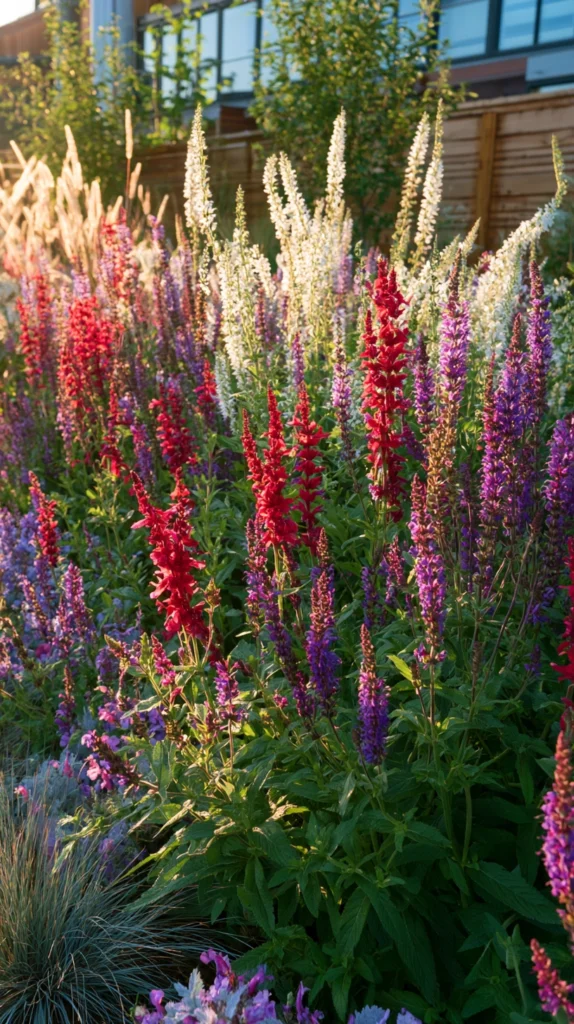
The annual salvias, specifically the tender varieties grown from seed or purchased as plug plants each year, are the summer garden’s most reliable source of intense red, purple, and blue in hot conditions.
Salvia splendens, the scarlet sage, is the classic summer bedding salvia. Its upright spikes of intense red flowers in heat and drought conditions that stop other red flowers cold make it one of the most reliable colour performers in the summer garden. The red is specifically vivid, hot, and unambiguous in the way that most red flowers become warm pink rather than true red in strong sun.
The newer Salvia splendens varieties extend the colour range to white, salmon, purple, and bi-coloured forms that give the heat tolerance of the classic red salvia in a wider range of design applications.
Annual salvias in the tender perennial category, Salvia coccinea, the scarlet sage native to the southern United States, and its varieties handle heat and drought with extraordinary ease while producing flowers of equal or superior quality to the more commonly grown S. splendens.
Position in full sun in any reasonably fertile, well-drained soil. Deadhead spent spikes regularly to stimulate the production of new flower spikes continuously through the season.
8. Gaillardia (Blanket Flower)
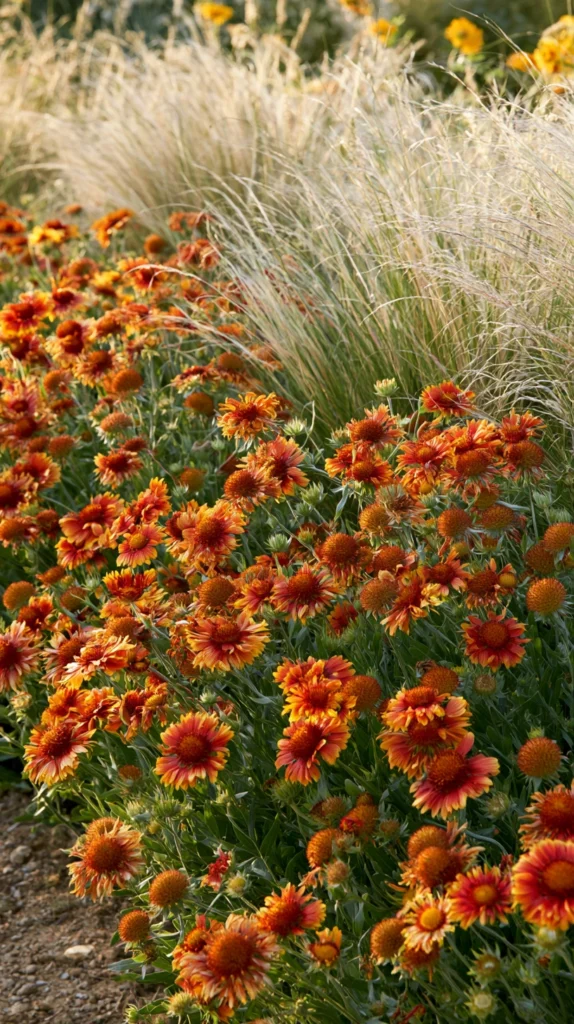
Gaillardia is the prairie and meadow flower that brings the warmth of North American grassland summers to the garden.
The native range of Gaillardia includes the Great Plains of North America, where summer temperatures regularly exceed thirty-five degrees Celsius and summer rainfall is variable and unreliable. In these conditions, Gaillardia evolved the heat and drought tolerance that makes it exceptional in temperate summer gardens experiencing increasingly intense conditions.
The flower heads are among the most vivid in any summer plant palette. Deep red centres fading to orange and then yellow at the petal tips create a sunset-coloured flower that works beautifully in combinations with other warm-toned heat-tolerant plants. The flower form, a bold daisy with a prominent central disc, has a visual confidence that suits the intensity of summer heat.
Annual gaillardia varieties, including the Fanfare series with their tubular rather than flat petals, flower from seed in their first year and produce flowers from July through September with regular deadheading.
Perennial gaillardia, Gaillardia x grandiflora, provides the same heat and drought performance across multiple seasons from an established root system. The perennial forms require well-drained soil over winter, as they are susceptible to root rot in wet conditions, but establish quickly and flower generously from their second year onward.
9. Bougainvillea (Bougainvillea glabra and B. spectabilis)
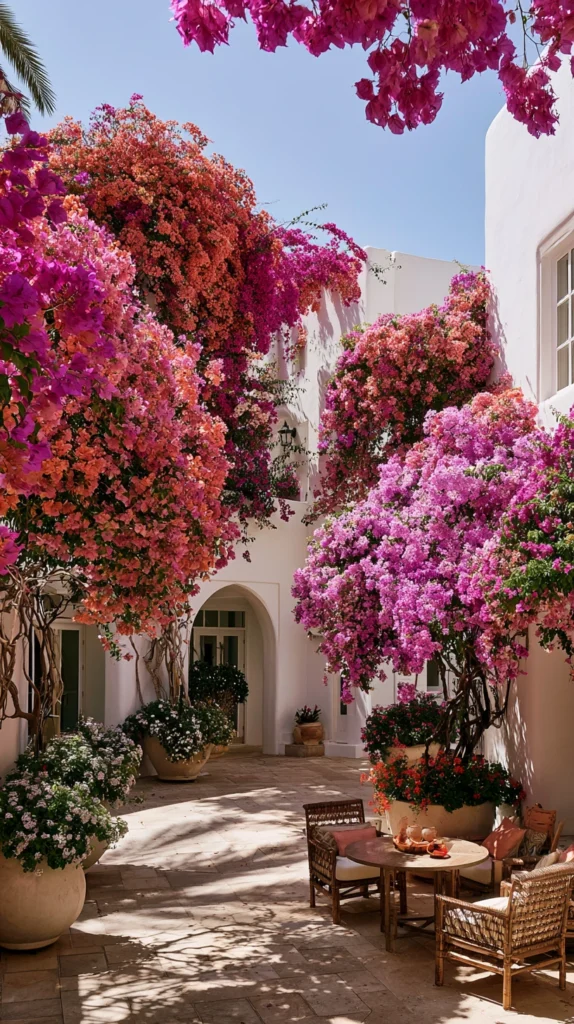
Bougainvillea is the most spectacular warm-climate flowering plant available to any gardener with the climate to support it.
In frost-free climates or in warm, sheltered microclimates in temperate zones, bougainvillea produces its vivid paper-like bracts in colours that range from the most intense magenta to deep purple, coral, orange, white, and bi-coloured combinations. The bracts are not petals but modified leaves that surround the small, insignificant true flowers at their centre. It is the bracts that provide the colour and the spectacle.
In temperate climates with cold winters, bougainvillea is grown as a container plant that is overwintered indoors or in a frost-free greenhouse and moved outdoors to the warmest, most sheltered position in the garden through the summer months. The summer heat that is a challenge for most garden plants is the condition that bougainvillea requires for its most spectacular flowering.
A bougainvillea in a large container on a hot, south-facing terrace in July is one of the most vivid and most beautiful flowering displays available in any garden. The combination of the intense bract colour and the unambiguous heat requirement of the plant makes bougainvillea the most distinctively warm-climate flower in the summer garden.
10. Salvia coccinea ‘Summer Jewel’
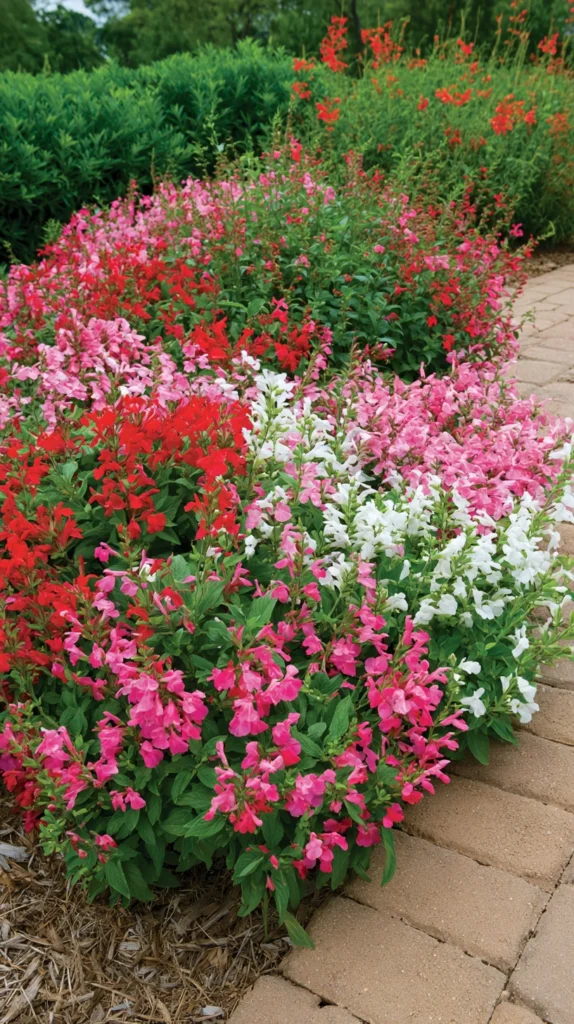
Salvia coccinea and its named varieties deserve specific mention beyond their inclusion in the general annual salvia section above.
The Summer Jewel series, including Summer Jewel Red, Summer Jewel Pink, and Summer Jewel White, represents the best of the heat-tolerant annual salvia category. The compact habit, thirty to forty centimetres, the dense flower production, and the genuinely extraordinary heat tolerance of these plants make them the premium choice for any hot, sunny position where colour continuity through the hottest months is the primary requirement.
Unlike Salvia splendens, which is specifically developed as a bedding plant and can look somewhat formal in its rigid upright habit, the Salvia coccinea Summer Jewel series has a more relaxed, naturalistic quality that suits informal planting schemes and mixed borders as well as formal bedding arrangements.
The red variety of Summer Jewel, in particular, has a colour purity and a heat performance that makes it the most reliable source of true red flowers in sustained heat conditions.
11. Cleome (Cleome hassleriana)
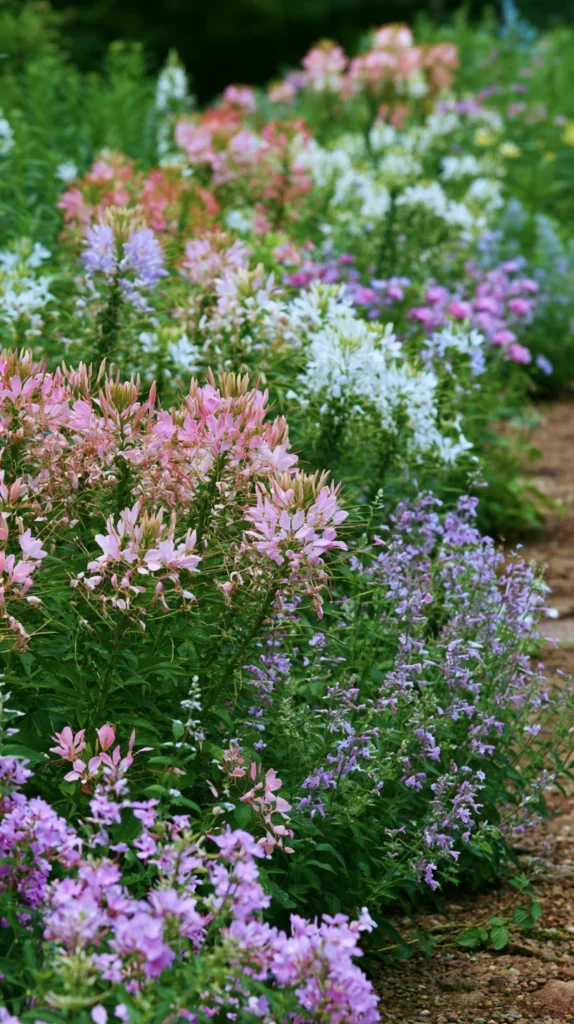
Cleome, the spider flower, is the heat-tolerant annual for gardeners who want height, airiness, and colour in the back of a border or the centre of an island bed without any of the fussiness that tall annuals often require.
Its tall, branching stems of one to one and a half metres, topped with rounded flower heads in pink, purple, white, and bi-coloured combinations, develop through the season in a way that makes each plant an increasingly complex and interesting object. The long seed pods that develop below the current flowering head give the plant its common name and contribute a structural quality to the plant that persists after the flowers have finished.
Cleome is self-seeding with considerable enthusiasm. Plants allowed to set seed at the end of the season produce offspring that appear in the following spring in the approximate area of the parent plant. Over two or three seasons, a single cleome plant becomes a colony that plants itself more effectively than any deliberate sowing.
The heat tolerance of cleome is genuine and substantial. It does not merely tolerate hot, dry conditions. It grows vigorously in them, reaching its full height and flowering potential in the sustained heat that limits other tall annuals.
Direct sow after the last frost in a sunny position. Thin to sixty centimetres between plants. No staking required, even at full height.
12. Catharanthus (Vinca, Periwinkle)
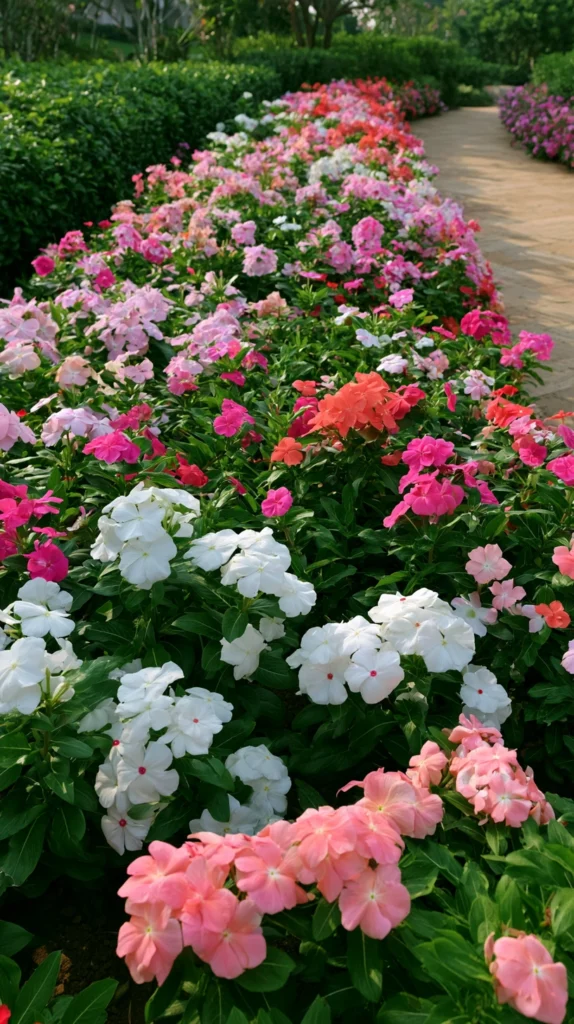
Catharanthus roseus, widely known as annual vinca or periwinkle, is the heat-tolerant annual that provides the most consistent and most trouble-free summer colour in challenging conditions.
It is native to Madagascar, where the combination of high temperature, high humidity, and seasonal drought has produced a plant of extraordinary adaptability. Unlike many heat-tolerant plants that prefer dry conditions, catharanthus handles both heat and humidity, making it useful in humid summer climates as well as dry ones.
The flowers are small but produced in extraordinary quantity from a compact plant. Every branch terminal produces a continuous succession of flowers throughout the season without deadheading. The plant self-manages its flower and seed cycle in a way that few other annuals do, maintaining a consistent floral display without any human intervention beyond initial watering.
The colour range of Catharanthus covers white, pale pink, deep pink, red, coral, and bicoloured combinations with contrasting central eyes. The trailing varieties that have been developed for container use add a trailing habit to the same heat performance.
Catharanthus in a container on a hot terrace requires very little watering once established and produces continuous flower colour throughout the summer with no deadheading, no feeding beyond a slow-release fertiliser at planting, and no management of any kind.
13. Pentas (Pentas lanceolata)
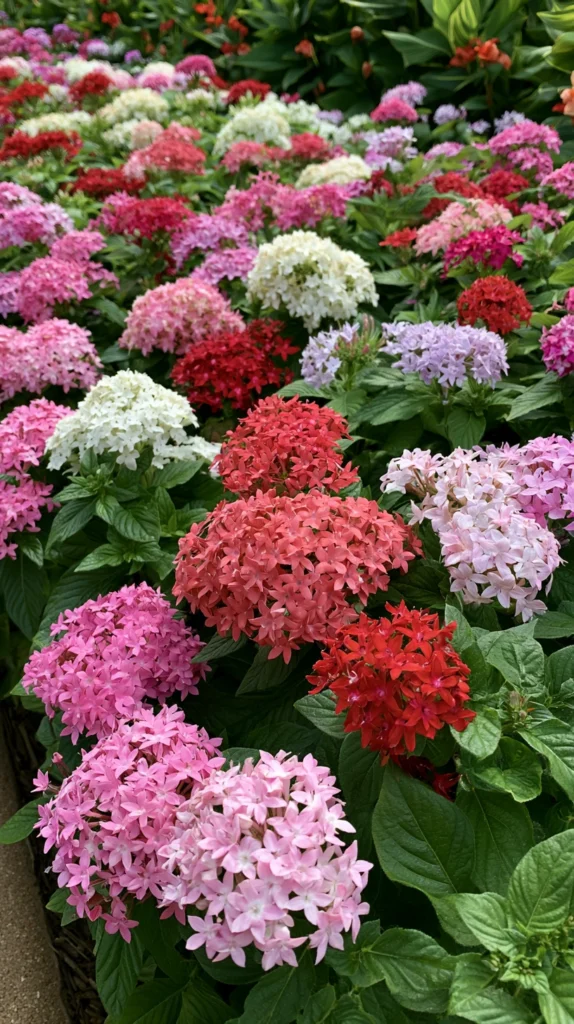
Pentas is a heat-tolerant flowering plant for the summer garden that is also one of the most important butterfly and hummingbird attractors available.
The flat-topped flower clusters of pentas, in red, pink, white, and lavender, provide a landing platform and accessible nectar source that butterfly species find irresistible. In a warm summer garden with pentas in full flower, the butterfly activity around the plants is among the most visible and most engaging wildlife activity in the whole garden.
The heat tolerance of pentas is exceptional. It is native to tropical Africa and the Arabian Peninsula, where temperatures that would stress most flowering plants are the ambient conditions of its natural habitat. In temperate gardens, it performs best in the hottest conditions, a south-facing position, a hot terrace, and a container that absorbs and re-radiates heat from surrounding hard surfaces.
Grow as a half-hardy annual in temperate climates. Start from seed indoors at a soil temperature of twenty-five degrees Celsius or above, which requires a heat mat in temperate climates. Transplant into the warmest available outdoor position after the last frost.
The combination of exceptional heat tolerance, continuous flower production, and outstanding wildlife value makes pentas one of the most valuable plants in any summer garden designed for both colour and ecological function.
14. Porterweed (Stachytarpheta jamaicensis)
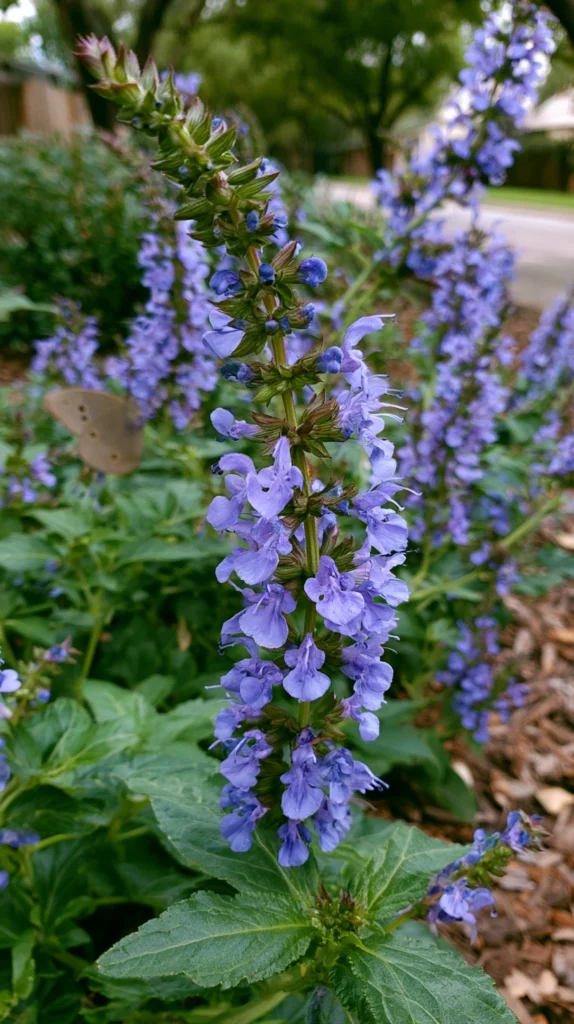
Porterweed is the heat-tolerant flowering plant that most serious butterfly gardeners grow, and most general gardeners have never encountered.
Its long, slender flower spikes carry a succession of small blue or red flowers that open sequentially from the base of the spike upward. At any given moment, only a few flowers are open simultaneously on each spike, but the spikes are produced continuously through the season, and the overall effect is of a plant in constant, if understated, flower.
The specific attraction of porterweed to butterfly species, and in warm climates to hummingbirds, is extraordinary. It has the quality of a butterfly magnet that exceeds most commonly recommended butterfly plants. A single large porterweed plant in full summer heat will have multiple butterfly species visiting throughout the day.
Porterweed requires genuinely warm conditions and performs best as a container plant that is overwintered indoors in temperate climates or in zones ten and eleven, where frost is not a risk. In warm summers, it grows vigorously, reaching one to one and a half metres in its tropical homeland and somewhat less in temperate summer garden conditions.
The ecological value of porterweed as a butterfly plant makes it worth the additional management required to overwinter it in frost-prone climates.
15. Four O’Clocks (Mirabilis jalapa)
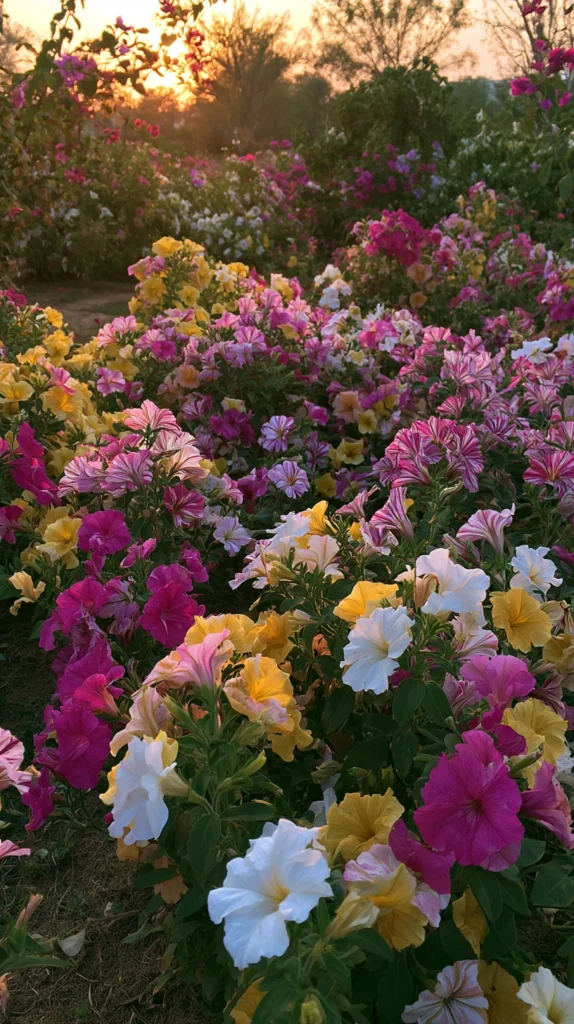
Four o’clocks are the heat-tolerant annuals with a specific flowering behaviour that makes them unique in the summer garden.
The flowers open in the late afternoon, typically around four o’clock, as the name suggests, and remain open through the night until they close the following morning. This afternoon-to-morning flowering pattern means that four o’clocks are specifically the summer garden’s flower for the evening, visible and fragrant as evening temperatures drop and outdoor dining and garden socialising begin.
The fragrance is significant. Sweet, warm, and vanilla-adjacent, the scent of four o’clocks drifting across a garden in the early evening is one of the most specifically pleasant garden fragrances available from an annual plant.
The colour range is unusually varied for a single species. Solid magenta. Solid white. Solid yellow. Striped combinations. Flecked and spotted variations. The ability to produce multiple colours from a single plant, and even multiple colours within a single flower, is a genetic characteristic that makes four o’clocks visually unpredictable in the most rewarding sense.
The heat tolerance is real and substantial. Four o’clocks thrive in the conditions that many summer annuals find challenging: the sustained heat of July and August, the reduced rainfall of midsummer, and the exposed south-facing border that reflects additional heat from surrounding hard surfaces.
Save the seed from the black, wrinkled seeds that develop after each flower. The stored seed grows true to the colour of the parent plant and produces plants that flower earlier and more vigorously than purchased seed.
How to Establish Heat-Tolerant Flowers Successfully
The paradox of heat-tolerant flowers is that most of them require careful establishment in cool, moist conditions before they can demonstrate their tolerance of hot, dry conditions.
A zinnia planted into a parched, hot border in July without any establishment watering will fail not because it cannot handle heat, but because it cannot establish a root system in the time available before heat and water stress overwhelm an unestablished plant.
Plant in the morning or the evening when temperatures are lower and the sun’s direct radiation on the plant is reduced. Water generously at planting to settle the roots into close contact with the surrounding soil. Mulch immediately after planting to retain moisture in the root zone through the first critical weeks.
Water regularly through the first two to three weeks of establishment, even for drought-tolerant species. This is the investment period during which the plant develops the root system that allows it to access water at depth and to handle the surface conditions that follow.
After establishment, reduce watering progressively for drought-tolerant species and stop supplemental watering entirely for the most drought-adapted ones. The root system is now able to do the work it has evolved to do.
Common Mistakes With Heat-Tolerant Flowers
Planting in shade because the plant looks stressed in the heat. A heat-tolerant plant that is wilting at midday is not necessarily in the wrong position. Many heat-tolerant plants wilt in the hottest part of the day and recover completely by evening. Wilting in the morning, before the day has reached its peak temperature, is the signal of genuine stress. Evening wilting is usually a temporary physiological adjustment.
Watering overhead in the hot sun. Water on leaves in strong sunlight can cause leaf scorch in some plants. Water at the root zone in the morning, before the day heats up, rather than overhead in the afternoon.
Choosing heat-tolerant plants for shade positions. The heat tolerance of most plants on this list is specifically calibrated for full sun conditions. In shade, they produce fewer flowers, grow more weakly, and demonstrate less of the vigour that makes them worth growing.
Not deadheading. Most heat-tolerant annuals, including zinnia, marigold, gaillardia, and salvia, respond to regular deadheading with extended and accelerated flower production. Leaving spent flowers to set seed signals the plant to redirect its resources from flower production to seed production.
Mixing heat-tolerant plants with moisture-loving ones in the same bed. A bed that is watered for its moisture-loving residents provides conditions that heat-tolerant, drought-adapted plants find excessive. The excess moisture reduces the performance of the heat-tolerant plants, while being necessary for the moisture-loving ones. Group plants by their water requirements.
Not saving seed. Many heat-tolerant annuals, including zinnia, four o’clocks, cleome, and marigold, produce seed that can be collected and stored for the following season at no cost. Saving seed from the best-performing plants of each season produces a selection that improves in its performance for your specific conditions over several years.
Quick Summary
- Zinnia actively thrives in heat rather than tolerating it, producing more and better flowers in hot conditions than in cool ones
- Portulaca is the perfect ground-covering annual for thin, dry, infertile soils in full sun, where almost nothing else will flower
- Lantana produces continuous colour from planting to frost with minimal maintenance and extraordinary butterfly attraction
- Marigold is the most reliably consistent heat-tolerant annual for any summer position in full sun
- Gazania opens its vivid, sun-tracking flowers only in direct sun and thrives in the heat-reflected conditions of stone and gravel gardens
- Celosia brings tropical heat performance and the most distinctive flower forms in the plume and cockscomb types
- Annual salvias, including Salvia splendens and S. coccinea, provide intense red, pink, and purple in sustained heat conditions
- Gaillardia carries North American prairie heat tolerance into the temperate summer garden with vivid sunset-coloured flower heads
- Bougainvillea is the most spectacular warm-climate container plant for hot terraces in temperate summer conditions
- Salvia coccinea Summer Jewel series delivers the best combination of compact habit, colour range, and heat performance in the annual salvia category
- Cleome provides height, airiness, and self-seeding confidence in the back of any hot, sunny border
- Catharanthus produces continuous flowers from a compact plant in hot, humid summer conditions without any deadheading
- Pentas combine exceptional heat tolerance with extraordinary butterfly attraction and hummingbird appeal
- Porterweed is the butterfly specialist’s heat-tolerant plant that provides outstanding wildlife value from a modest planting
- Four o’clocks provide the summer garden’s most fragrant evening flower in vivid and unpredictable colour combinations
- Establish all heat-tolerant plants with consistent watering in the first two to three weeks, regardless of their ultimate drought tolerance
The summer garden that peaks in June and fades by July is a garden designed for the wrong season.
July and August are the months when the garden is most used. When outdoor dining and evening gatherings and long afternoons in the garden happen. These are the months the garden should be at its best, not in a tired, spent version of its June peak.
The heat-tolerant flowers on this list are the answer.
Plant them for the summer that actually arrives. Not the gentle June days but the sustained heat of a real summer. The flowers that thrive in that heat are the flowers that make the garden worth being in when you most want to be there.
Plant for July.
The rest of the summer takes care of itself.