
14 Crochet Wall Decor Ideas That Add Texture, Warmth, and Handmade Soul
A crochet piece on a wall does something that no printed, painted, or manufactured wall decor can.
It shows a hand.
The specific human gesture of each stitch. The slight tension variation that no machine can replicate. The fact that someone sat somewhere with yarn and a hook and made this thing, loop by loop, for hours, with the specific intention that it would hang on a wall and be looked at by people who did not make it.

This quality is what people mean when they say a room has soul. Rooms with soul contain evidence of human making. Evidence that someone cared enough about the space to make something for it rather than simply buying something for it.
Crochet wall decor delivers this quality in a form that is also genuinely beautiful. The texture catches light. The yarn has warmth. The pattern has logic and complexity. And every piece is slightly different from every other piece in a way that mass production cannot reproduce.
Here are 14 ideas that bring this quality to walls in every room.
Why Crochet Wall Decor Works Better Than Most People Expect
The assumption that crochet is a craft medium rather than a design medium has persisted for decades.
It is wrong.
The finest crochet wall pieces belong in the same conversation as contemporary textile art, woven wall hangings by established makers, and the decorative textile traditions of cultures around the world that have been using fibre as a wall surface for centuries. The difference between a great crochet wall piece and a great woven wall piece is technique, not intention or quality.
For the home decorator who crochets or who sources handmade pieces from makers, the medium offers something that framed prints and mass-produced wall art do not. It is three-dimensional. The raised stitches and the variation in yarn thickness create a surface that is not flat in the way that a print or a canvas is flat. Light plays across it differently at different times of day. It changes as you move in relation to it.
It is also tactile in a way that most wall art is not. Visitors to a room with a crochet wall piece almost always want to touch it. This is a quality of handmade textile art that no other wall decor medium produces.
1. A Large-Scale Crochet Wall Tapestry in Natural Cotton
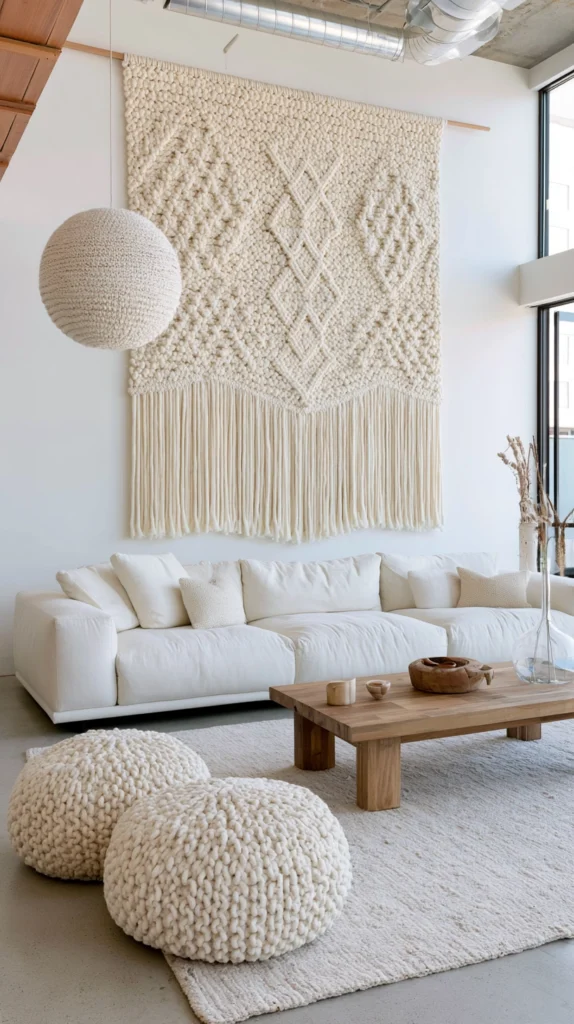
The large-scale crochet wall tapestry is the piece that changes a room.
Not a small hanging beside a gallery of framed prints. A tapestry that commands its own wall, that is the room’s primary decorative statement, that fills the vertical space above a sofa or a bed or a sideboard with texture and warmth, and the specific quality of something made rather than manufactured.
Natural cotton yarn in cream, oatmeal, and warm white creates a tapestry of extraordinary warmth and material honesty. The yarn’s natural fibre shows in the stitch texture. The slight irregularity of the cotton twist is visible up close. The cream of the yarn is warm in the way that synthetic alternatives are not.
The design of the tapestry should be considered as carefully as any other large wall piece. A geometric pattern in neutral tones creates a wall piece of intellectual character. A flowing, organic pattern that references natural forms, waves, leaves, or abstract shapes with botanical suggestion creates a warmer and more romantic quality.
A tapestry of ninety by one hundred and twenty centimetres or larger makes the right scale of statement for a wall above a sofa in a standard room. Scale down for smaller walls. Scale up for rooms with high ceilings where a smaller piece would look lost.
Why a large natural cotton tapestry is the highest-impact crochet wall decor choice:
- The scale creates a room-defining statement that smaller pieces cannot achieve
- Natural cotton in cream and oatmeal tones suits almost every room palette
- The texture of the crochet surface creates depth and shadow that flat art cannot
- A handmade or artisan-sourced tapestry is genuinely unique in a way that manufactured art is not
- Cotton is lightweight relative to its visual scale and easy to hang without heavy wall fixings
- The natural material is durable and does not fade or deteriorate in the way some synthetic yarn does
2. A Boho Macramé-Crochet Hybrid Hanging
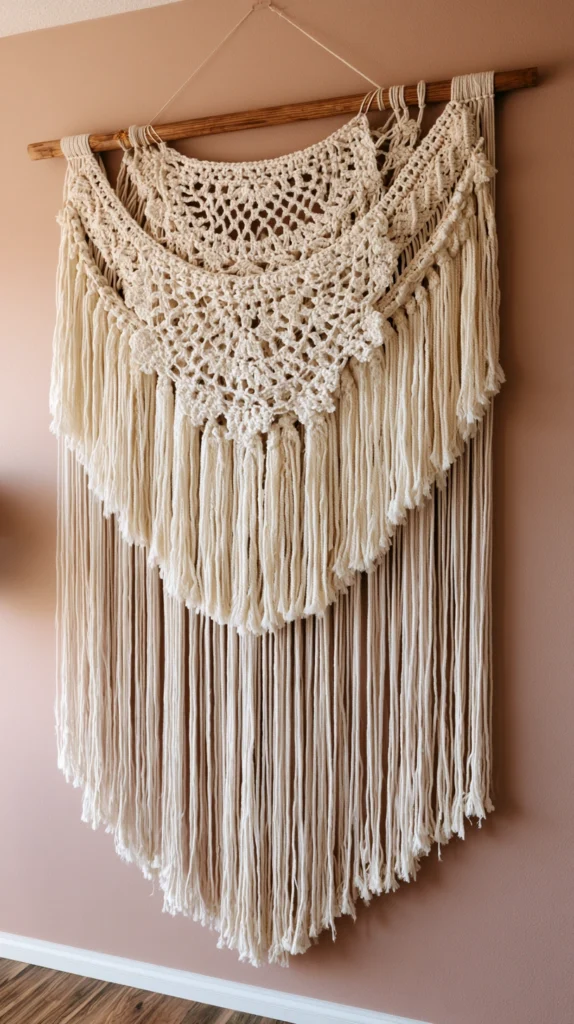
The boundary between macramé and crochet is genuinely blurry, and pieces that combine techniques from both are some of the most beautiful textile wall hangings available.
A macramé-crochet hybrid might begin with a row of macramé square knots and transition into crochet net stitch panels, or use crochet motifs as elements within a macramé framework. The two techniques use similar materials, natural cotton cord and yarn, and their aesthetic languages are closely related. The structural quality of macramé combined with the surface texture of crochet creates a piece that is richer than either technique alone.
The natural material palette of these hybrid pieces, undyed cotton in cream and off-white, or natural hemp in warm brown tones, suits the boho aesthetic that both techniques reference. Against a warm-toned wall or beside natural wood furniture and dried botanicals, the macramé-crochet hybrid looks as if it has always been there.
Fringe is the finishing detail that most strongly connects a crochet wall piece to the boho hanging tradition. Long knotted fringe in the same natural cotton as the body of the piece creates the movement and the weight that makes the hanging feel complete.
3. A Mandala Crochet Wall Hanging
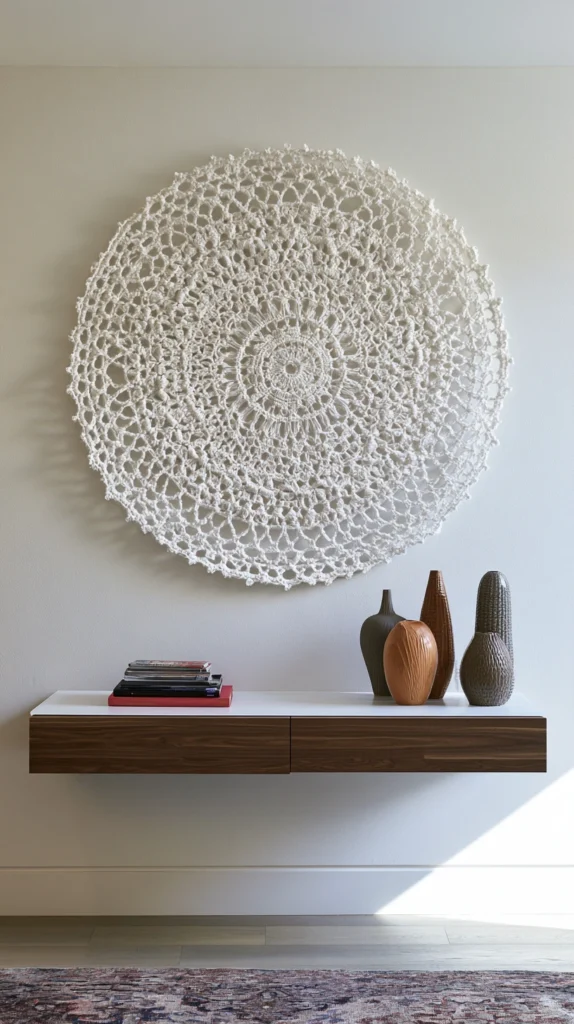
The mandala design is one of the most popular crochet wall hanging patterns and one of the most specifically suited to the medium.
The mandala’s radial symmetry, working outward from a central point in expanding rounds, is exactly how crochet is worked in the round. The most natural structural logic of the crochet medium produces the mandala form. A pattern that is architecturally forced in many other craft media is completely native to crochet.
A crochet mandala of forty to sixty centimetres in diameter, worked in natural cotton or a fine wool in cream and warm neutral tones, creates a wall piece of considerable beauty. The concentric rounds of the mandala catch light from the raised stitches in each round, creating a three-dimensional quality that makes the piece visually complex from any angle.
Hung on a wooden dowel or a twig of natural wood, the mandala becomes a hanging that suits every room, from bedroom to living room to bathroom. Its circular form is a specific relief from the predominantly rectangular form of most wall art.
A coloured mandala, using two or three tones within a warm palette, terracotta and cream, sage green and natural cotton, dusty blue and white, adds the colour variation that a monochrome mandala lacks, while remaining within the warmth and handmade quality that makes the crochet mandala work.
4. A Gallery of Small Crochet Frames
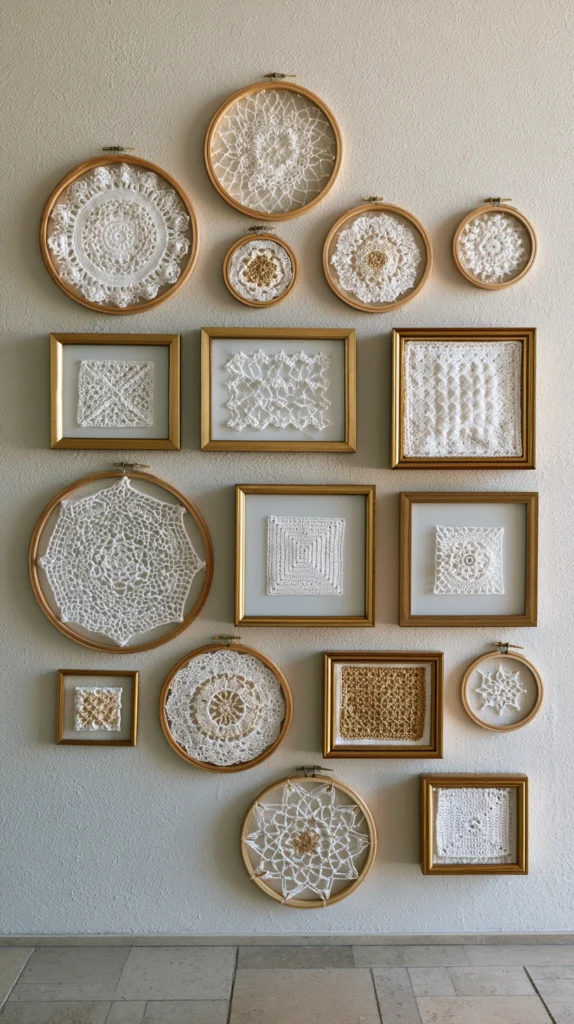
The gallery wall concept applied to small crochet pieces creates a wall installation of accumulated handmade warmth.
Rather than one large piece, a collection of smaller crochet hangings in related but not identical forms. A circular mandala beside a rectangular panel beside a triangular geometric. A small starburst beside a square granny square panel beside a crescent. The collection reads as gathered rather than purchased, assembled over time from different makers or different making sessions, with an organic variety that a single purchased set cannot replicate.
Frame the individual pieces consistently to create visual coherence in the variety. Simple wooden hoops, the same diameter for each piece, provide a consistent geometric container for the different crochet forms within them. Or mount each piece on a backing of natural linen pinned over a simple rectangular canvas, giving each piece the format of a small framed artwork.
The spacing between pieces matters as much as the pieces themselves. A tight grouping where the frames almost touch creates a dense, richly textured installation. A loose grouping with significant space between each piece gives each piece room to be seen individually while still reading as a collection.
5. A Crochet Dreamcatcher With Feather and Bead Detail
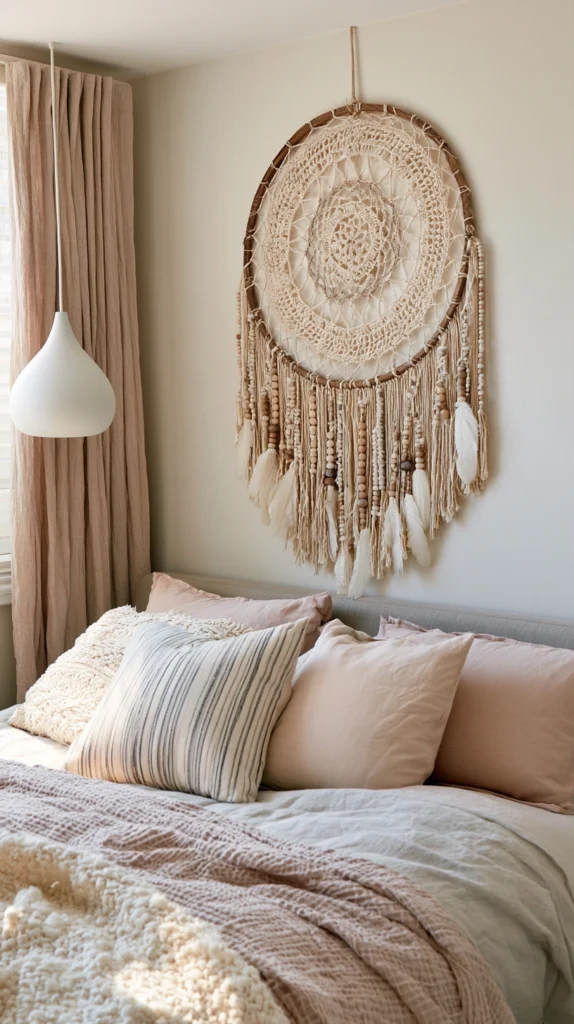
The dreamcatcher form has deep cultural origins in the Ojibwe and other indigenous North American traditions, and its use outside those traditions is something to approach with genuine awareness.
For makers who choose to create dreamcatcher-inspired forms as textile art rather than as cultural reproduction, the crochet version of the web-within-circle form creates a genuinely beautiful wall piece. The crochet web worked within a wooden or metal hoop. Feathers, natural stones, and beads hung from the lower edge of the hoop on cords of natural cotton.
The crochet web within the hoop requires a fine thread rather than bulky yarn to produce the delicate, open-work quality that the form requires. A size one or two steel crochet hook and a thin cotton thread create the finest possible web within the circular frame.
The beads and feathers chosen for the hanging should be natural materials, wooden beads, natural feathers from ethical sources, and semi-precious stones. The heaviness of synthetic alternatives is wrong for the delicacy of the crochet web within the hoop.
A dreamcatcher-inspired crochet hanging in a bedroom, above the headboard or in a corner that catches any air movement and allows the hanging elements to move, is one of the most specifically bedroom-appropriate wall pieces available.
6. A Crochet Wall Panel in a Bold Geometric Pattern
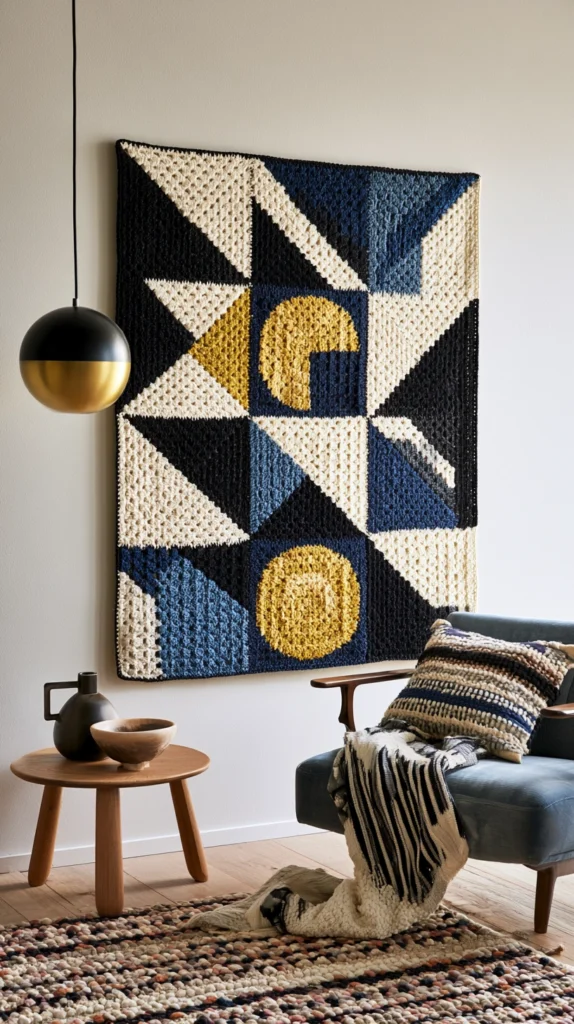
The graphic potential of crochet is underused in most decorative applications.
A bold geometric crochet wall panel, worked in two strongly contrasting colours or in multiple tones that create a complex optical pattern, demonstrates that the medium is capable of the same graphic power as woven textiles and printed art.
A colour-block panel where each block is a crochet rectangle in a single colour, joined and arranged to create a grid of contrasting colours across the panel’s surface, creates a geometric piece of contemporary character. The crochet stitch texture within each colour block adds the handmade quality that a printed geometric pattern cannot provide.
Tapestry crochet, where different colours are worked simultaneously within a single row to create colour patterns within the fabric rather than in joined separate pieces, creates the most precise and most graphic geometric patterns available in the crochet medium. The Aztec, Nordic, and traditional textile patterns that work best in tapestry crochet have a cultural richness and complexity that purely invented patterns often lack.
A tapestry crochet wall panel in black and cream, in terracotta and white, or in a Nordic palette of grey, cream, and warm red creates a wall piece that reads as textile art rather than a craft project.
7. Crochet Hoops as a Simple, Minimalist Installation
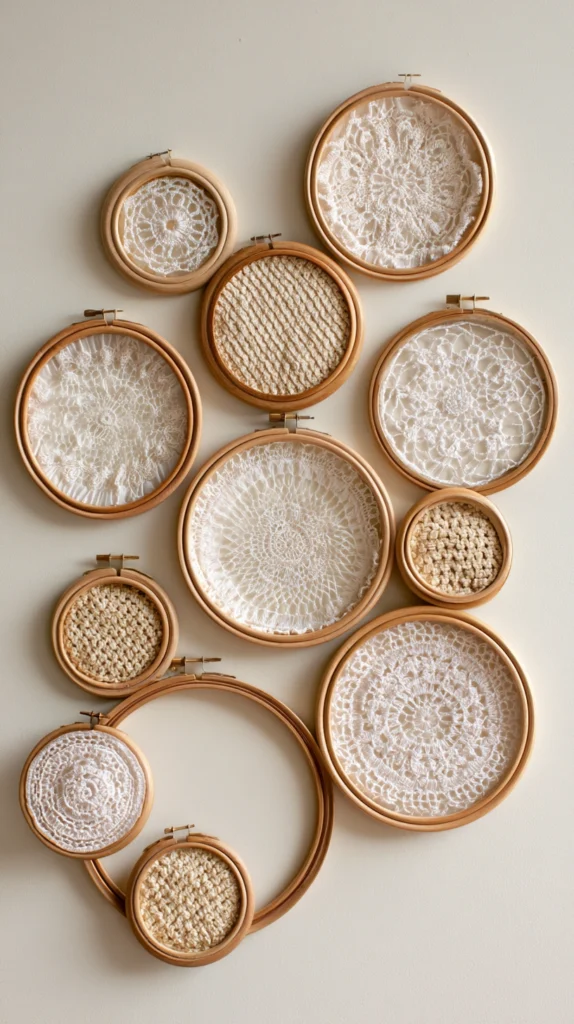
The crochet hoop installation is the most minimal and most accessible version of the crochet wall decor idea.
A wooden embroidery hoop, the same hoops used for needlepoint and cross-stitch, with crochet fabric stretched within it and the excess fabric trimmed to the edge of the hoop, creates a simple, framed crochet piece that sits between a textile and a wall object.
Grouped in a cluster on the wall, five to seven hoops of different diameters with different crochet patterns or colours stretched within them, the hoop installation creates a wall display of considerable character and flexibility.
The simplicity of the hoop as a frame means the crochet fabric itself does all the decorative work. A fine lace pattern stretched in a small hoop becomes a delicate decorative object. A bold single-colour stitch pattern stretched in a large hoop becomes an abstract textile artwork. A variegated yarn worked in a simple pattern stretched in a medium hoop creates a colour statement without any pattern complexity.
Hoops can be painted before the fabric is mounted. A hoop painted in a colour that complements the crochet within it creates a more designed effect than the natural wood hoop. A hoop painted gold or black creates a more gallery-like presentation.
8. A Textured Crochet Wall Panel for a Tactile Statement
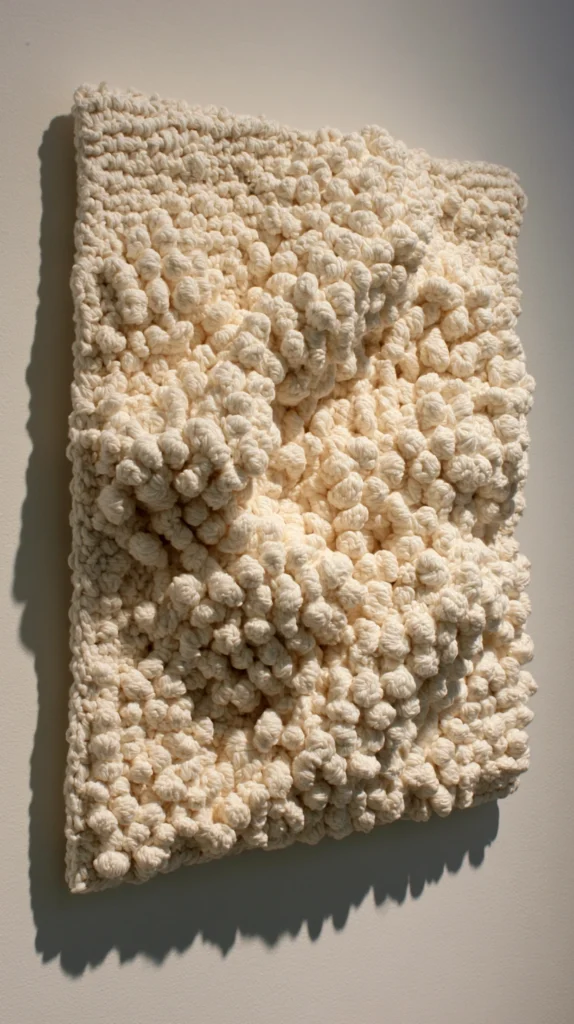
The textured crochet wall panel exploits the three-dimensional quality of the crochet medium most directly.
Stitches like the bobble stitch, the popcorn stitch, the puff stitch, and the crocodile stitch create raised surface elements that project from the base fabric significantly. A panel worked predominantly in these raised stitches has a genuinely sculptural surface, with hills and valleys of yarn that create deep shadow at any raking light angle.
A large textured panel in a single cream or warm neutral tone relies entirely on the texture rather than on colour for its visual interest. The light catching the raised stitches and creating shadow in the recessed areas between them produces a constantly changing visual surface as the time of day and the angle of available light change.
This purely textural approach is the most specifically contemporary version of crochet wall decor. It has the quality of a plaster relief or a carved stone panel in textile form. It would not look out of place beside a contemporary abstract painting or a sculptural ceramic installation.
A wall lamp positioned to cast light across the surface of a textured crochet panel at a raking angle maximises the shadow play that makes the texture visible and creates a genuinely spectacular wall installation that changes character throughout the day.
9. A Crochet Sampler Wall Hanging
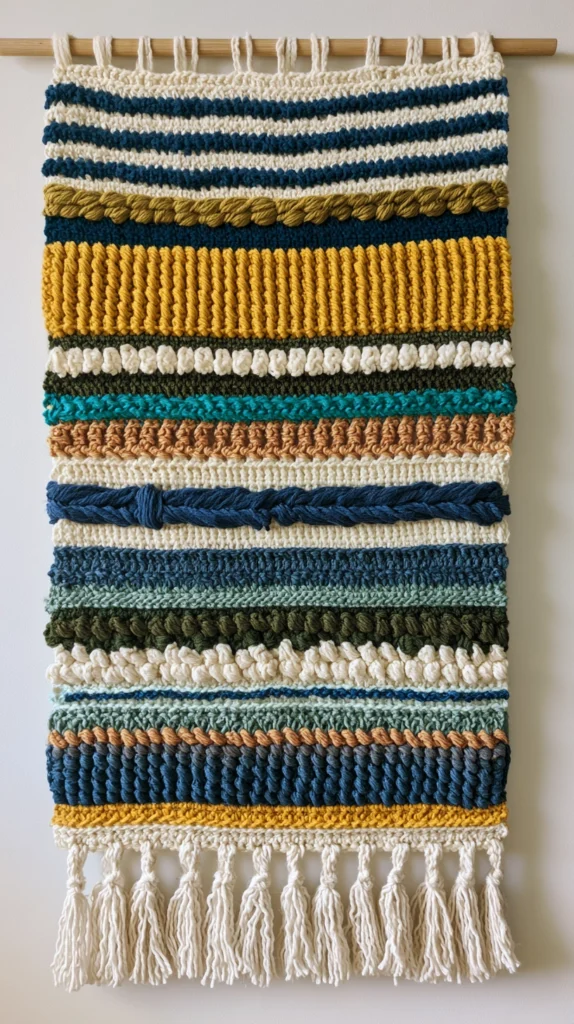
The sampler tradition in textile craft is centuries old.
The embroidered sampler, where a maker practices and displays different stitch forms within a single framed piece, has been hung on walls since the medieval period. The crochet sampler applies the same principle to the crochet medium.
A crochet sampler wall hanging composed of horizontal bands, each band in a different stitch pattern, creates a textile education on the wall. The viewer sees the variety of forms that crochet can produce: the dense, warm fabric of the half double crochet; the open, lacy quality of the shell stitch; the geometric precision of the grid stitch; the textured surface of the moss stitch.
This variety within a single piece creates a wall hanging of genuine visual complexity that a single-stitch panel cannot match. The eye travels from band to band, registering the different surfaces and different structural logics of each stitch.
In natural cotton in a cream and oatmeal palette, a sampler hanging has the warm, documentary quality of a traditional textile piece alongside the contemporary appeal of its format as a wall hanging rather than a framed needlework on a stiff backing.
10. A Crochet Letter or Word Panel
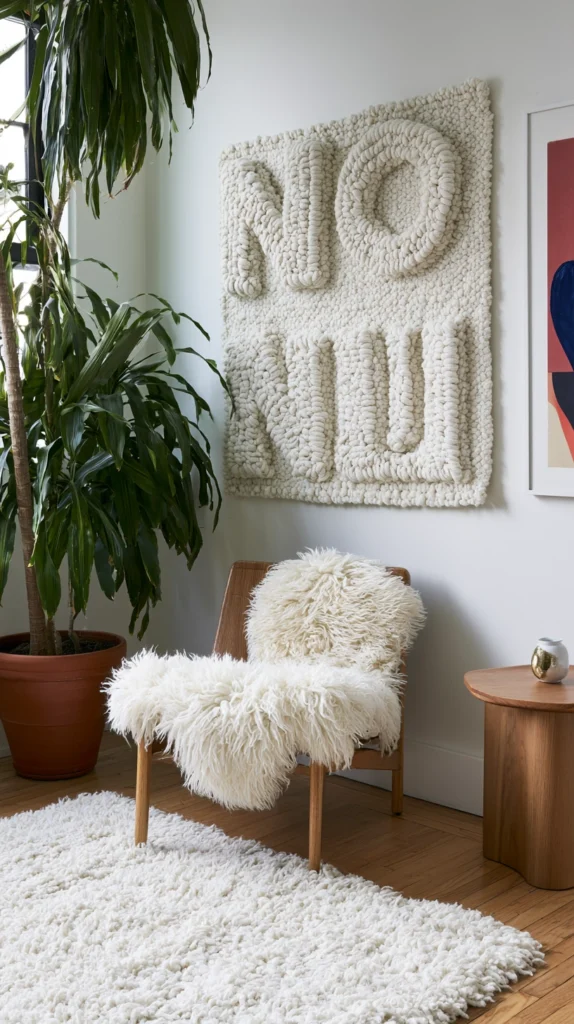
The crochet word panel is the textile equivalent of the word art print, but handmade and textural in a way that the print cannot be.
A single initial, a word that matters, a short phrase that belongs on the wall of a specific room, worked in tapestry crochet or in surface crochet on a base fabric, creates a wall piece that is both decorative and personal.
The initial of a family surname above a fireplace. The word HOME in a vintage-style font worked into a cream and natural panel for an entryway. PEACE or DREAM in the bedroom. The word GATHER for a dining room wall. The letters that mean something to the household, rather than the generic motivational phrases that decorate a thousand identical rooms.
Tapestry crochet letters, where the letter form is created by changing colours within the fabric, require planning the letter shapes on a graph paper grid, but produce extremely clean and readable letterforms.
Surface crochet letters, where chain stitch or slip stitch is worked on top of a completed base fabric to outline the letter, are more improvisational and have a softer, more casual quality that some letter applications suit better.
11. A Nature-Inspired Crochet Installation
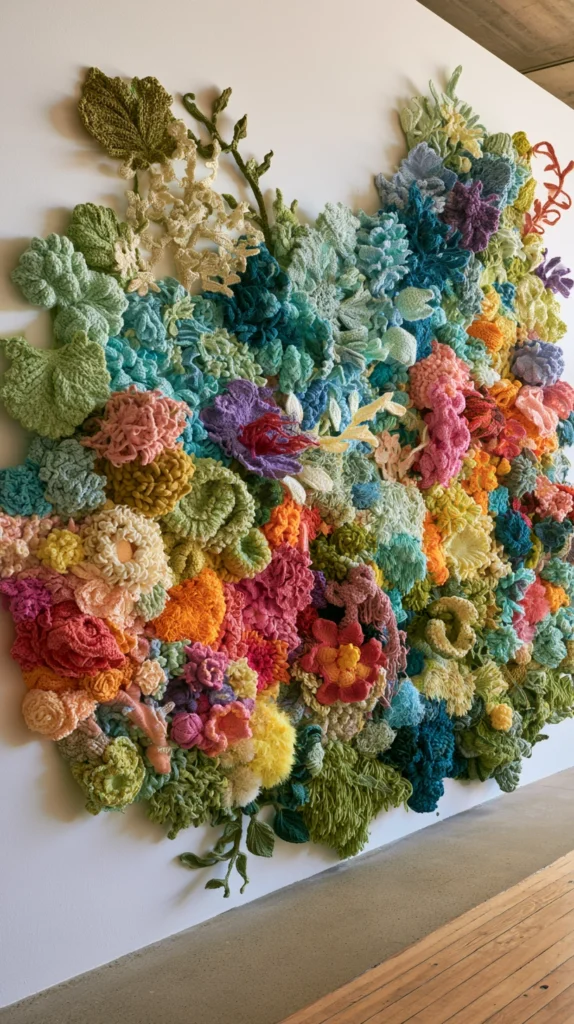
The natural world provides the most enduring design vocabulary available in any medium.
Crochet leaves. Crocheted flowers in different scales. Crocheted feathers arranged in a fan. A crocheted branch with crocheted leaves attached along its length. These individual nature-referencing elements, arranged on a wall as a three-dimensional installation rather than a flat hanging, create a wall piece of genuine originality.
The installation might begin with a real or faux branch mounted to the wall as a structural element, with crocheted leaves, flowers, and birds attached at intervals along its length. Or it might be purely crochet, a large crocheted tree form worked as a flat panel with branches in different stitch textures radiating from a central trunk.
The nature installation approach suits children’s rooms particularly well. A crocheted tree on the wall with crocheted owls, birds, and leaves brings the natural world into the room in a warm, handmade form that is genuinely beautiful and specifically right for a child’s space.
In a living room or bedroom, a more restrained nature installation of crocheted leaf forms in autumn tones, ochre, terracotta, and warm brown, creates a seasonal wall piece that is contemporary in its installation format and deeply warm in its natural material and colour.
12. A Crochet Tapestry in Regional or Cultural Pattern
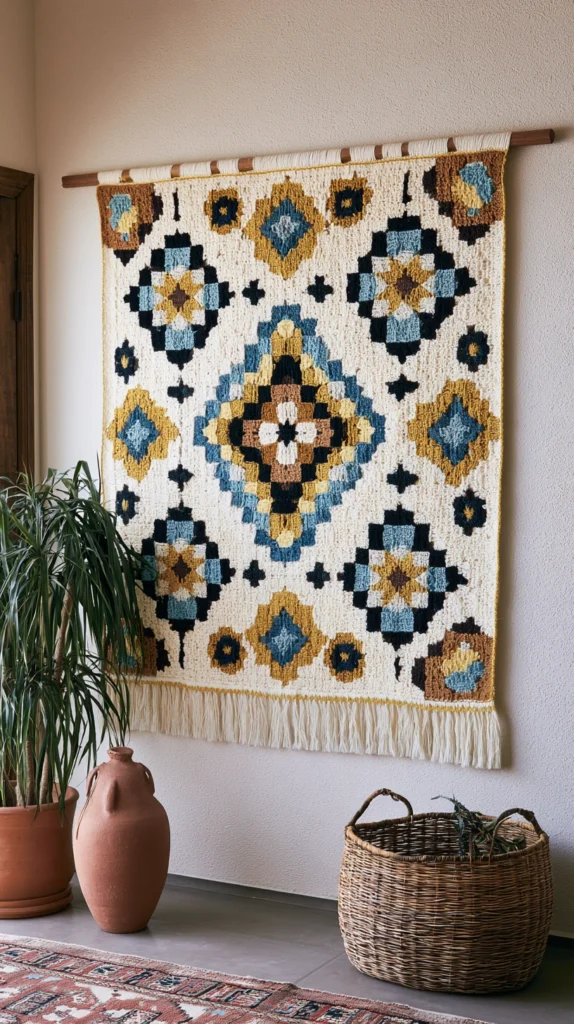
Every textile tradition in the world has its specific patterns, colour relationships, and structural logics.
Scandinavian folk patterns. Andean geometric traditions. African kente cloth patterns. Turkish kilim motifs. Japanese sashiko geometric forms. These traditions have been developing their visual vocabularies for centuries, and the patterns they have produced are among the most sophisticated design works in human history.
Crochet tapestry techniques allow many of these traditional patterns to be worked in the crochet medium. The fair-isle style of working two colours simultaneously to create repeating motifs within a single row, usually associated with knitting, works equally well in crochet and allows traditional Nordic, Andean, and other geometric traditions to be recreated in tapestry crochet form.
The cultural sensitivity of this approach matters. Working in the tradition of a culture you belong to or have a genuine personal connection to is different from appropriating a cultural pattern without that connection. The most satisfying and most authentic approach to this kind of pattern work is through the textile traditions that have personal meaning.
A crochet tapestry worked in a traditional pattern of personal or cultural significance, framed and hung as a wall piece in the home, is a genuinely significant object. It connects the maker and the viewer to a tradition that extends far beyond the individual piece.
13. A Crochet Mobile as a Dimensional Wall Installation
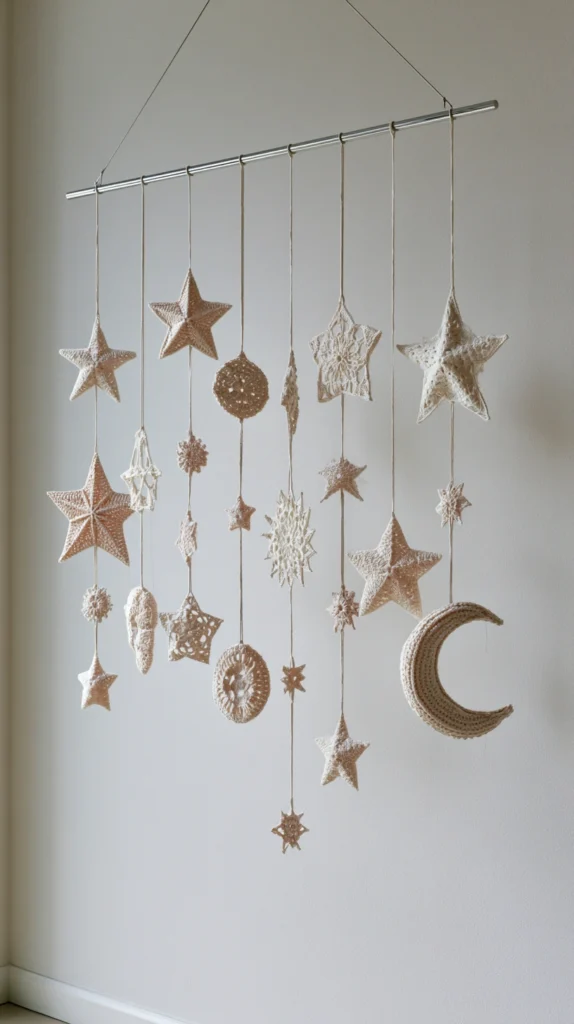
The crochet mobile extends the wall decor idea into three dimensions.
Crocheted elements of different forms, stars, moons, leaves, geometric shapes, suspended at different heights from a horizontal rod or a natural branch, create a mobile that exists at the boundary between wall art and hanging sculpture.
Unlike a flat wall hanging, the mobile changes with any air movement. The suspended elements turn and shift. Different combinations of elements come into view and retreat. The mobile at rest presents one composition. The mobile in movement presents a continuous series of compositions that are never the same.
A crochet mobile of natural cotton stars and moons in cream and warm gold, hung above a child’s bed or in a corner of a living room, creates a wall installation that is simultaneously decorative, kinetic, and deeply soft in its material quality.
The rod or branch from which the mobile hangs should be considered carefully. A natural branch of appropriate length, straight or slightly irregular, creates a connection to the natural materials of the crochet elements. A polished wooden rod creates a cleaner, more intentional effect. A copper or brass rod creates a warmer metallic contrast with the natural cotton elements.
14. A Commissioned or Gifted Crochet Wall Piece With Known Provenance
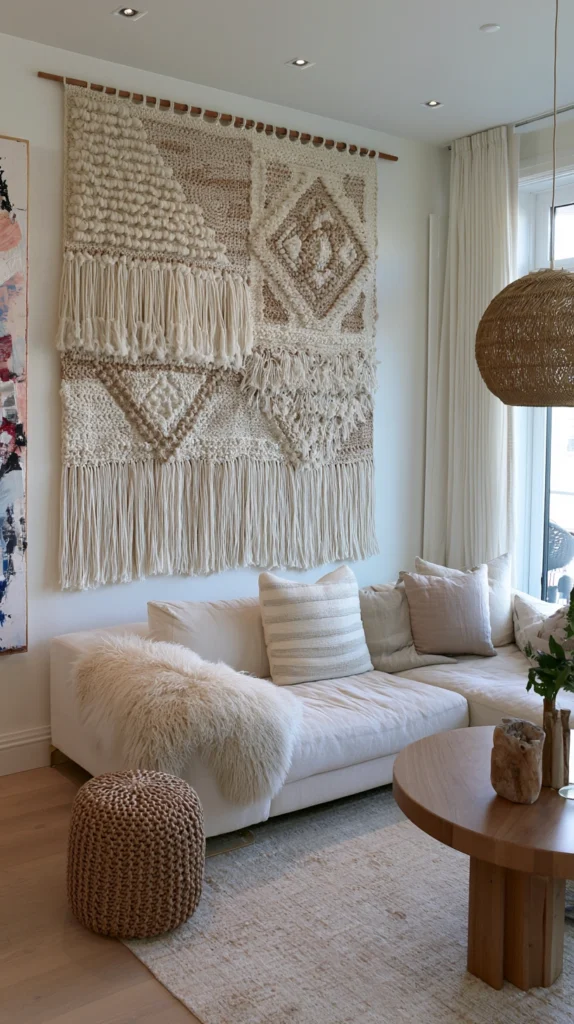
The crochet wall piece with known provenance, the piece made by a specific person for a specific reason, is the wall art that means the most and retains the most meaning across the years.
The piece was made by a grandmother for a new home. The wall hanging was commissioned from a local maker whose work you have followed for years. The piece was made by a friend for a housewarming gift. The panel was worked on by a new crafter as their first large project and hung not because it is perfect, but because it is theirs.
These pieces carry a specific quality that the most technically accomplished anonymous piece cannot have. They are connected to people. They have a story that can be told to everyone who asks about them. They accumulate meaning alongside the household that lives with them.
This is the deepest argument for crochet wall decor. Not the texture or the warmth or the specific aesthetic quality of the handmade. The fact that things made by human hands for human purposes carry something of the person who made them into the room where they hang. The room that contains known, made objects is a different room from one that contains only purchased ones.
A crochet piece with provenance is not just wall decor. It is a relationship, represented in textile form, hung on the wall of a home where it will be looked at, asked about, and held in some form of regard for the entire period that the home remains the home of someone who knows its story.
How to Display Crochet Wall Decor for Maximum Impact
The hanging method is as important as the piece itself.
A crochet wall tapestry hung too high loses its texture in the distance between the viewer and the piece. Too low and it is below eye level, and the sense of it as a wall piece is lost. At eye level, with the centre of the piece at approximately one hundred and fifty centimetres from the floor, the texture and detail of the crochet surface can be appreciated from the natural standing viewing distance.
The hanging rod, dowel, or branch from which most crochet wall pieces are suspended is a design element in its own right. A natural branch with visible bark and slight irregularity has an organic quality that a purchased wooden dowel does not. A copper rod creates a warm metallic contrast. A driftwood piece found on a beach has the specific provenance story of where it came from.
Leave space around the piece. Crochet wall decor surrounded by other wall art, competing for attention from all sides, loses its specific quality of quiet presence. A significant crochet tapestry should have clear wall space around it, enough that the eye arrives at the piece from a neutral ground rather than from other visual content.
Common Mistakes With Crochet Wall Decor
Hanging pieces too small for the wall. A small crochet hoop on a large expanse of wall looks timid and accidental. Either scale up to a piece appropriate for the wall or create a gallery of smaller pieces that together fill the space properly.
Choosing yarn that does not hold its form. Acrylic yarn in a soft weight may be inexpensive and widely available, but it does not drape or hold its form in the way that natural cotton, wool, or linen does. Crochet wall pieces in natural fibres maintain their shape and their quality over years of hanging. Synthetic alternatives soften and distort.
Ignoring the colour of the wall behind. A cream crochet piece against a cream wall disappears. A cream piece against a warm terracotta, sage green, or dark blue wall is spectacular. Consider the wall colour as part of the display design before choosing the piece colour.
Making the piece without a clear vision of its final scale. The piece that grows organically without a planned finished size often ends up too small for its intended wall or too large for the intended space. Plan the final dimensions before beginning and measure the wall space where the piece will hang.
Hanging without checking the piece is level. A crochet wall piece hung at a slight angle looks unintentional. Use a spirit level or a level app on a phone when hanging any significant wall piece.
Using cheap hanging hardware. A heavy crochet tapestry hung from a small nail in an inadequate wall fixing is a tapestry that will fall. Use appropriate wall fixings for the weight of the piece and the wall material it is fixed to.
Quick Summary
- A large natural cotton tapestry of ninety centimetres or larger creates a room-defining statement at the wall’s full scale
- A macramé-crochet hybrid with knotted fringe bridges the two most popular textile wall hanging techniques in one piece
- A crochet mandala worked in the round creates a circular form that is structurally native to the crochet medium
- A gallery of small crochet pieces in wooden hoops reads as an accumulated collection rather than a single purchased installation
- A dreamcatcher-inspired crochet web with natural feathers and bead detail suits a bedroom wall above the headboard
- A bold geometric tapestry crochet panel demonstrates that the medium is capable of graphic power equal to woven textiles
- Simple crochet fabric stretched in painted or natural wooden embroidery hoops creates the most minimal and accessible wall installation
- Raised-stitch textured crochet panels create sculptural, three-dimensional surfaces that change character as the available light changes
- A stitch sampler hanging of horizontal bands in different crochet patterns creates a textile education and a wall piece simultaneously
- A crochet letter or word panel in tapestry crochet creates personal, textural wall art that mass-produced word prints cannot match
- A nature installation of crocheted leaves, flowers, and branches on a wall suits both children’s rooms and adult spaces
- A tapestry worked in a traditional regional or cultural pattern connects the piece to a heritage that extends far beyond the individual maker
- A crochet mobile as a dimensional wall installation creates kinetic, ever-changing compositions that a flat hanging cannot
- A crochet piece with known provenance, made by a specific person for a specific reason, carries meaning that the most technically accomplished anonymous piece cannot
- Hang at eye level, use natural rod or branch hanging hardware, and leave clear wall space around significant pieces
- Always choose natural fibre yarn for wall pieces that need to hold their form across years of display
The crochet piece on the wall is not a decoration.
It is evidence.
Evidence that someone made something. That the room was considered carefully enough to receive a made thing. The people who live there value the specific quality of the handmade over the general quality of the purchased.
Every loop in the stitch is a small decision. Every row is an hour of someone’s attention.
That is what hangs on the wall.
And that is what people feel when they stand in the room with it.