15 Backyard Flower Bed Ideas That Add Instant Color to Any Outdoor Space
A backyard without flower beds is a backyard that is working with one hand tied behind its back.
The lawn looks after itself in a broad, green, undifferentiated way. The fence and the paving do their structural jobs. But colour, the thing that makes a garden feel alive and worth looking at from every window in the house, almost always comes from flower beds.
Not just any flower beds. The right flower beds in the right places with the right plants make a backyard feel like a genuinely designed outdoor room rather than a rectangle of grass surrounded by boundaries. They add structure. They define the shape of the space. They give the eye somewhere to travel and rest, and discover.
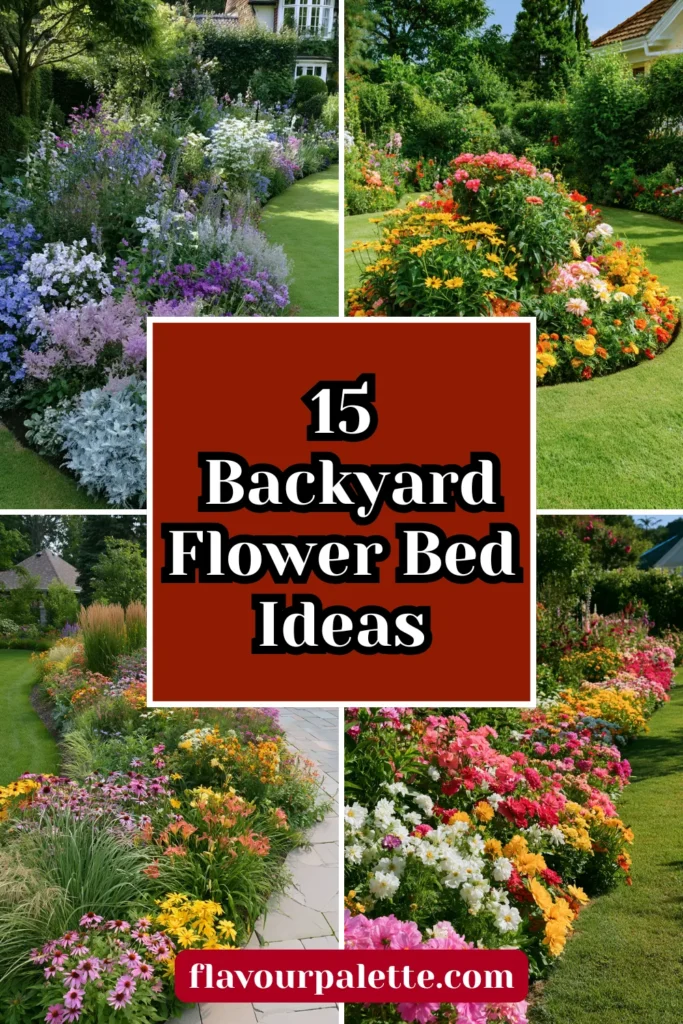
And they add colour. The kind of vivid, shifting, seasonally changing colour that no paint colour or outdoor furniture can replicate because it is genuinely alive.
The good news is that the gap between a dull backyard and a colourful one is almost always just a few well-placed flower beds away.
Here are 15 ideas that close that gap quickly.
Why Flower Beds Transform a Backyard More Than Almost Any Other Addition
Colour in a garden has a quality that colour in an interior cannot fully match.
It is not static. A flower bed planted in May is different in June, completely different in August, and transforming again in September. The garden you look at on Monday is not quite the same garden you look at on Friday. This constant, gentle change is what makes a backyard with good flower beds genuinely addictive to be in and to watch.
Flower beds also add ecological value that no hard landscaping or furniture addition can approach. A well-planted flower bed with a variety of species flowering across the season supports dozens of pollinator species, provides nesting material and food for birds, and contributes to the biodiversity of your local environment in ways that a lawn cannot.
And practically, flower beds define the shape and layout of a backyard in a way that gives the space structure and intention. A lawn bordered by planted beds has clear edges and a clear character. A lawn without beds is simply a lawn.
The investment of time and money in a flower bed, spent once and maintained seasonally, delivers colour and structure for years rather than the single-season return of most outdoor decoration.
1. A Mixed Perennial Border for Year-Round Structure and Colour
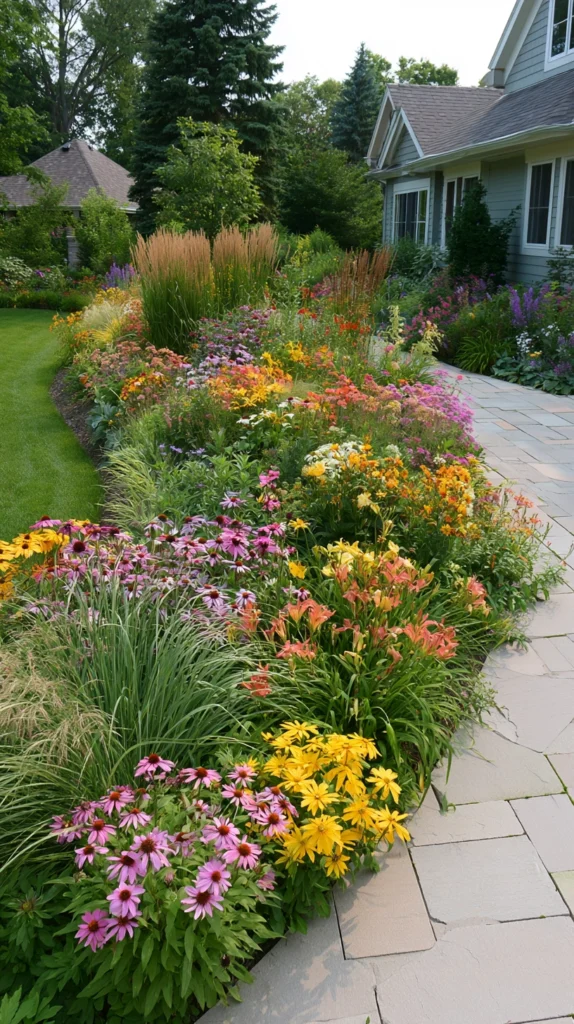
The mixed perennial border is the most rewarding flower bed in any backyard because it earns its colour over the years rather than the seasons.
Perennials return every year from their root systems. Plant them once, and they grow, spread, and improve with each successive year. The perennial border planted in year one looks good. In year three, it looks established. In year five, it looks like it has always been there.
The key to a mixed perennial border that delivers colour from spring through autumn is layering the flowering times of the plants within it. Spring-flowering hellebores and pulmonaria overlap with early summer-flowering geraniums and salvias. Midsummer brings echinacea, rudbeckia, and heleniums. Late summer and autumn add the dahlias, asters, and sedums that carry the border to the first frost.
No single moment of the season is without colour. The border is simply displaying different plants in different combinations at different times, each one ceding the lead to the next.
The structural plants in the border, the ones that hold their form and provide visual interest even when not in flower, are as important as the flowering ones. Ornamental grasses that provide movement and seed heads. Shrubby salvias with persistent grey-green foliage. The solid presence of a repeat-flowering shrub rose.
What makes a mixed perennial border work across the whole season:
- Spring flowering bulbs planted beneath perennials for early colour before perennials emerge
- Early summer perennials flowering from June, including geraniums, salvias, and early roses
- Midsummer peak with echinacea, rudbeckia, and heleniums providing the most abundant display
- Late summer and autumn colour from dahlias, asters, verbena, and ornamental grasses
- Winter structure from persistent seed heads, dried grasses, and evergreen foliage plants
- Repeat-flowering roses that contribute continuously from June through October
2. A Cottage Garden Bed of Mixed Annuals and Perennials
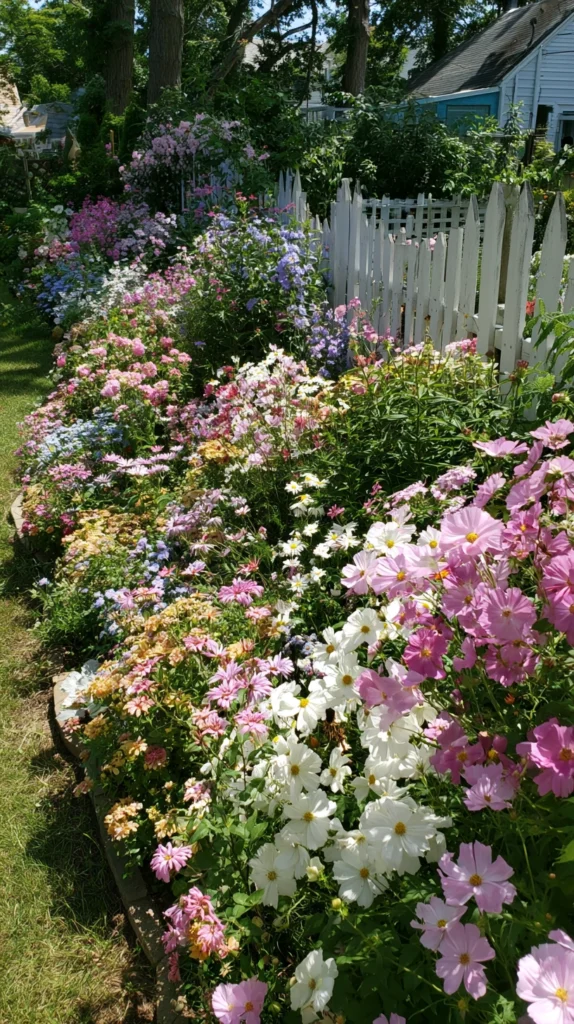
The cottage garden flower bed is the most romantic and the most forgiving style of backyard flower border.
It combines annuals, perennials, bulbs, and self-seeding plants in a deliberately unstructured mix that looks as if the plants themselves decided where they wanted to grow. Tall plants pushing through shorter ones. Self-seeded annuals appear in unexpected places. The slight chaos of a planting that has filled every available space with something flowering.
This style is forgiving because the apparent disorder means that any slightly wrong choice or positioning error disappears within the overall exuberant mix. There is nowhere to make a visible mistake when every plant is surrounded by three others competing for the same space.
Classic cottage garden plants include foxgloves rising dramatically from a base of lower planting. Sweet peas climb whatever they can reach. Hollyhocks against a fence or wall. Lupins produce their dense flower spikes in early summer. Delphiniums add vertical blue and purple accents. Old-fashioned roses with a generous, cupped flower and strong fragrance.
The cottage garden bed looks best when it slightly overflows its boundaries. When it is not quite contained by the edge that marks it from the lawn. When plants lean outward and trail over the border edge with more enthusiasm than discipline. The contained, perfectly edged cottage garden border looks like a contradiction in terms.
3. A Hot Colour Border for Maximum Visual Impact
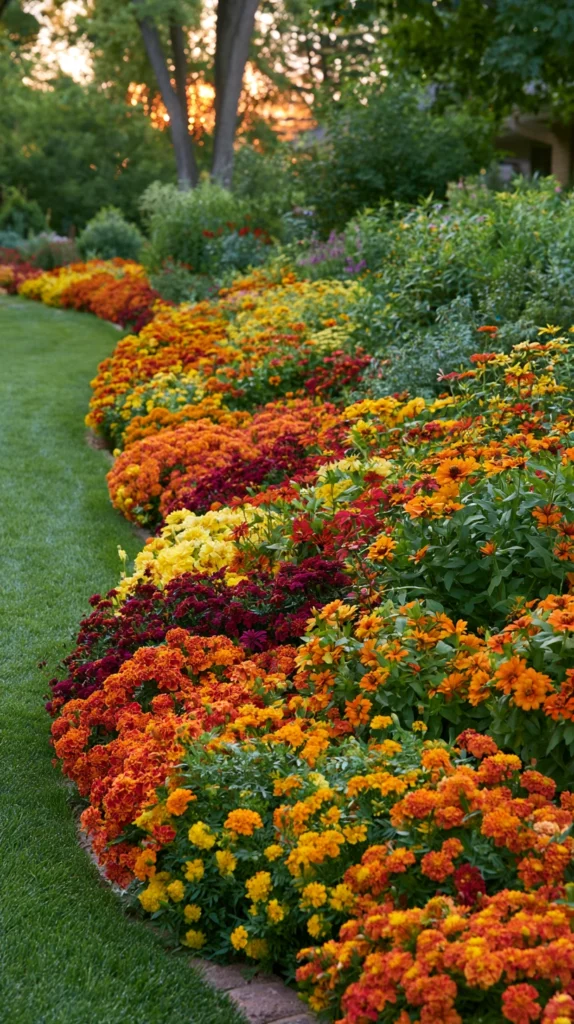
The hot colour border is the flower bed that does not whisper.
Deep red. Burning orange. Cadmium yellow. Magenta. The colours of the warm end of the spectrum combined in a single bed create a display of extraordinary visual energy that is visible from every part of the garden and from every window of the house.
Hot colour beds work because the colours within the warm spectrum are naturally harmonious. Red, orange, and yellow are all related by their warmth, and they sit together without clashing in the way that warm and cool colours clashed would. Add in the deepest purples and burgundies that sit at the red end of the cool spectrum, and the combination becomes richer and more complex without losing its essential warmth.
Dahlias are the primary plant for a hot colour bed. The range of dahlias available in the deep reds, oranges, and yellows that the hot border needs is enormous. Bishop of Llandaff, with its deep red flowers and dark foliage. David Howard has its soft orange flowers above bronze leaves. Yellow Star has its simple, vivid yellow blooms.
Add crocosmia Lucifer for burning red spikes above arching grass-like foliage. Heleniums Moerheim Beauty in deep mahogany orange. Red hot pokers, Kniphofia, for vertical orange and yellow accent. Zinnias in coral and tangerine in the gaps where direct sowing is practical.
The hot border is at its best from July through October. Position it where it catches the afternoon and evening sun so the colours glow rather than merely shine.
4. A Cool and Calming Blue and Purple Bed
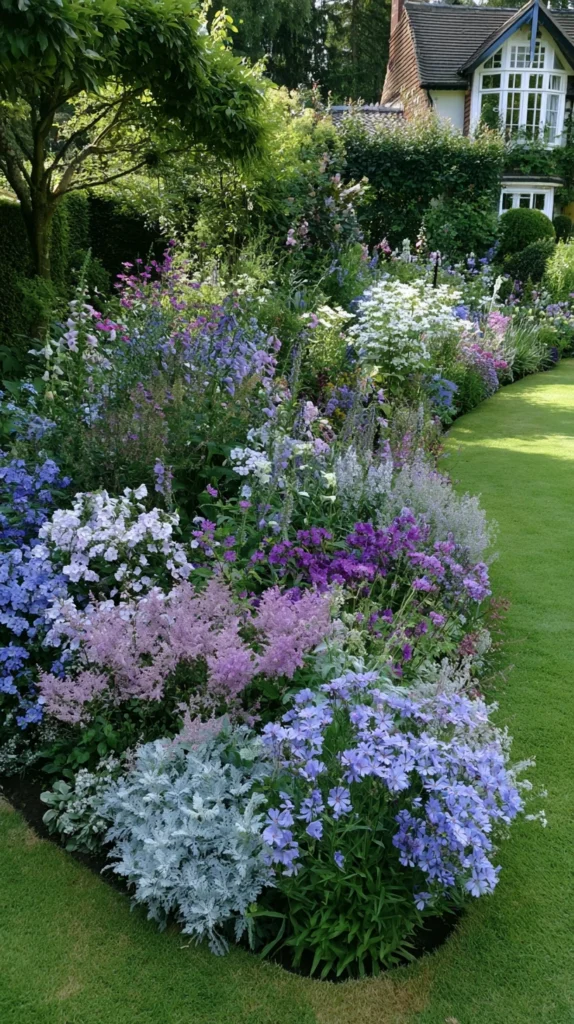
The opposite of the hot border is the cool colour planting that uses the blues, purples, silvers, and whites of the cool spectrum to create a bed that feels restful, airy, and slightly romantic.
Cool colour flower beds are particularly effective in small gardens where a hot border might feel overwhelming. The receding quality of blue and purple makes the planting seem further away than it is, which creates an impression of greater garden depth and space.
Agapanthus, with its globe-shaped heads of clear blue or deep purple, is the anchor plant for many cool colour borders. Its architectural quality, the strong stem rising from strap-like leaves to a perfect sphere of small tubular flowers, gives the bed structure and form as well as colour.
Salvias provide the reliable, continuous blue-purple contribution from July through September. Salvia nemorosa Caradonna has dark purple flower spikes above dark stems. Salvia guaranitica Black and Blue has its deep blue flowers on nearly black calyces. These plants bring the deepest, most saturated blues available in any summer garden.
Catmint, Nepeta, provides softer blue-purple along border edges and pathways. Lavender, in its best varieties, contributes the additional dimension of scent to the visual cool palette. White agapanthus and white cosmos provide the light relief that prevents the cool border from feeling heavy or monotonous.
5. A Shaded Woodland Bed Under Trees
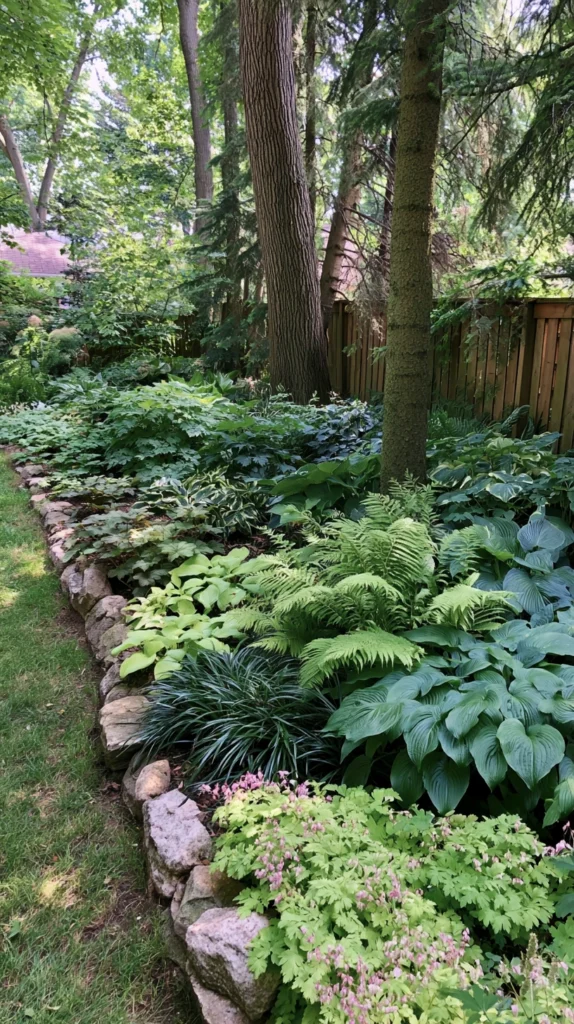
The shaded area beneath a tree is the flower bed challenge that most backyards have, and most gardeners treat as impossibly difficult.
It is not impossible. It requires different plants from the sunny border, plants that have evolved in forest understorey conditions rather than open meadow, but these plants are as beautiful and as varied as any sun-loving flower.
Hostas are the anchor plant of the woodland bed. Their enormous, architectural leaves in blue-green, gold, and variegated forms provide structural presence through the whole season. Their flower spikes in summer are a secondary attraction to the foliage display.
Hellebores flower in late winter and early spring before the tree above them is in full leaf, taking advantage of the light before the canopy closes. Their nodding flowers in cream, pink, burgundy, and deep purple provide the first colour of the year in a shaded bed.
Astilbes bring feathery flower plumes in pink, red, cream, and white to shaded conditions in midsummer. Ferns of every species provide the defining foliage texture of a woodland planting. Pulmonaria, with its spotted or silver leaves and pink-to-blue flowers, bridges the gap between hellebores and hostas at the season’s transition.
The shaded woodland bed succeeds by working with the conditions beneath the tree rather than fighting them. The plants listed above will not grow in full sun. In the shade, they produce their most beautiful expressions.
6. A Raised Flower Bed for Better Drainage and Visual Height
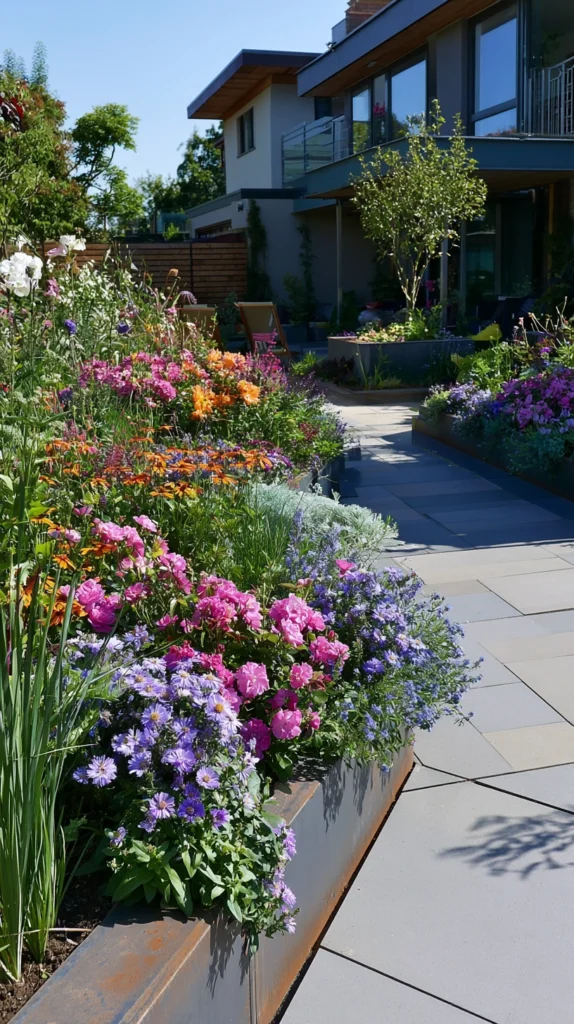
The raised flower bed solves multiple garden problems simultaneously.
Poor drainage in heavy clay soil drowns roots and limits the plants that can be grown. The difficulty of gardening at ground level for older gardeners or those with mobility challenges. The visual flatness of a garden with no level changes or vertical interest at the boundary of planting areas and paths.
A raised bed of thirty to forty-five centimetres brings planting to a height that is both visually more prominent and practically more accessible. The improvement in drainage from soil elevated above the surrounding ground level is immediately transformative for plants that struggle in wet conditions.
Build raised flower beds from materials that suit the garden’s overall aesthetic. Sleepers in a new, dark-stained form for a contemporary garden. Reclaimed brick for a garden adjacent to an older property. Corten steel that develops its rust patina over the first two years for a modern, architectural approach. Dry stone walling for a rural or cottage garden setting.
Fill with a soil-compost mix of the quality you would put into a raised vegetable bed. The investment in good growing medium pays back in plant performance throughout every subsequent season.
A raised bed at a boundary provides the additional benefit of adding visual height to a flat garden. The elevation of the planting surface adds to the effective height of the planting within it, making plants appear taller and more prominent than they would at ground level.
7. A Pollinator Garden Bed That Buzzes All Summer
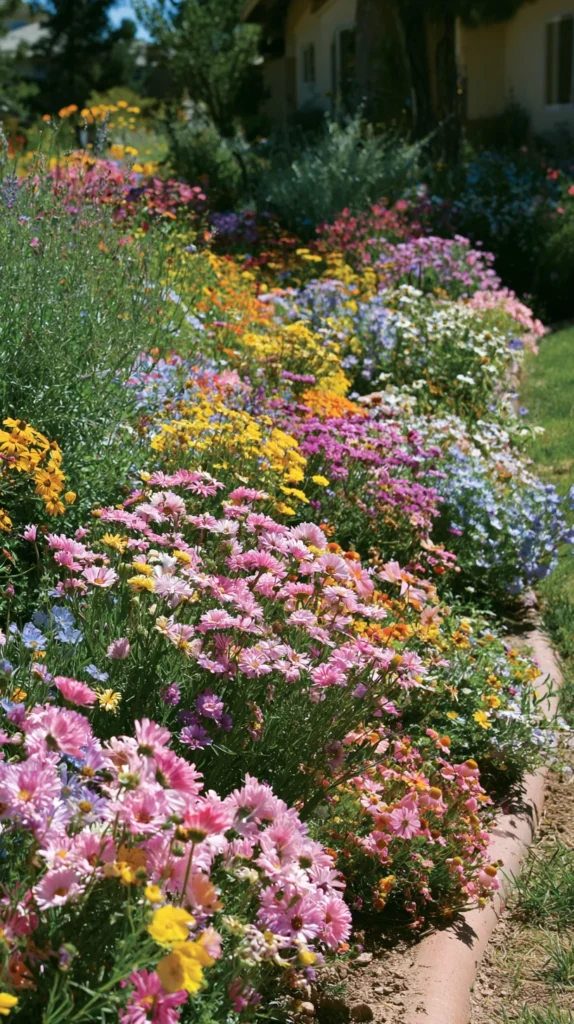
The pollinator garden bed is the flower bed that produces the most visible daily reward of any planting in this list.
On a warm summer afternoon, a pollinator bed planted with the right species is genuinely busy. Bumblebees move systematically from flower to flower. Honeybees are visiting the lavender and the echinacea. Hoverflies are hovering above the open flowers of phacelia and borage. Butterflies working the buddleia and the verbena.
The sound of a pollinator bed in full summer is extraordinary. A low, persistent hum of insect activity that carries across the garden in warm weather and communicates that the planting is genuinely functioning as habitat rather than merely looking attractive.
The plants that attract the widest range of pollinator species are almost all single-flowered rather than double. Double flowers, where the extra petals come at the cost of reduced or absent pollen and nectar, look impressive to human eyes and are useless to bees and butterflies.
Phacelia tanacetifolia for immediate, intense blue-purple attraction to bees. Borage has its clear blue star flowers that bees visit throughout the day. Lavender is the constant companion of bumblebees through July and August. Echinacea for butterflies in midsummer. Verbena bonariensis for every butterfly species that visits the garden. Buddleia, the butterfly bush, for late summer butterfly feeding.
8. A Fragrance Garden Bed Designed for Evening
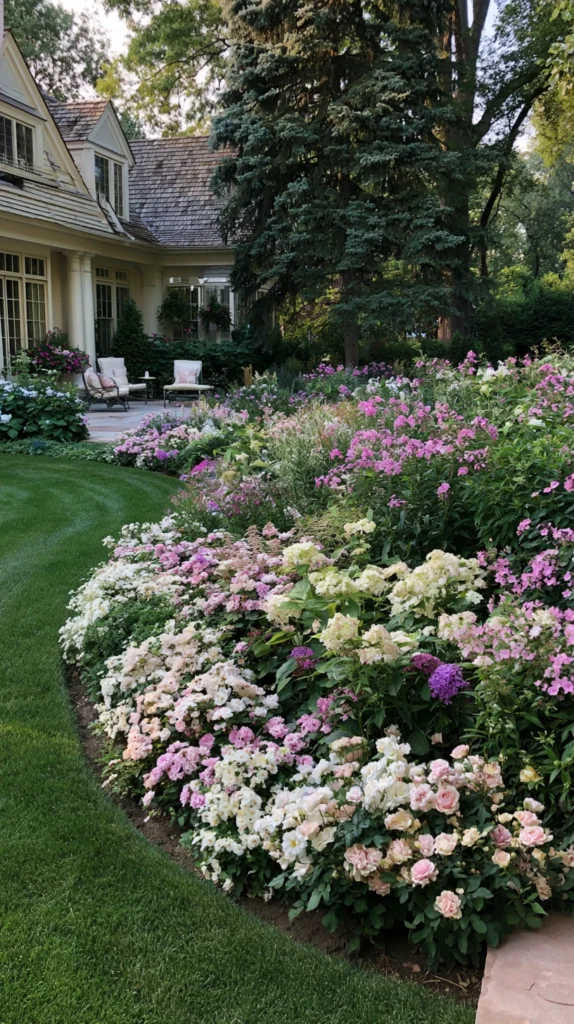
Most flower bed ideas focus on what the garden looks like.
A fragrance bed focuses on what it smells like, specifically at the time of day when the garden is most used and most enjoyed.
Scent is the most powerful sense for triggering memory and emotion. A garden that smells extraordinary creates an experience that persists in memory long after the visual details have faded. The smell of jasmine on a warm evening. Roses in the still afternoon heat. Night-scented stocks release their fragrance as the temperature drops at dusk.
Evening scent is produced by specific plants that time their fragrance release to attract night-flying pollinators. These plants, placed near the main evening seating area, transform the experience of sitting outdoors at dusk into something genuinely extraordinary.
Night-scented stocks, Matthiola longipetala, are unimpressive plants by day but release an extraordinary honey-and-vanilla fragrance from late afternoon onwards. Plant in generous drifts beside any path or seating area that is used in the evening.
Tobacco plants, Nicotiana alata rather than the modern bedding varieties bred for compact growth and reduced scent, produce white star-shaped flowers that add visual interest by day and intense fragrance from evening onwards. Evening primrose opens its pale yellow flowers specifically at dusk and releases a soft, sweet scent through the night.
Position the fragrance bed between the house and the main sitting area so the scent drifts across the path of movement in the garden on warm evenings.
9. A Cutting Garden Flower Bed for Indoor Blooms
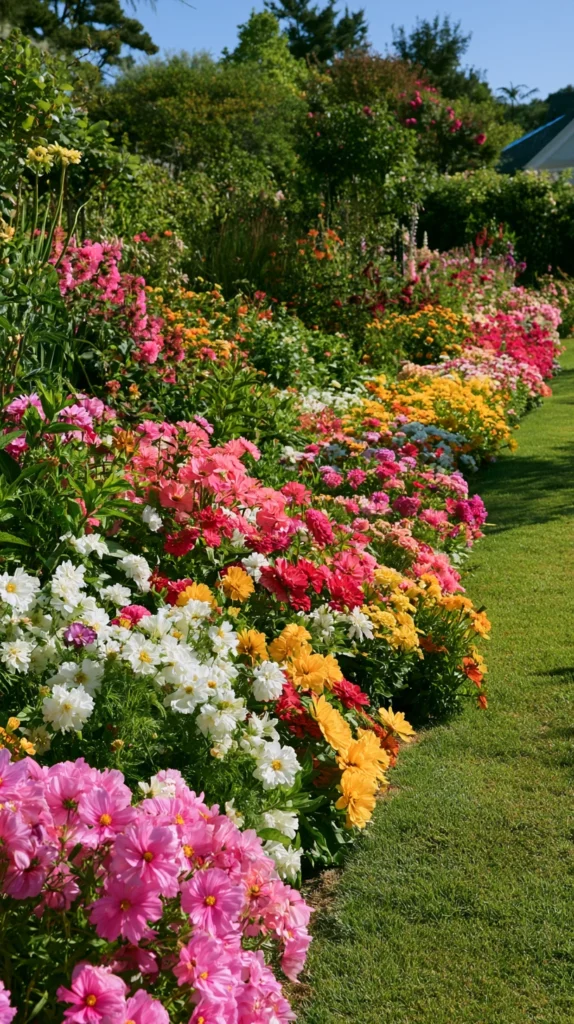
The cutting garden flower bed is the bed that gives back to the house as well as the garden.
A defined area planted specifically for cut flowers, with varieties chosen for their vase life, their stem length, and the value of their flowers as indoor decoration, produces material for fresh arrangements from June through October.
This is the bed that makes buying flowers from a supermarket feel completely unnecessary. The bundles of zinnias, cosmos, dahlias, and sweet peas that would cost twenty pounds at a florist are picked fresh from your own garden and in the house within the hour.
The cutting bed is planted in straight rows for efficiency rather than in ornamental drifts. It does not need to look beautiful from a distance. Its job is to produce stems. The beauty it creates is inside the house rather than in the garden.
Plant in the sunniest available position. The most productive cut flower varieties need maximum light to produce the longest, strongest stems.
Zinnias in every colour for continuous cutting from July through October. Cosmos in pink and white and the deep burgundy of Double Click Cranberries. Sunflowers for scale and drama. Sweet peas for scent and delicacy from June through August. Dahlias from July onwards are the most spectacular and long-lasting cut flowers in any garden.
Add ammi majus, the white laceflower that provides the filler foliage of a florist’s bunch, and the cutting bed produces material for complete, professional-quality arrangements without any purchased material.
10. A Drought-Tolerant Mediterranean Flower Bed
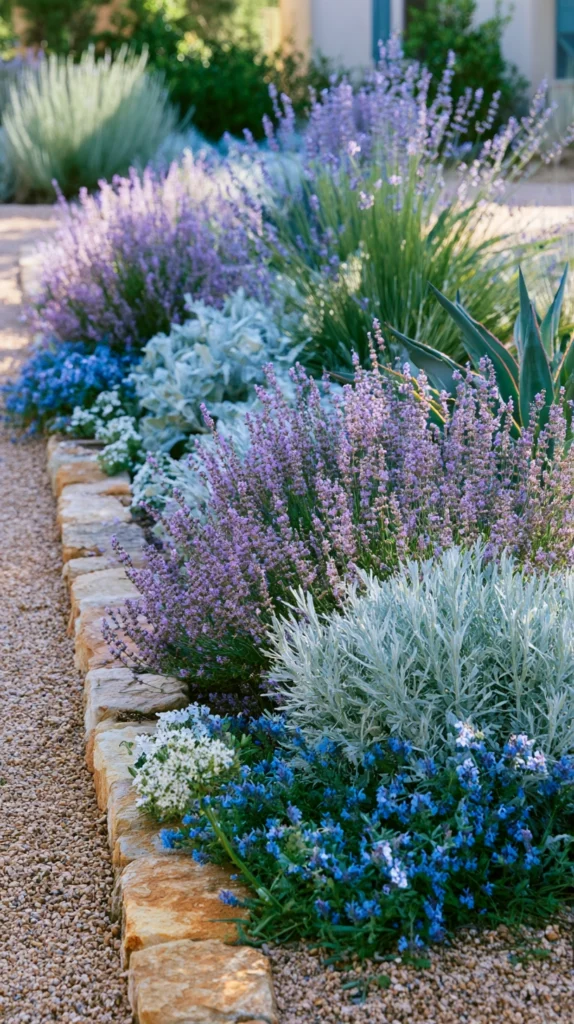
The drought-tolerant Mediterranean flower bed is the correct response to the increasing frequency of dry summers in many regions and to the desire for a beautiful flower bed that does not require constant irrigation.
Mediterranean plants are adapted to conditions of dry, hot summers and wet, mild winters. These conditions are increasingly replicated in many temperate gardens during the summer months. Plants that evolved in those conditions simply do not need supplemental watering once established.
Lavender across the front of the bed in generous drifts. Cistus in its various forms with tissue-paper flowers in white, pink, and magenta. Rosemary is grown as a border shrub rather than a culinary herb. Phlomis with its felted silver leaves and whorls of yellow flowers. Stachys byzantina, lamb’s ears, at the border edge with its woolly silver carpet of foliage.
Agapanthus in shades of blue and white for the midsummer peak. Alliums with their globe-shaped heads on long stems above the lower Mediterranean planting. Verbena bonariensis seeds itself through the entire bed and provides a floating purple from July through September.
This planting requires almost no water from May through September after the first establishment year. It looks its best in the dry, hot conditions that other borders find challenging.
11. A Spring Bulb Bed for Early Season Colour
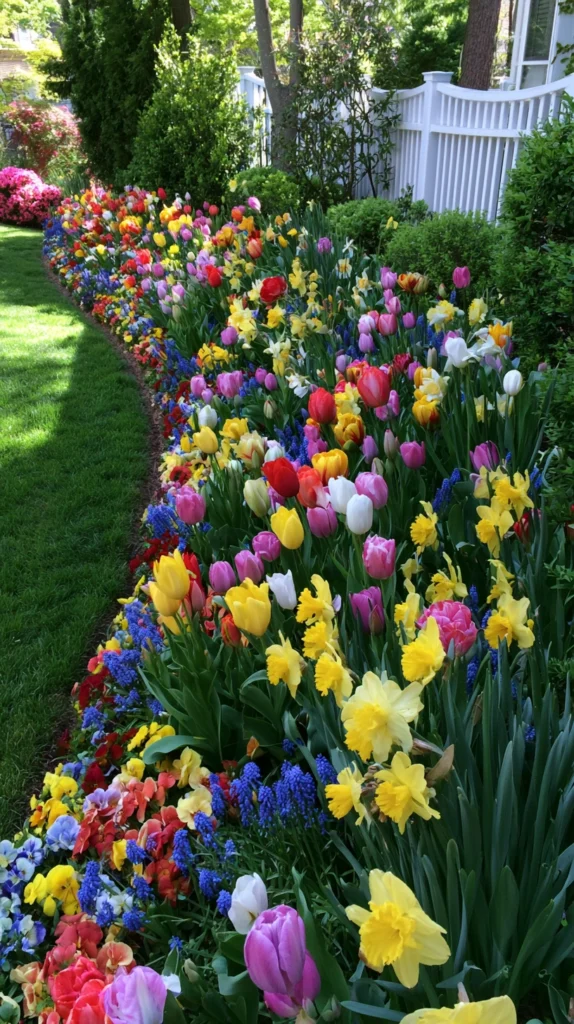
Spring bulbs planted in autumn produce colour at the moment the garden needs it most.
After winter, when the prospect of another year of garden colour feels genuinely distant, a bed of daffodils, tulips, and alliums in April and May delivers the garden’s first significant colour display. The relief and pleasure of the first spring colour is genuinely disproportionate to the effort of planting a bag of bulbs in October.
A dedicated spring bulb bed, planted with early, mid, and late varieties of the same species to extend the display across the whole of spring, provides continuous colour from February through May before the summer perennials take over.
Layer the planting for maximum density and extended season. Plant large daffodil bulbs at the deepest level. Tulips at an intermediate depth on top. Small species tulips, muscari, and miniature narcissi at the shallowest level. Each layer flowers at a slightly different time, and the combined display is denser and longer than any single-layer planting.
Follow the bulbs with summer perennials and annuals that grow through and over the dying bulb foliage as it retreats in May and June. The bulb foliage needs to die back naturally to feed next year’s bulb, but its decline can be hidden beneath the emerging growth of the summer plants that follow.
12. A Gravel Garden Flower Bed
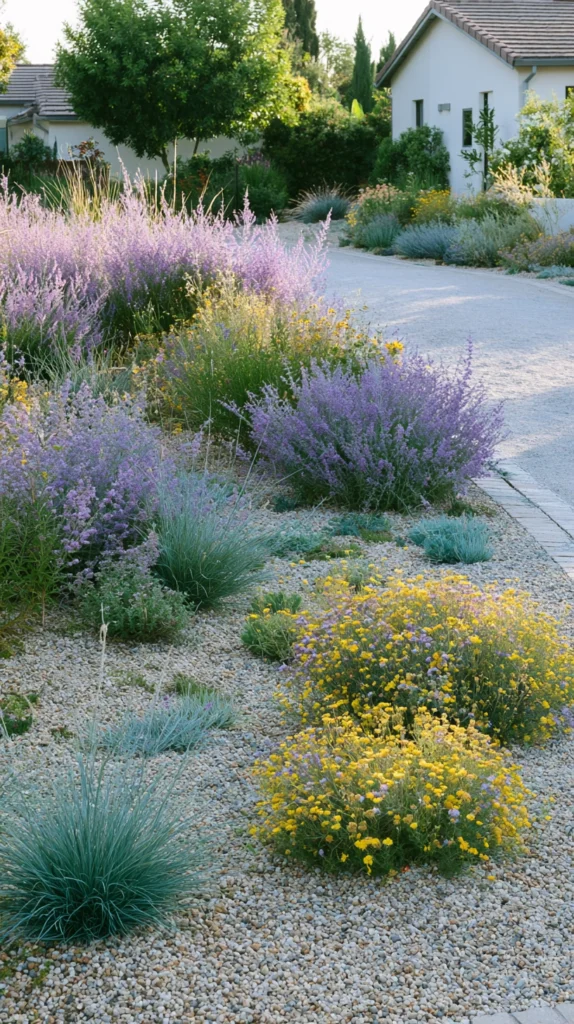
The gravel garden flower bed is the approach that makes difficult, dry, free-draining soil into an asset rather than an obstacle.
A layer of gravel mulch, five to eight centimetres deep, across the surface of a flower bed in poor, dry soil creates a growing environment that naturally moisture-retentive plants find challenging and drought-tolerant plants find perfect. It reduces weed germination dramatically. It improves drainage around the plant crowns where rot most commonly starts. And it creates a surface that looks considered and intentional.
In a gravel garden bed, the plants are chosen for their affinity with dry, open conditions. Sedums in species and variety. Alliums rising from the gravel in spring. Verbascum, with its tall flower spires above felted silver leaves. Salvia nemorosa varieties for midsummer blue-purple. Poppies self-seed into the gravel and appear exactly where they want to be each year.
The gravel garden has a specific aesthetic that sits somewhere between formal and naturalistic. The clean, even surface of the gravel provides visual order. The plants growing through it have the loose, self-directed quality of natural colonisers.
It is the flower bed that looks most like a garden that arrived rather than one that was designed.
13. A Tropical and Exotic Planting Bed for High Summer Drama
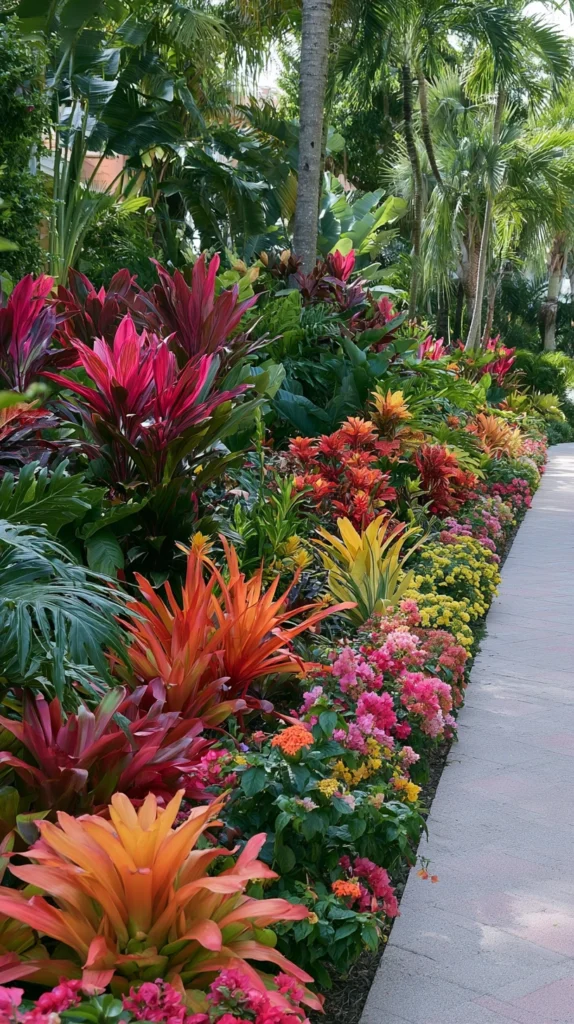
The tropical flower bed is the backyard’s most theatrical summer statement.
Plants with enormous leaves, vivid colours, and architectural forms that would look entirely at home in a botanical garden hothouse create a bed of extraordinary visual drama that peaks from July through September.
Cannas with their paddle-shaped leaves in green, burgundy, and bronze-striped forms, and their vivid red, orange, and yellow flowers. Dahlias in their largest dinner-plate forms. Ginger lilies, Hedychium, with their fragrant white and cream flowers above dramatic leaf stalks. Ricinus communis, the castor bean plant, has enormous bronze or green leaves that bring genuine tropical scale.
These plants are not hardy through winter in temperate climates and are treated as tender perennials or annuals. Canna rhizomes lifted in autumn, overwintered in a frost-free place, and replanted in May provide the same plants more cheaply than buying new ones each year. Dahlias treated the same way reward the small effort of lifting and storing with bigger and more productive plants each successive year.
The tropical bed requires the sunniest, most sheltered position in the garden. A south-facing aspect with a warm wall or fence behind it creates the microclimate that these plants genuinely need to perform at their spectacular best.
14. A Border Along the Fence Line That Transforms the Boundary
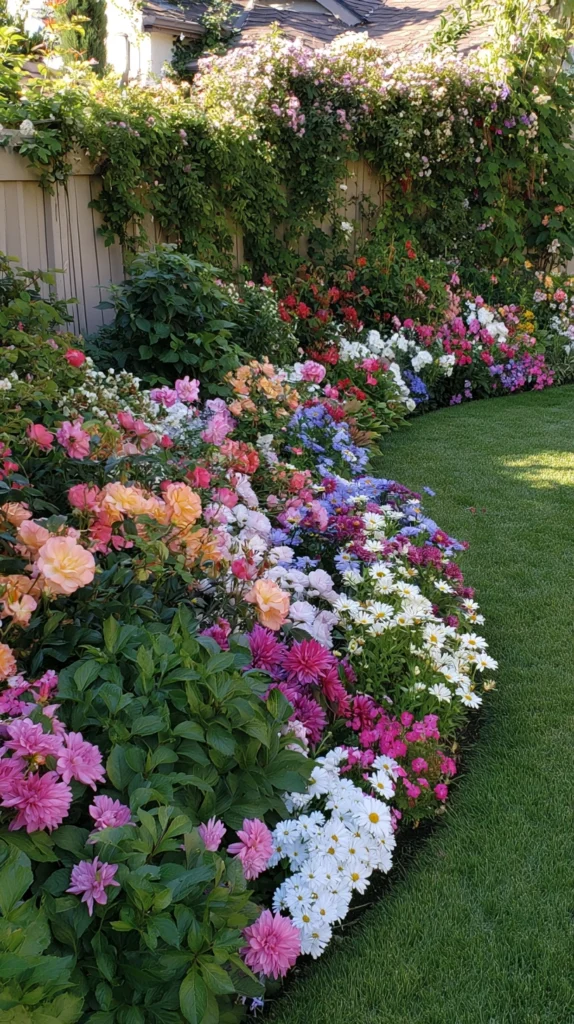
The fence line border is the flower bed that has the highest potential impact on the overall feel of a backyard.
Most garden fences are the most visible and most visually prominent feature of any backyard. They are also, in their bare, panel form, the least attractive. A border of flowering plants along the length of a fence line transforms the most dominant boundary feature from a wall to a backdrop.
The fence becomes something different when it is partially hidden behind planting. Not invisible but contextualised. The flower border uses the fence as support, as a windbreak, and as the backdrop against which its colour reads.
Tall plants at the back close to the fence. Mid-height plants in the middle of the border. Low plants at the front edge. The layered depth creates a border that has form and dimensionality rather than appearing flat.
Climbing plants on the fence surface above the border, roses trained horizontally across the fence panels, and clematis climbing through the fence gaps, add a vertical layer of colour above the horizontal planting below.
A fence entirely hidden behind a layered border with climbing plants above is no longer a fence. It is a living wall. The boundary becomes the planting rather than something to plant in front of.
15. An Island Flower Bed in the Centre of the Lawn
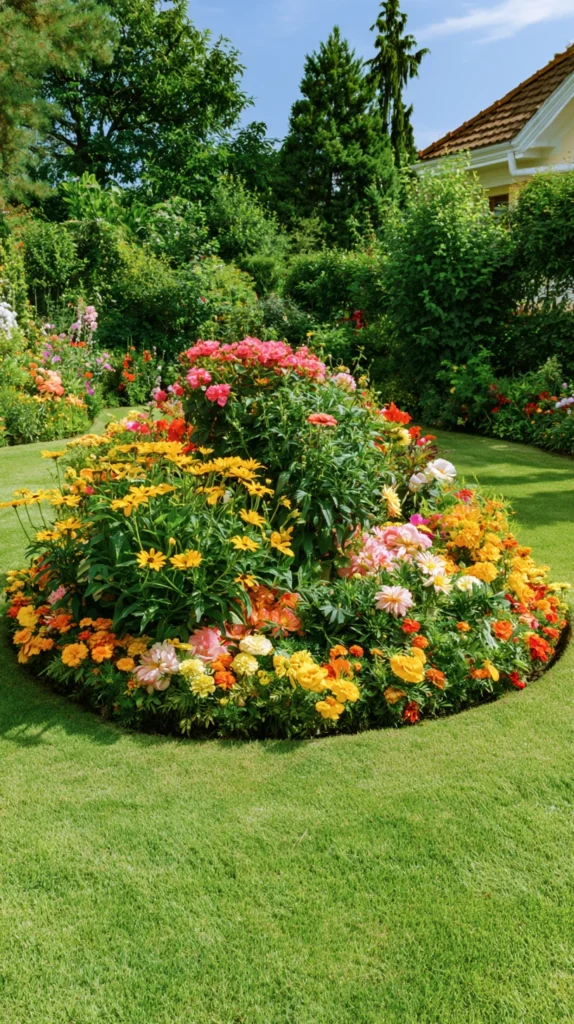
The island bed is the most confident flower bed decision a backyard owner can make.
Taking space from the lawn, specifically from its centre, and filling it with a flower bed that can be seen from every direction simultaneously and from every part of the garden, is the design decision that most dramatically changes the character of a flat, undifferentiated backyard lawn.
An island bed has no single front or back. It is designed to be attractive from 360 degrees. The tallest plants go in the centre. Progressively shorter plants graduate outward to the edges. The effect is of a planted mound, highest at the centre and lower at the perimeter.
A circular or oval island bed reads as more intentional than a rectangular one. The curved form contrasts with the rectangular lawn that surrounds it and creates visual interest through the contrast of forms.
An island bed entirely planted with perennials returns every year and gets better with successive seasons. An island bed of mixed annuals and perennials delivers more immediate colour while the perennial framework establishes.
The island bed changes the experience of the lawn. It creates a space to walk around rather than across. It gives the eye a destination in the centre of the garden rather than at its edges. It turns a flat, open space into a garden with a centre of gravity.
How to Plan a Flower Bed for Maximum Impact With Minimum Maintenance
The highest-maintenance flower bed is the one planted with plants unsuited to the conditions of the site.
The most important design decision for any flower bed is the honest assessment of the actual conditions available. Sun or shade. Wet or dry soil. Exposed or sheltered. Heavy clay or light sand. The plants that suit those conditions will thrive with minimal effort. The plants that do not will consume constant time and resources and fail anyway.
Match plants to conditions first. Add colour preferences second. The gardener who chooses plants by how they look in a catalogue and ignores the site conditions will spend the season rescuing plants that were never suited to the position they were placed in.
Plant densely from the beginning. Sparse planting leaves gaps that weeds fill immediately and enthusiastically. A bed planted at the correct density for each species closes the canopy over the soil within one growing season and suppresses most weed germination by removing the light that weed seeds need to germinate.
Mulch every bed every spring. A five-centimetre layer of compost or bark mulch applied in March before planting has emerged significantly reduces the weed germination that the rest of the growing season would otherwise require constant attention to manage.
Deadhead regularly from July onwards. Removing spent blooms from dahlias, zinnias, cosmos, and most other summer annuals and perennials stimulates the production of new flower buds and extends the flowering season by weeks.
Common Mistakes in Backyard Flower Bed Design
Planting in insufficient sun. The most common cause of disappointing flower beds is that most flowering plants need a minimum of six hours of direct sun per day. A flower bed in partial or full shade needs to be planted with the shade-tolerant species that genuinely suit those conditions.
Choosing plants that peak simultaneously. A flower bed that flowers spectacularly in June and has nothing to show from July onwards has failed at its basic purpose. Stagger the flowering times of plants within the bed across the whole season.
Making the beds too narrow. A border of thirty centimetres depth cannot accommodate the layered planting that makes a flower bed genuinely beautiful. Minimum sixty centimetres for a simple border. Ninety centimetres or more for a mixed perennial planting with the depth to layer multiple plant heights.
Neglecting the soil. Plants are only as good as the soil they are growing in. The investment in good compost and organic matter before planting pays back in every subsequent season through improved plant performance and reduced maintenance.
Planting and forgetting. A flower bed is not a set-it-and-forget-it garden element. Perennials need dividing every three to five years. Annuals need replacing each season. Dead material needs removing. Edges need re-cutting annually. A fifteen-minute weekly visit to the flower bed through the growing season is the minimum maintenance requirement for a bed that continues to look good.
Starting too large. A large flower bed poorly maintained looks worse than a small bed well maintained. Start with the area you can genuinely manage and expand as experience and confidence grow.
Quick Summary
- A mixed perennial border layers plants that flower at different times to deliver colour from spring through the first frost
- A cottage garden bed combines annuals, perennials, and self-seeders in a deliberately informal mix that forgives planning imperfections
- A hot colour border of dahlias, crocosmia, and rudbeckia in red, orange, and yellow creates maximum visual energy
- A cool colour bed of agapanthus, salvias, and catmint uses receding blues and purples to create depth and calm
- A shaded woodland bed beneath trees uses hellebores, hostas, and ferns to turn a difficult condition into a beautiful one
- A raised flower bed improves drainage, adds visual height, and makes planting accessible regardless of the soil below
- A pollinator bed planted with single-flowered, nectar-rich species creates audible, visible insect activity on warm summer days
- A fragrance bed planted with evening-scented species transforms the experience of sitting outdoors at dusk
- A cutting garden bed provides fresh stems for indoor arrangements from June through October without any florist involvement
- A drought-tolerant Mediterranean bed of lavender, cistus, and salvias requires almost no water after the first establishment year
- A spring bulb bed planted in autumn delivers the garden’s first and most welcome colour display from February through May
- A gravel garden bed with drought-tolerant plants in a gravel mulch reduces watering, improves drainage, and rewards difficult dry conditions
- A tropical planting bed of cannas, dahlias, and ginger lilies creates the most theatrically dramatic summer display available
- A fence line border transforms the most dominant and least attractive backyard feature into a layered living wall
- An island bed in the centre of the lawn gives the garden a centre of gravity and changes the entire character of the outdoor space
- Always match plants to site conditions before choosing by colour, plant at a density that closes the canopy, and mulch every spring
A backyard with flower beds is a different kind of outdoor space from one without them.
More alive. More interesting. More worth being in at every time of day and every point in the growing season.
The gap between the two is almost always just a decision about where the first bed goes and what goes in it.
Make that decision this weekend.
The colour follows as soon as the plants are in the ground.