
15 Spring Mudroom Refresh Ideas for a Cleaner Entry
The mudroom is the room that works hardest in any home and gets thanked for it least. It absorbs the chaos of daily life — wet boots, tangled dog leads, abandoned backpacks, dripping umbrellas, and the accumulated debris of a family moving in and out of the world — and it does so without complaint, season after season.
But when spring arrives and the quality of light changes, when the door gets opened more frequently, and the traffic in and out of the house intensifies, the mudroom either rises to the occasion or becomes an obstacle.

A spring refresh doesn’t require a full renovation. With the right ideas and a focused weekend, you can transform your entry from a stress point into a space that actually sets the tone for a calmer, more organized home. Here are 15 ideas to get you started.
1. Start with a Full Clearout

Every meaningful refresh begins with removal rather than addition. Before you buy a single hook or basket, empty the mudroom. Pull out every boot, bag, coat, and forgotten item and lay them somewhere you can assess it honestly.
Winter coats that are too heavy for the coming months should be cleaned and stored elsewhere — in a wardrobe, under a bed, or in vacuum storage bags that compress them into a fraction of their original volume. Boots caked in winter mud should be cleaned before being stored or donated.
Children’s outgrown shoes, broken umbrellas, single gloves without partners, and sports equipment from activities nobody does anymore should all leave the mudroom for good. What remains after the edit should be only what the household genuinely uses during the spring and summer months ahead.
2. Repaint in a Fresh, Welcoming Color
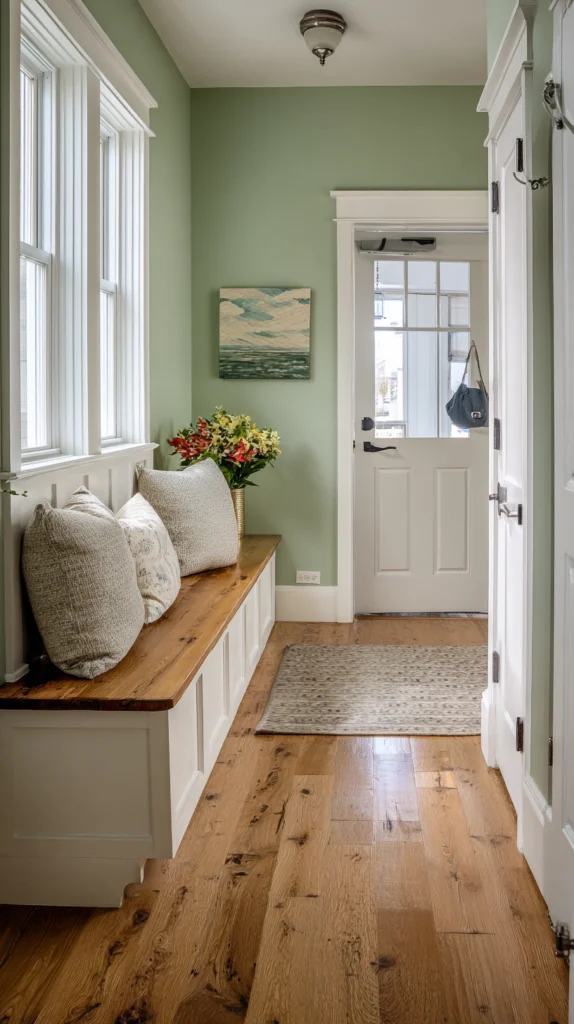
Few things refresh a room as quickly or as dramatically as a coat of paint, and the mudroom is a particularly rewarding space to repaint because it is usually small enough to complete in a single day. For spring, move away from the dark, moody tones that suit a winter entry and toward something lighter and more welcoming.
A warm white, a soft sage green, a pale clay, or a fresh linen tone instantly makes the mudroom feel cleaner, larger, and more inviting. If you want to be bolder, a deep navy or a rich forest green on a single accent wall or the door itself can make a small mudroom feel jewel-like and considered. Use a durable, washable paint finish — eggshell or satin — that can withstand the inevitable scuffs and splashes of a high-traffic entry space.
3. Upgrade Your Hook System

Hooks are the backbone of any functional mudroom, and if yours are insufficient, poorly positioned, or simply ugly, spring is the time to address them.
The ideal hook system has hooks at multiple heights — adult height for coats and bags, a lower row for children’s items and dog leads, and perhaps a highest row for rarely needed items like sun hats and spare bags. Double hooks that hold both a coat and a bag on the same fixture are particularly practical for small mudrooms where wall space is limited.
Choose hooks in a finish that complements your refresh — matte black for a modern or Japandi-inspired entry, antique brass for something warmer and more traditional, or painted ceramic hooks for a cottage or grandmillennial aesthetic.
4. Install a Built-In Bench with Storage Beneath

A bench in the mudroom solves two problems simultaneously — it gives people somewhere to sit while removing and putting on shoes, and it creates an opportunity for concealed storage beneath. A built-in bench with a hinged lid that opens to reveal a deep storage cavity below is one of the most useful pieces of mudroom furniture you can invest in.
Use the cavity beneath the bench for seasonal items, spare bags, sports equipment, and anything that needs to be accessible but not permanently on display. If a built-in bench is beyond the current budget, a freestanding storage bench with baskets or drawers below serves the same function and can be taken with you if you move.
5. Add a Boot Tray or Drying Rack

Wet and muddy footwear is the mudroom’s primary challenge, and a dedicated boot tray is the simplest and most effective solution to the problem of dirt being tracked through the house. A wide, deep tray in metal, rubber, or galvanized steel placed directly inside the door gives every household member a clear, designated place for outdoor shoes and boots.
For spring, when rain is frequent,t and footwear gets genuinely wet, pair the boot tray with a small drying rack that allows boots and shoes to air properly rather than sitting in a puddle of their own moisture. A boot scraper positioned just outside the door adds a final line of defense against mud entering the house at all.
6. Introduce Seasonal Baskets and Bins
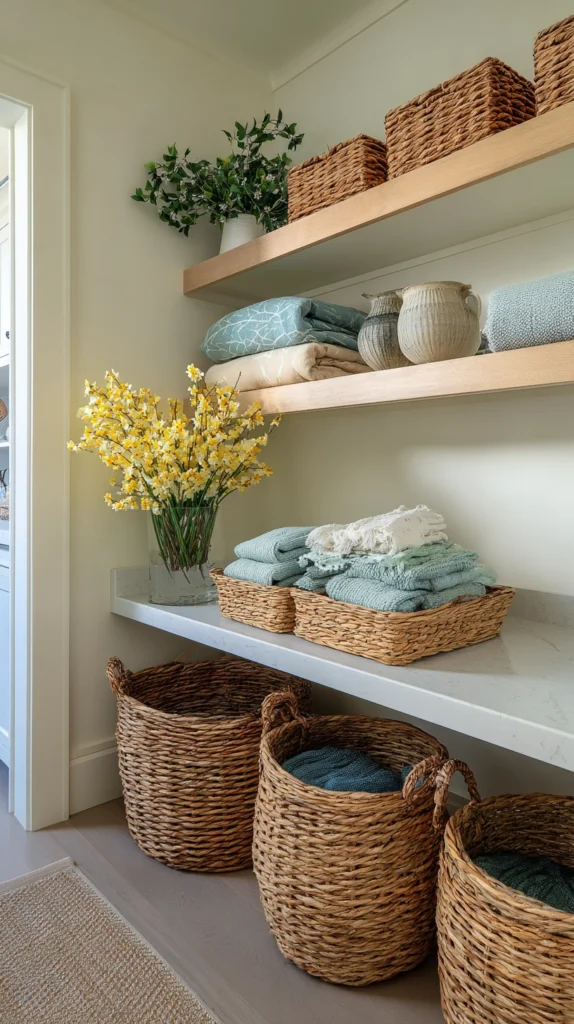
The organizational power of baskets and bins in a mudroom cannot be overstated. Individual labeled baskets — one per family member — eliminate the argument about whose belongings are cluttering the shared space and give everyone personal responsibility for their own corner of the entry.
For spring, swap out the heavy, dark winter storage bins for something lighter and more seasonal — natural seagrass baskets, whitewashed wicker, or simple cotton canvas bins in soft natural tones.
Label each basket clearly with the occupant’s name, and establish from the beginning of the season that bags, hats, and small personal items live in their designated basket rather than on the floor or the bench.
7. Create a Dedicated Dog Zone
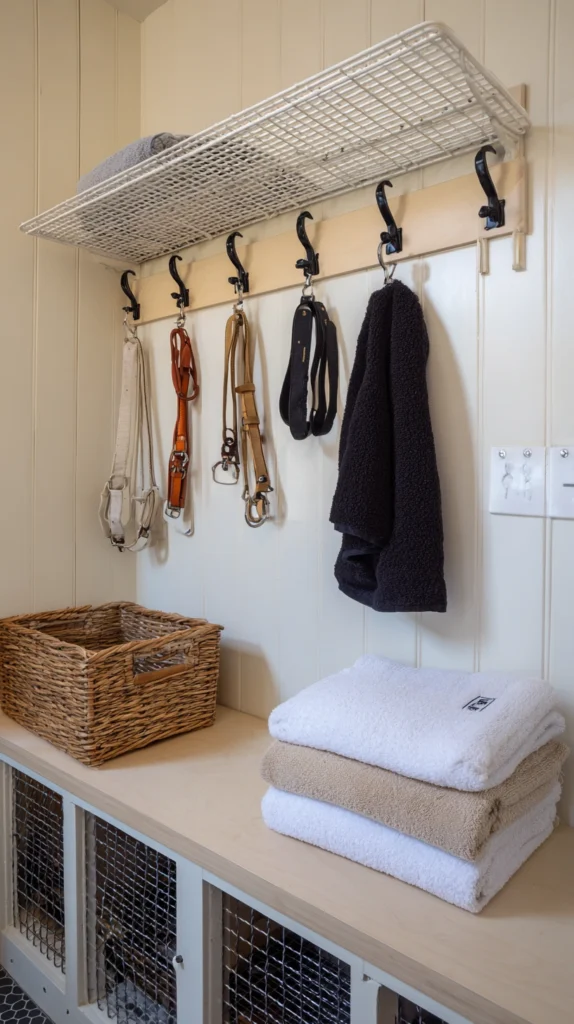
For households with dogs, the mudroom takes on an additional dimension of complexity — wet paws, leads, harnesses, waste bags, and the general chaos of a muddy animal re-entering the house need to be managed without contaminating the rest of the entry. A dedicated dog zone within the mudroom addresses this directly.
A low hook for leads and harnesses, a small shelf or basket for waste bags and treats, a waterproof mat for paw wiping, and a dedicated towel hanging from a low hook for post-walk drying are all that’s needed. Some mudrooms incorporate a small built-in dog wash station with a handheld showerhead — an investment that pays for itself within the first muddy spring walk.
8. Hang a Mirror to Brighten and Open the Space

A mirror in the mudroom serves both a practical and a spatial purpose. Practically, it gives household members a final opportunity to check their appearance before leaving the house — an underrated convenience that people miss immediately when the mirror isn’t there.
Spatially, a well-positioned mirror reflects light into what is often a dark, windowless, or poorly lit entry, making the space feel dramatically larger and more welcoming.
Choose a mirror with a frame that suits your refresh — a simple round mirror with a thin brass frame for a modern look, an arched mirror with a natural rattan frame for something more organic, or a larger rectangular mirror with a painted wooden frame for a classic entry aesthetic.
9. Refresh the Flooring with a New Mat or Runner

The floor of the mudroom endures more punishment than any other surface in the house, and even the most beautifully organized mudroom will look tired if the flooring is worn, stained, or simply wrong for the space. If replacing the floor itself isn’t currently feasible, a new mat or runner can make a striking difference.
For spring, choose a natural fiber mat — coir, jute, or sisal — that scrubs mud from shoes effectively while looking handsome doing it. A longer runner in a durable indoor-outdoor fabric can define the entry corridor and add color or pattern to a neutral mudroom. Ensure whatever you choose is easy to clean — machine washable for fabric options, or simply hoseable outdoors for natural fiber mats.
10. Add a Charging Station for Devices
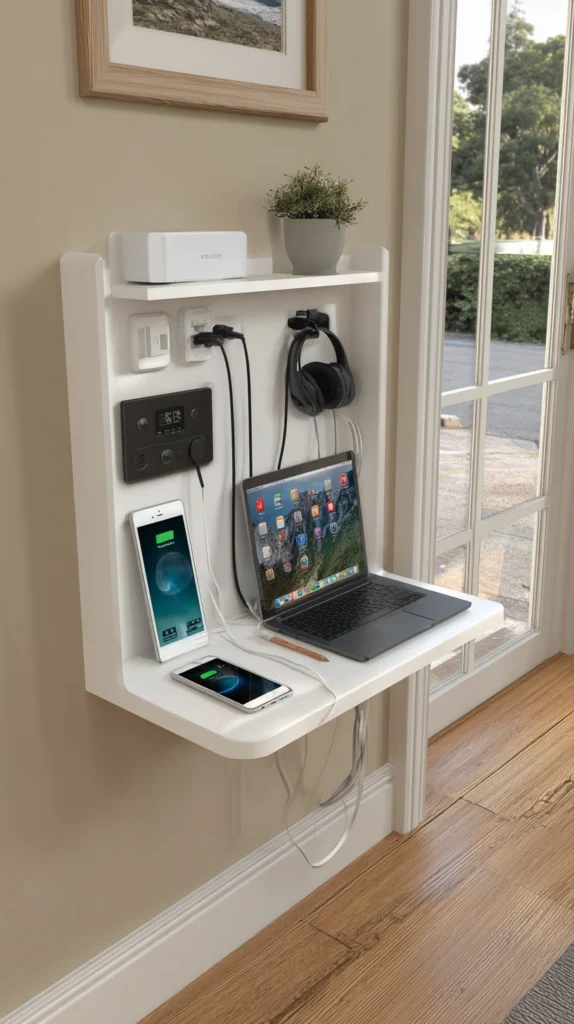
The modern mudroom is increasingly the place where devices come to charge — phones, tablets, wireless earbuds, and anything else the household carries in and out of the world daily.
Rather than allowing charging cables to snake across the bench or floor in a tangle, integrating a small, dedicated charging station into the mudroom design keeps devices organized, cables managed, and ensures everything is fully charged and ready to leave with its owner in the morning.
A small shelf with a multi-port charging hub installed behind it, with cable management clips keeping each cable tidy and labeled, is a practical addition that takes less than an afternoon to set up and removes a daily source of household friction.
11. Bring in Spring with a Small Botanical Touch
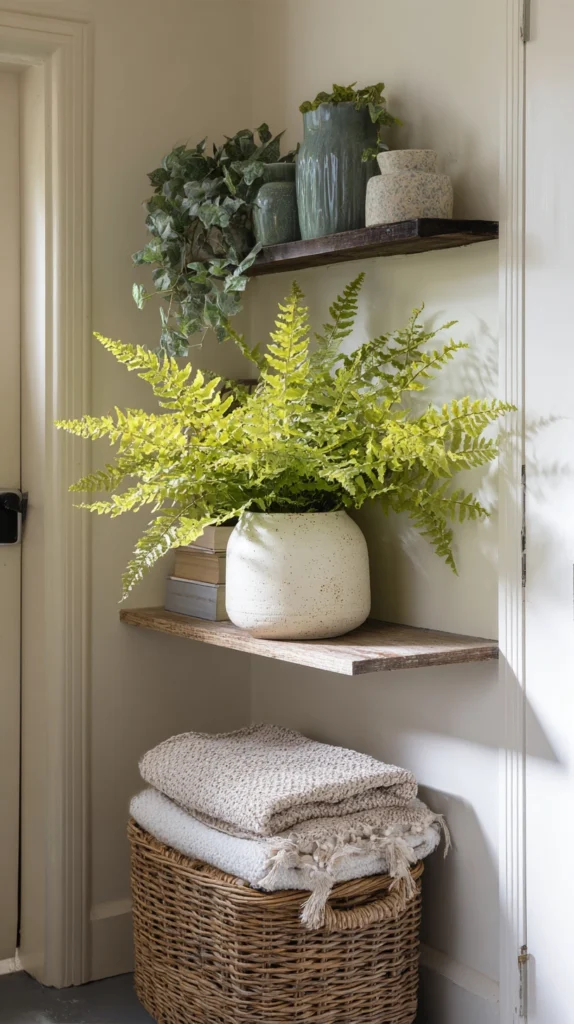
The mudroom is the first interior space your home offers to anyone who enters, and a small botanical touch — nothing elaborate, nothing high-maintenance — signals the season and sets a welcoming tone.
A small potted plant on a shelf or windowsill, a simple vase of fresh seasonal stems on the bench, or a spring wreath hung on the interior wall of the mudroom rather than the exterior door all work beautifully.
Choose plants that tolerate lower light and the temperature fluctuations of an entry space — a small fern, a trailing pothos, or a succulent all manage the mudroom environment well. The botanical element doesn’t need to be large to be effective — even a single stem in a bud vase communicates care and intentionality.
12. Install Proper Lighting
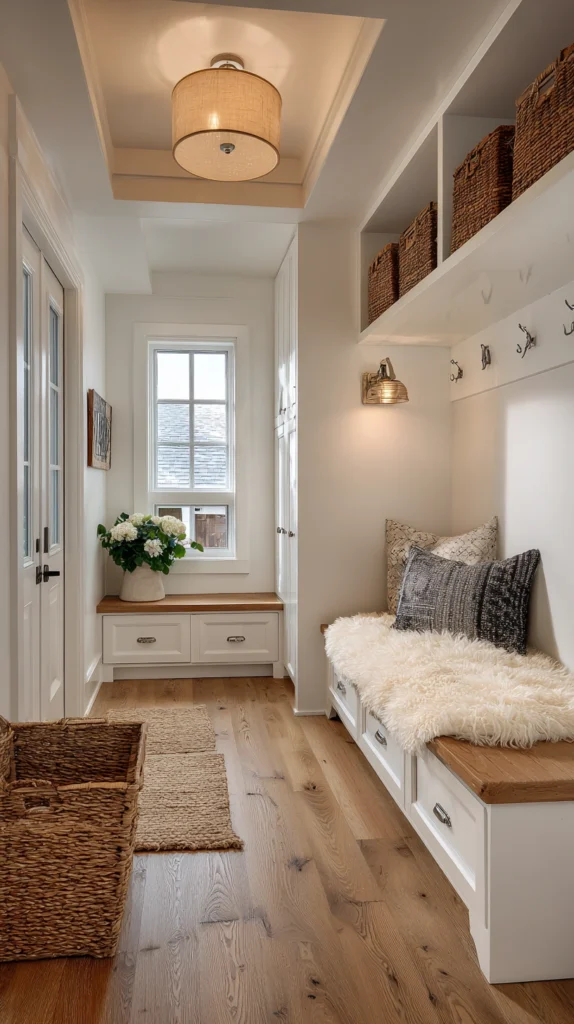
Mudrooms are chronically underlighted, and this single deficiency makes every other organizational effort harder to appreciate. Good lighting in a mudroom means being able to find items quickly, see the floor clearly, and experience the entry as a welcoming rather than a dim and slightly dispiriting space. If overhead lighting is fixed and insufficient, add a plug-in wall sconce on either side of the mirror or above the bench.
Battery-powered LED lights installed inside storage cabinets illuminate the contents without requiring electrical work. A statement pendant light, where ceiling height allows, can transform the mudroom from a purely utilitarian space into something that feels genuinely designed.
13. Establish a Launching Pad System

A launching pad is the organizational concept of designating a specific surface or zone in the mudroom where everything needed for the next day is prepared and waiting the night before. School bags packed and hanging on their hooks. Keys in their designated dish. Sunglasses on their shelf. Permission slips in the outgoing mail tray. Sports kit in its bag by the door.
The launching pad system doesn’t require any additional furniture or storage — it simply requires a commitment to using the mudroom proactively rather than reactively. Introduce it as a family habit at the start of spring, when routines are being refreshed along with the physical space, and the morning chaos that so often begins in the mudroom will diminish almost immediately.
14. Use Vertical Wall Space for a Family Command Center
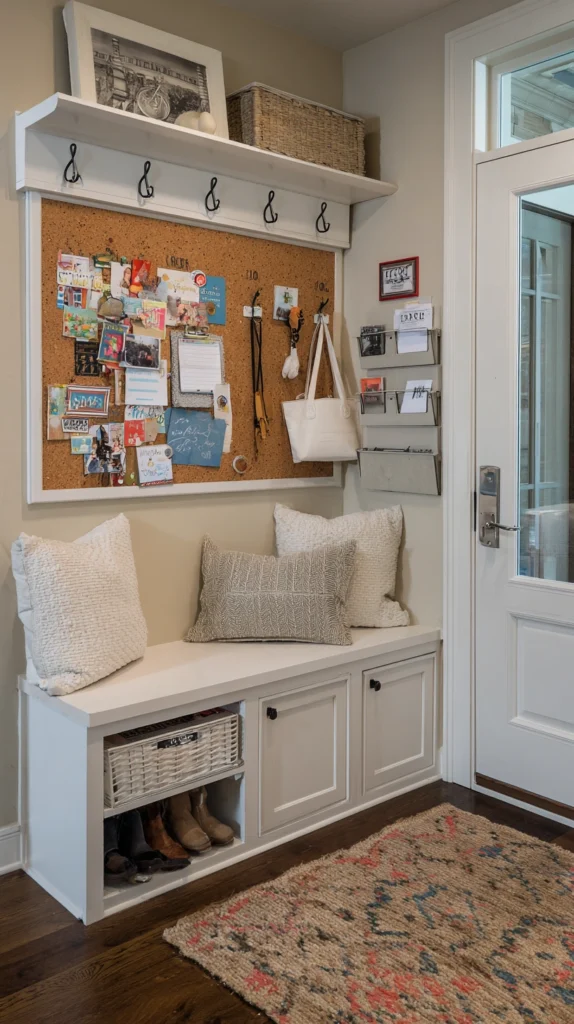
The wall above the main hook and bench area in a mudroom is prime real estate that many households leave entirely blank. A family command center — a coordinated arrangement of a wall calendar, a corkboard for notices and reminders, a small whiteboard for messages, and perhaps a row of individual mail slots for each family member — transforms this wall into the household’s organizational nerve center.
Contain it within a defined wall area so it looks intentional rather than chaotic, and choose components that coordinate visually — matching frames, a consistent color palette, and uniform labeling. A well-designed command center reduces the number of missed appointments, forgotten permission slips, and unanswered messages that create household stress.
15. Finish with a Signature Scent
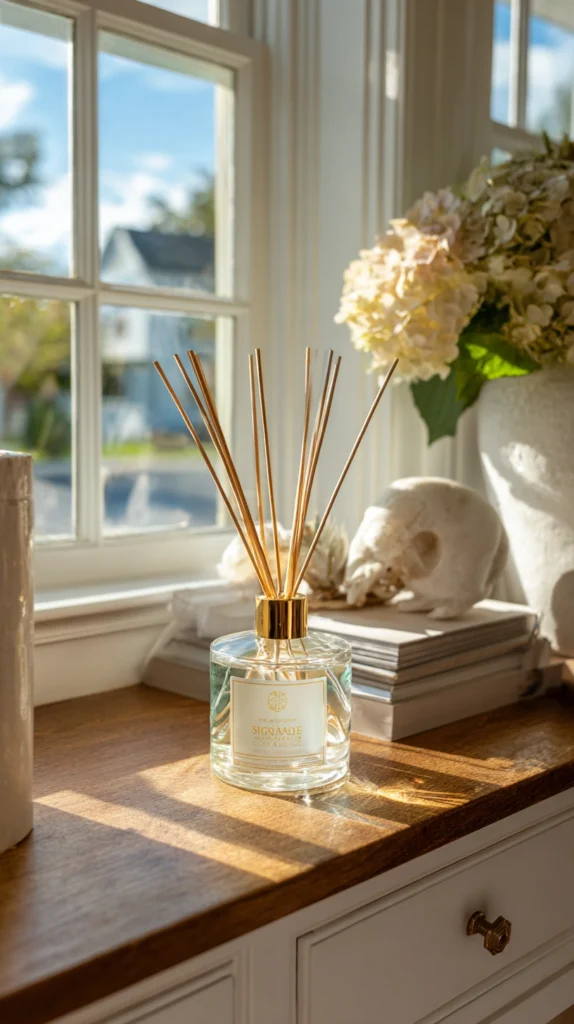
The final and most sensory mudroom refresh idea is about smell rather than sight. The mudroom has a natural tendency toward damp boots, wet dog, and general outdoor odors that no amount of organization can eliminates.
Counteracting this with a signature scent — something clean, botanical, and uplifting — transforms the experience of entering the home entirely. A reed diffuser in a spring scent like eucalyptus and mint, white tea, or fresh linen, placed on a high shelf where it won’t be knocked over. A small candle on the bench, lit for the hour before the household returns in the evening.
A linen spray was misted onto the bench cushion and the fabric storage bins. Scent is the most immediate and emotionally resonant sense — get it right in the mudroom and every entry into your home becomes, however briefly, a genuinely pleasant experience.
The Mudroom as a Reset Button
A refreshed mudroom does something quietly powerful for the whole household — it establishes that order is possible, that transitions between inside and outside life can be managed with grace, and that even the most functional spaces deserve care and intention. When the entry works well, the rest of the home tends to follow.