15 Inspiring Outdoor Tortoise Enclosure Ideas
The outdoor tortoise enclosure is one of those animal husbandry projects that rewards genuine design thinking far more than most people anticipate when they first acquire a tortoise. The tortoise, with its slow pace and apparently simple needs, gives the impression of being an easy animal to accommodate — a box, some soil, a water dish, and a heat lamp, the assumption goes, should be sufficient. It is not.
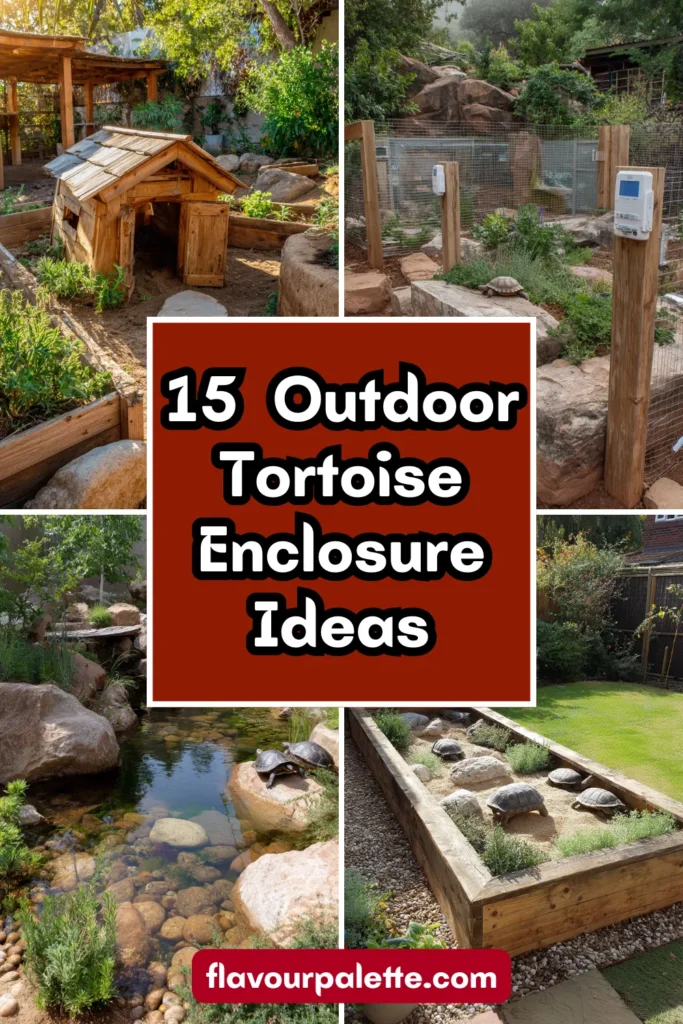
The domestic tortoise in its native habitat is an animal that travels significant distances daily across varied terrain, forages through complex plant communities, thermoregulates across a gradient of sun and shade, and engages with a sophisticated sensory environment of texture, scent, temperature variation, and natural substrate.
The welfare gap between a tortoise kept in a minimal enclosure and one kept in a well-designed outdoor environment that replicates the complexity of its native habitat is enormous — in longevity, in behavioral richness, in immune function, and in the quality of the daily experience that the animal has.
The outdoor tortoise enclosure, properly designed and properly maintained, is also one of the most visually beautiful and most personally rewarding garden projects available to any animal keeper, creating a miniature landscape of considerable horticultural and aesthetic interest that benefits the garden as well as the tortoise. Here are fifteen ideas for building one that achieves both ambitions completely.
1. A Raised Timber Bed Enclosure for Drainage and Visibility
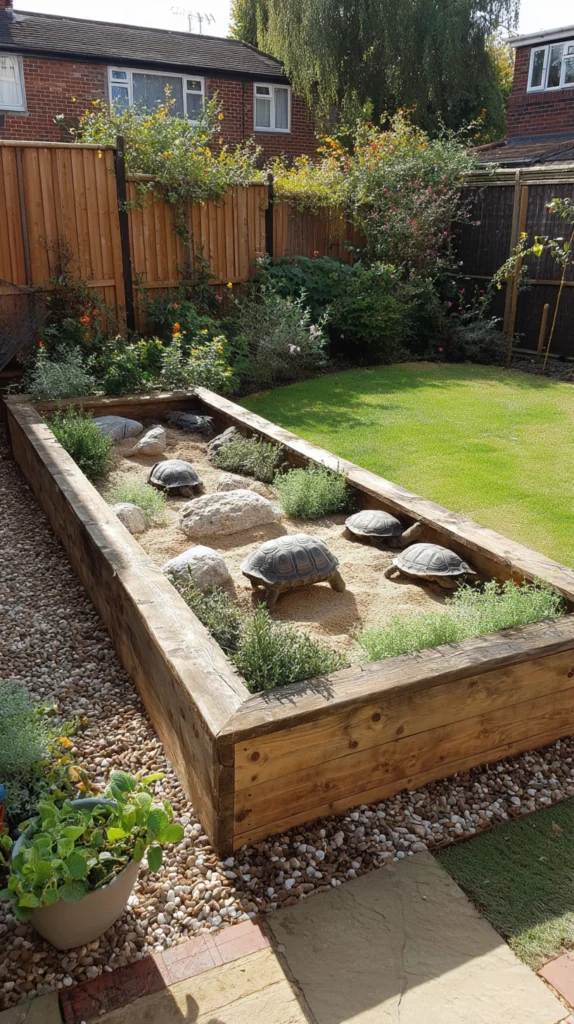
The raised timber bed tortoise enclosure — constructed from treated timber sleepers, hardwood planks, or reclaimed timber boards stacked to a height of thirty to forty-five centimeters above the surrounding garden level — is the most accessible, most cost-effective, and most frequently recommended starting point for the outdoor tortoise keeper, combining the practical benefits of excellent drainage, improved soil warming, and easy predator management with the visual appeal of a raised garden bed that integrates naturally into most garden contexts.
The raised format provides superior drainage compared to a ground-level enclosure, which is critical for tortoises — waterlogged substrate is one of the most common and most damaging environmental conditions in outdoor tortoise keeping, leading to respiratory infections and shell problems that a well-drained raised bed prevents.
The timber sides should be of sufficient height — a minimum of thirty centimeters above the internal substrate level — to prevent the escape of most tortoise species, and the corners should be curved or filled to prevent the tortoise from using the corner’s leverage to climb.
Fill the raised bed with a substrate appropriate to the specific tortoise species — a mixture of topsoil and horticultural sand in approximately equal proportions suits most Mediterranean species, providing drainage alongside the moisture retention that the animals need.
2. A Mediterranean Landscape Tortoise Garden
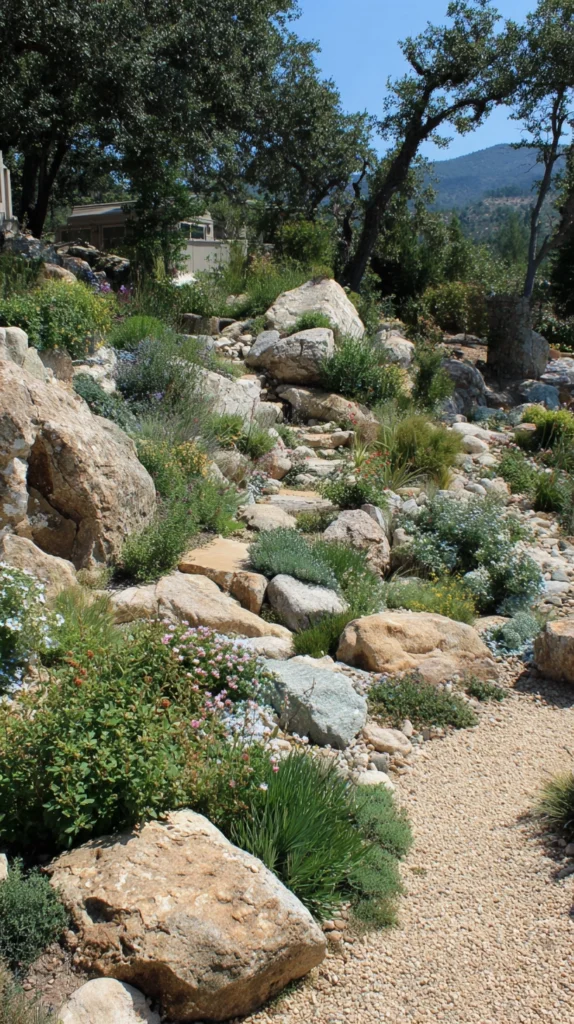
The Mediterranean landscape enclosure takes the tortoise’s specific geographic and ecological origin as its design brief, creating a miniature version of the scrubby, rocky, sun-drenched landscapes of southern Europe and the Mediterranean basin, where most of the commonly kept tortoise species — Hermann’s tortoises, spur-thighed tortoises, marginated tortoises — evolved and to which their behavioral and physiological systems remain adapted.
This enclosure style uses irregular stone placement — flat stones embedded at varying angles to create basking surfaces, rocky outcrops for shade and shelter, and textured terrain that encourages the walking, climbing, and foraging behaviors that flat-surface enclosures cannot stimulate.
Plant the enclosure with Mediterranean species appropriate to tortoise consumption: thyme, rosemary, oregano, Mediterranean sage, various sedum species, and the drought-tolerant plants that provide both food and the structural complexity of a proper habitat.
The visual result of a well-planted Mediterranean tortoise garden is an enclosure of considerable horticultural beauty that could sit attractively in any garden, regardless of its primary function as animal housing.
3. An Integrated Pond and Tortoise Zone
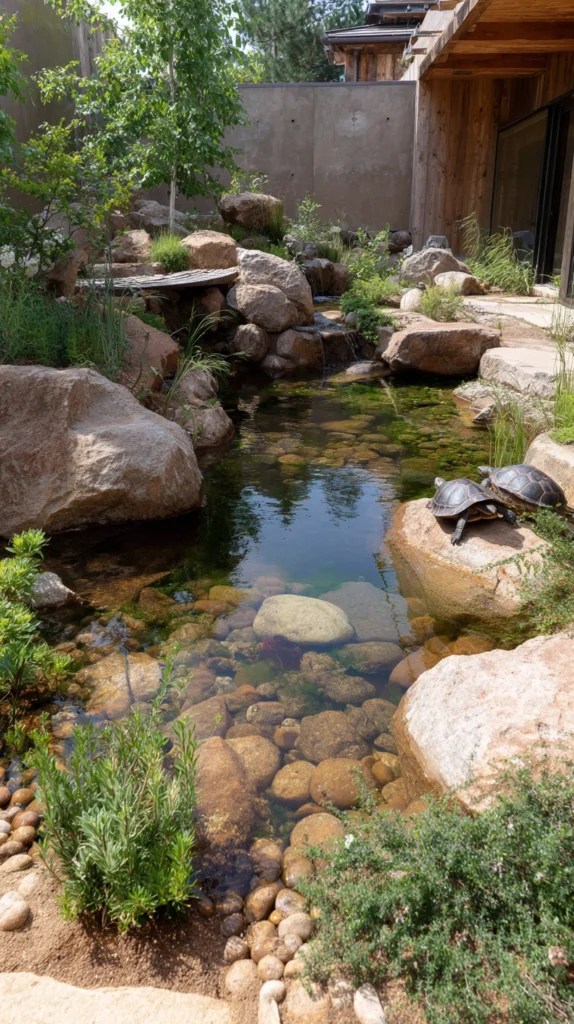
Many tortoise species — particularly the semi-aquatic and water-loving varieties — benefit from access to shallow water for soaking, hydration, and the thermoregulatory function that water immersion provides in hot weather.
An outdoor enclosure that integrates a very shallow soaking pond — no more than three to five centimeters of water at its deepest point, with gently sloping entry and exit sides that the tortoise can navigate safely without risk of flipping or drowning — within the broader enclosure landscape creates a habitat of greater complexity and welfare value than a purely terrestrial enclosure.
The pond should have a smooth, non-slip surface at its shallowest approach — large smooth pebbles or fine gravel laid in a thin layer — and should be designed so that the tortoise can enter and exit without assistance in every weather condition it will encounter. Position the pond in the enclosure’s most sunny area for maximum water temperature and for the thermoregulatory benefit that warm water soaking provides.
4. A Fully Planted Edible Landscape Enclosure
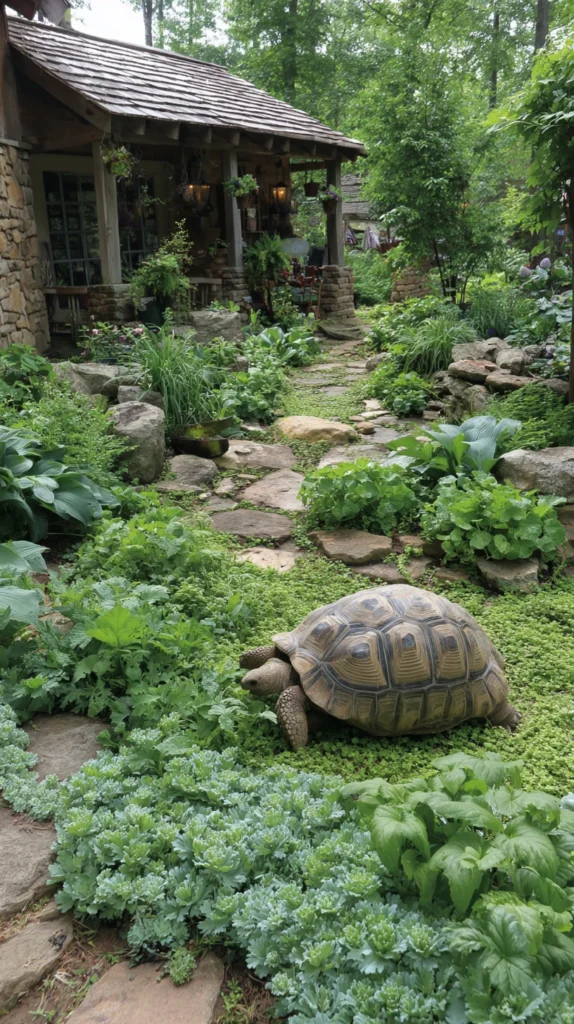
The enclosure planted entirely with species that the tortoise can and will eat — a living, productive landscape in which the tortoise is both inhabitant and harvester — creates the most naturalistic and the most behaviorally enriching outdoor tortoise environment available, providing the continuous, varied foraging opportunities that the wild tortoise experiences as a fundamental daily activity.
The edible landscape enclosure requires knowledge of the specific tortoise species’ dietary requirements and preferences, and a planting scheme calibrated accordingly.
For Mediterranean species, the palette includes dandelion, clover, plantain, hawkbit, various vetches, opuntia cactus pads, sedum, and the herbs listed in the Mediterranean landscape section above. For grassland species, native grasses and meadow wildflowers provide the foraging substrate.
The planting should be dense enough to require genuine foraging — thin plantings that are consumed within the first week provide no ongoing foraging value — and robust enough to recover between grazing sessions, which requires rotating the tortoise’s access across different planting zones.
5. A Predator-Proof Fully Enclosed Run
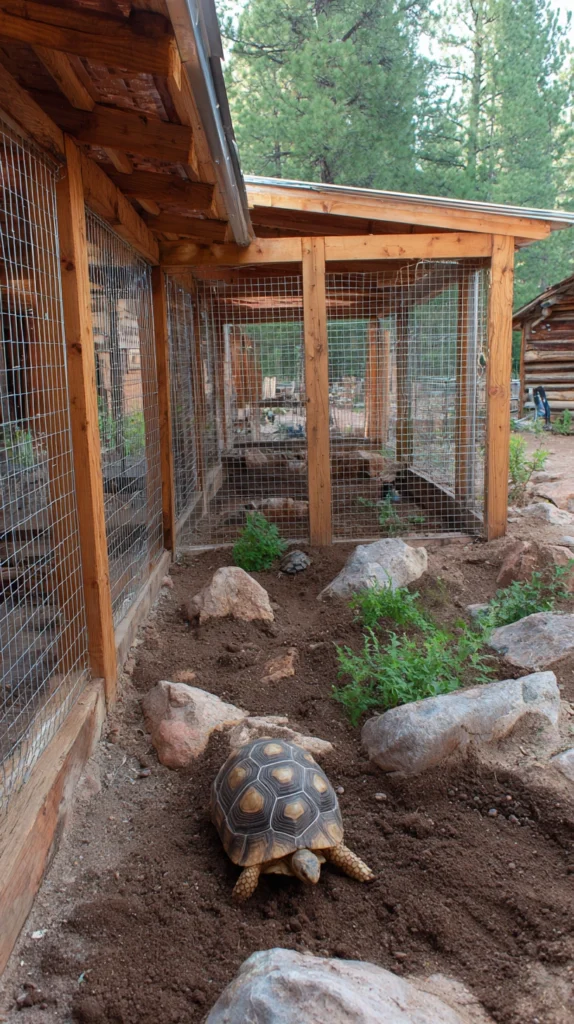
The tortoise enclosure without a predator-proof overhead covering is an enclosure whose occupants are vulnerable to the birds of prey, foxes, and cats that represent the most common predatory threats to outdoor tortoises in most temperate climates.
A fully enclosed run — wire mesh on all sides and overhead, with a secure latching door for keeper access — provides complete predator protection at the cost of some visual openness, and in gardens where predator pressure is high, the trade-off is unambiguously worth making.
The overhead covering should be in a galvanized welded mesh of sufficient gauge to resist a determined fox — fourteen gauge or heavier — and should be angled or peaked to prevent the accumulation of standing water and to shed leaf debris.
The wire mesh sides should extend below the soil surface as a horizontal apron — at least thirty centimeters buried outward from the enclosure perimeter — to prevent burrowing predators from undermining the enclosure boundary. Choose a mesh aperture size that prevents the insertion of a fox’s muzzle — no larger than twenty-five millimeters square for the lower sections of the enclosure walls.
6. A Tortoise House with Outdoor Run Combination
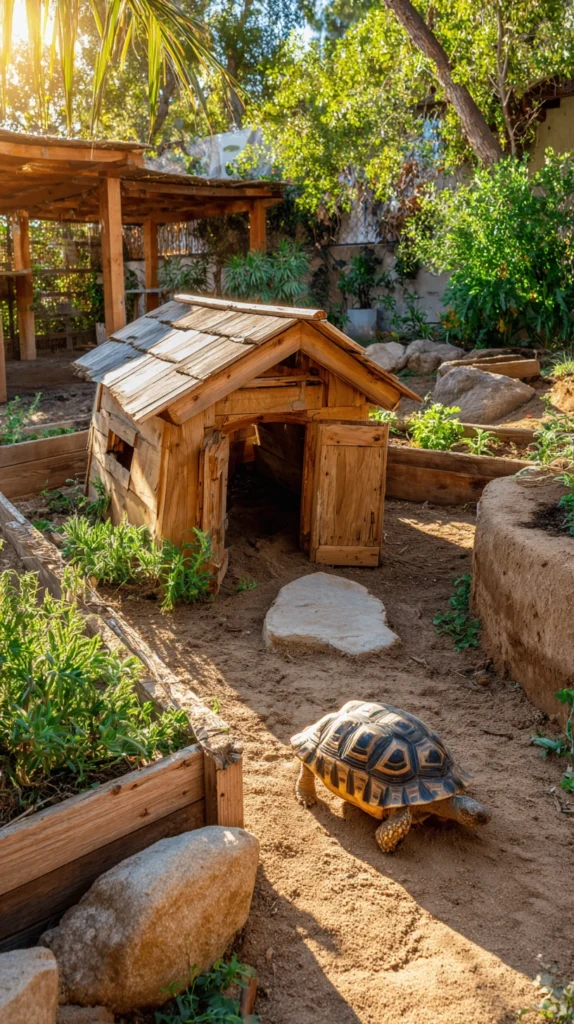
The most complete outdoor tortoise housing system combines a properly insulated, properly ventilated tortoise house — the sleeping and shelter structure — with an adjacent outdoor run that the tortoise can access independently through a connecting door or flap during appropriate weather conditions.
The tortoise house provides the dry, wind-protected, temperature-stable sleeping environment that the tortoise requires for overnight and cool-weather conditions, and the outdoor run provides the space, light, warmth, and environmental complexity for the active foraging period of the warm daytime hours.
The connection between house and run should be simple and self-operable by the tortoise — a low-threshold opening that the animal can push through independently — and the house temperature should be maintained with a thermostatically controlled heat source for the cooler months at the shoulder of the outdoor season.
The exterior of the tortoise house can be designed with the same aesthetic care as any other garden building — painted timber, a green sedum roof, a slate or tile roof — to create a garden structure of genuine character.
7. A Bioactive Substrate Enclosure with Naturalistic Soil Ecosystem
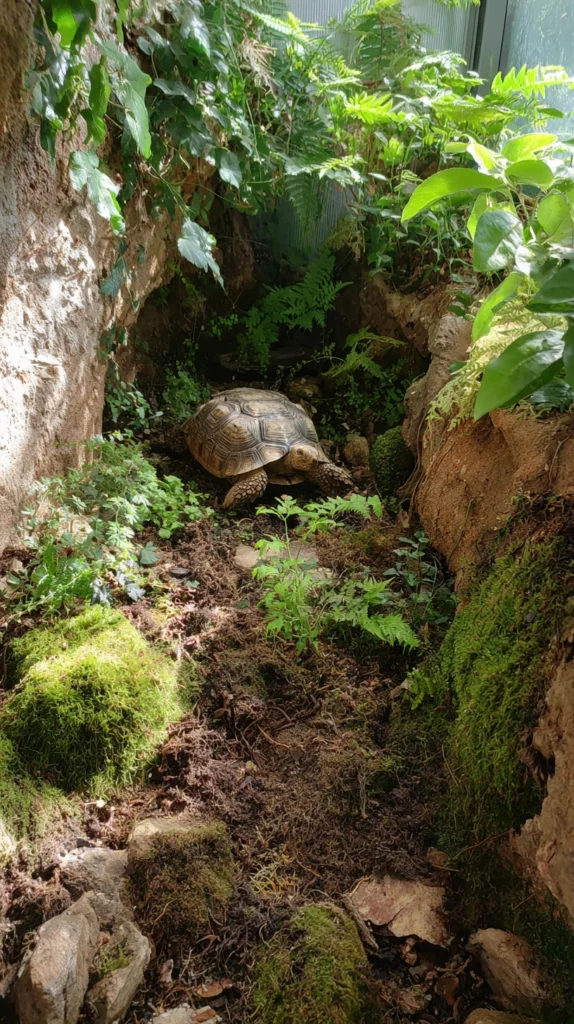
The bioactive tortoise enclosure — one whose substrate is not simply soil and sand but a living ecosystem of beneficial microorganisms, invertebrates, and plant root systems that process waste, cycle nutrients, and maintain the substrate’s health without regular complete replacement — is the most ecologically sophisticated outdoor tortoise keeping approach available and the one that produces the most genuinely naturalistic environment for the animal.
A bioactive substrate is established by inoculating the enclosure’s soil with a healthy population of springtails and isopods — tiny invertebrates that consume organic waste before it can accumulate to problematic levels — and by planting the substrate densely enough that root systems create the soil structure that supports the invertebrate community.
The bioactive enclosure requires less frequent substrate replacement than a conventional soil substrate, maintains better microbial balance, and provides the tortoise with a genuinely complex soil environment to explore and forage within.
8. A Tiered Terrain Enclosure for Behavioral Complexity
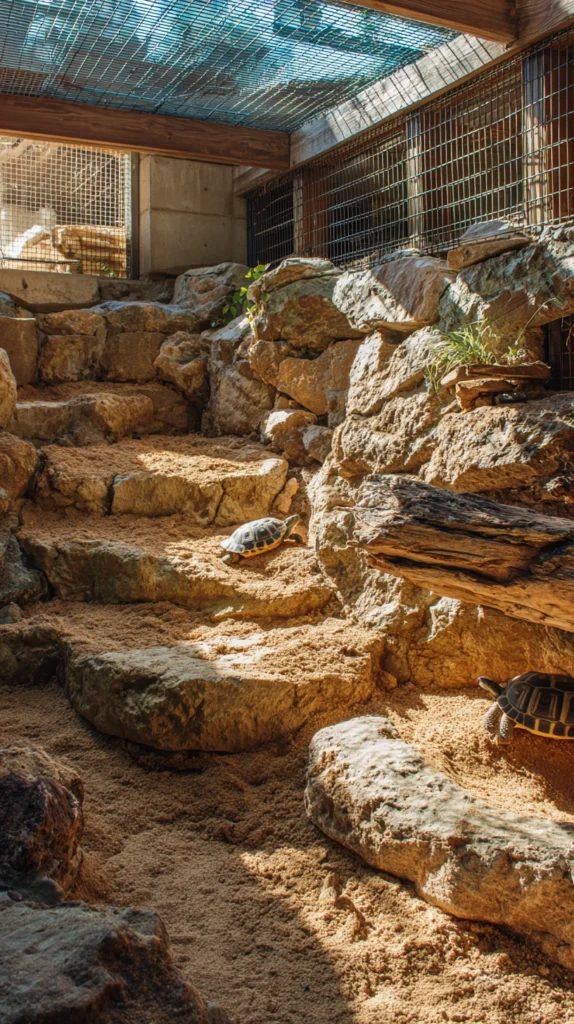
The flat-bottomed enclosure — a level substrate within a rectangular boundary — is the most common and the least behaviorally enriching outdoor tortoise enclosure configuration, because tortoises in the wild inhabit terrain of considerable topographic variety, and the behavioral repertoire they have developed is partly a response to that variety.
A tiered enclosure — one whose terrain varies in elevation through the use of built-up substrate mounds, embedded stone steps, and varied gradient changes — provides the climbing, navigating, and terrain-reading behavioral opportunities that a flat enclosure cannot stimulate.
The terrain variation also creates microclimates — the exposed mound top is warmer than the shaded valley between mounds, the south-facing slope is warmer than the north-facing slope — that give the tortoise genuine thermal choice throughout the day and allow proper thermoregulation in a way that a single-temperature flat environment does not permit.
9. A Tortoise Enclosure with a Dedicated Hibernation Zone
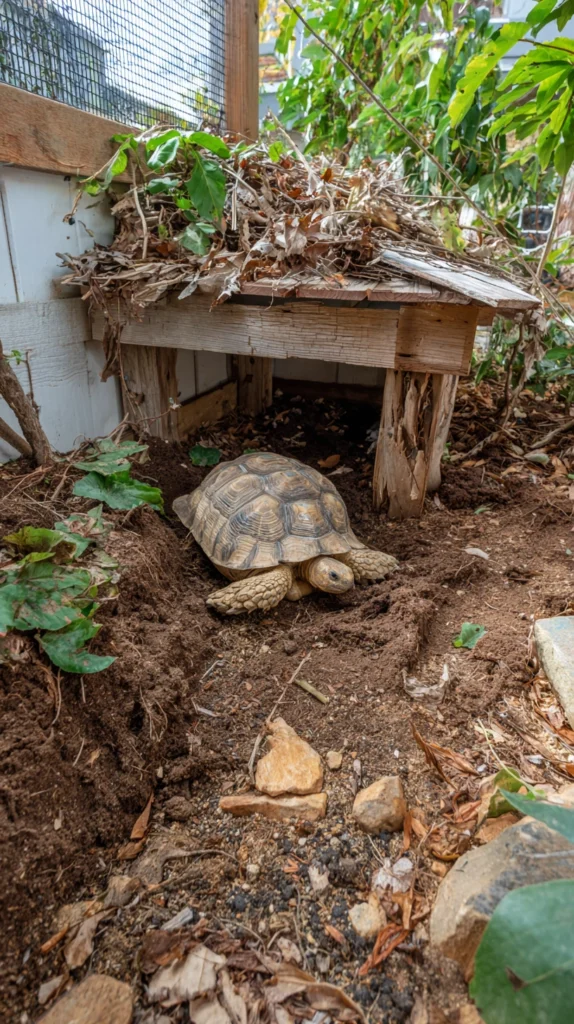
For species that hibernate naturally — Hermann’s tortoises, spur-thighed tortoises, and several other Mediterranean species — the outdoor enclosure should include a specific hibernation zone that provides the conditions the animal requires for safe, successful winter dormancy.
A hibernation zone in an outdoor enclosure is typically a deeper substrate area — at least forty to sixty centimeters of compacted soil and leaf litter — positioned on the enclosure’s most sheltered, least frost-penetrated side, ideally against a south-facing wall or fence that provides thermal mass and wind protection.
The hibernation zone should be protected from waterlogging — the most dangerous environmental condition for a hibernating tortoise — through a combination of good drainage beneath the substrate and an overhead covering that sheds rain while allowing air circulation.
Many keepers prefer indoor hibernation in a controlled environment for maximum safety, but for keepers committed to fully outdoor management, a properly designed hibernation zone provides adequate conditions for species-appropriate hibernation.
10. A Hot House and Cold Frame Seasonal Extension
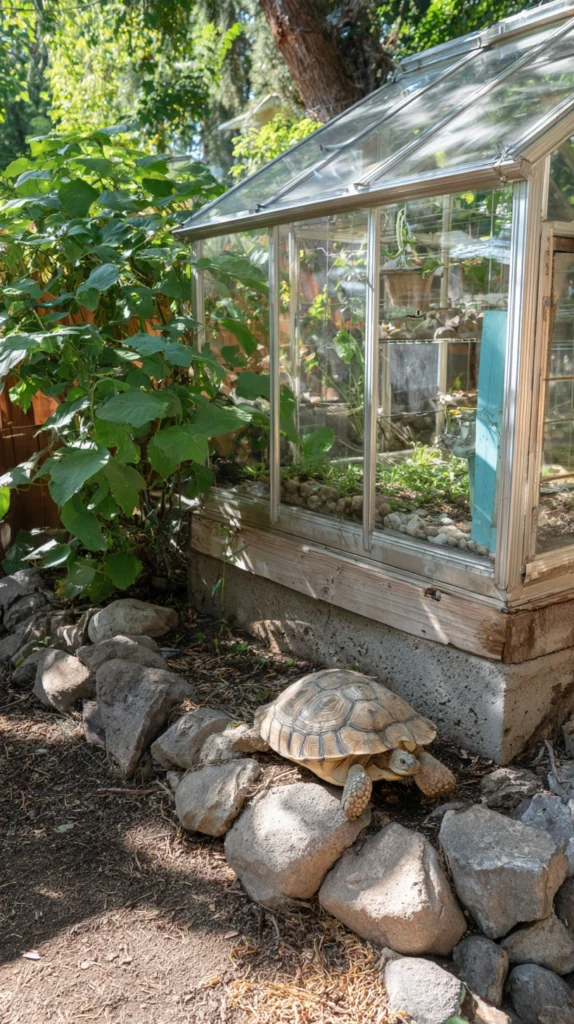
The British and northern European climate provides a genuine outdoor season for Mediterranean tortoises of perhaps five to six months in a good year, and the remaining months require the tortoise to be housed indoors or in a frost-free greenhouse structure.
A permanent cold frame or small greenhouse structure attached to or adjacent to the outdoor enclosure — with access between the greenhouse and the open run — extends the effective outdoor season by several weeks at each end, providing a frost-free, light-rich environment that bridges the gap between full outdoor conditions and full indoor housing.
The cold frame or greenhouse maintains the tortoise in a more naturalistic, more light-rich environment than indoor housing allows, reduces the metabolic stress of repeated environmental transitions, and provides the keeper with the logistical benefit of a semi-outdoor housing option that requires less daily management than a full indoor setup.
11. A Shade House Enclosure for Hot Climate Keeping
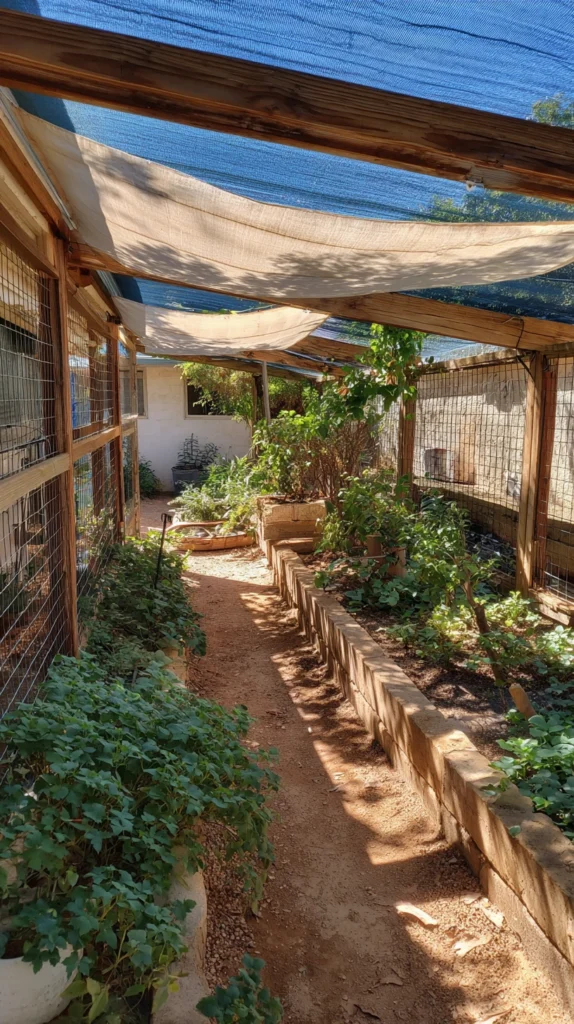
For keepers in hot, dry climates — southern Europe, California, Australia, and similar regions where summer temperatures regularly exceed the thermal comfort range of many tortoise species — the primary environmental challenge is not providing warmth but managing excessive heat and providing adequate shade.
A shade house enclosure — a structure whose roof is constructed from shade cloth of appropriate density, typically providing forty to sixty percent shade, supported on a simple timber or metal frame above the enclosure — creates a microclimate that is significantly cooler than the surrounding garden while still providing adequate natural light for vitamin D synthesis and the behavioral activity that UV exposure promotes.
Supplement the shade house structure with planted areas of dense vegetation that provide ground-level shade and the evaporative cooling of transpiring plant material, and ensure adequate water provision — a shallow soaking dish and regular misting of the substrate during the hottest periods — to support thermoregulation in high-temperature conditions.
12. A Community Enclosure for Multiple Tortoises
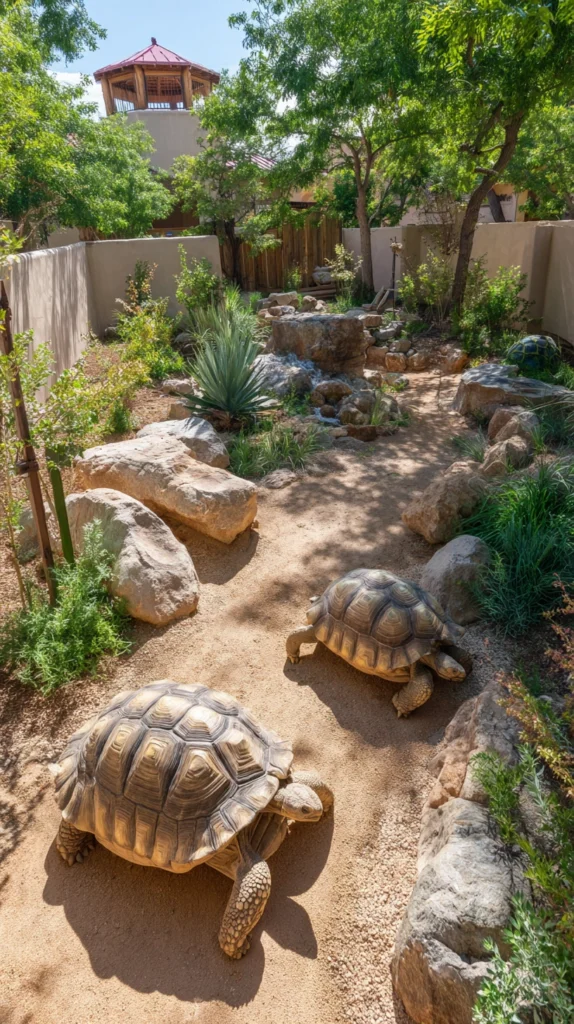
The multi-tortoise outdoor enclosure — a single outdoor space housing several tortoises of the same species and compatible size — requires specific design considerations that single-tortoise enclosures do not, primarily because the social dynamics of a tortoise group include dominance behavior, competition for basking spots and food, and occasional aggression that the enclosure’s design must accommodate and manage.
The community enclosure should be large enough — a minimum of two to three square meters per tortoise, ideally more — that each animal can establish a territory and move away from social pressure without being constrained by the enclosure boundary.
Multiple basking sites of equivalent quality — the same exposure, the same surface temperature — prevent the dominance monopoly of a single basking spot. Multiple feeding stations reduce food competition. Dense planting provides visual barriers that allow subordinate animals to be out of sight of dominant ones, which reduces stress-related suppression of feeding and activity.
13. An Aesthetic Show Enclosure for Garden Integration
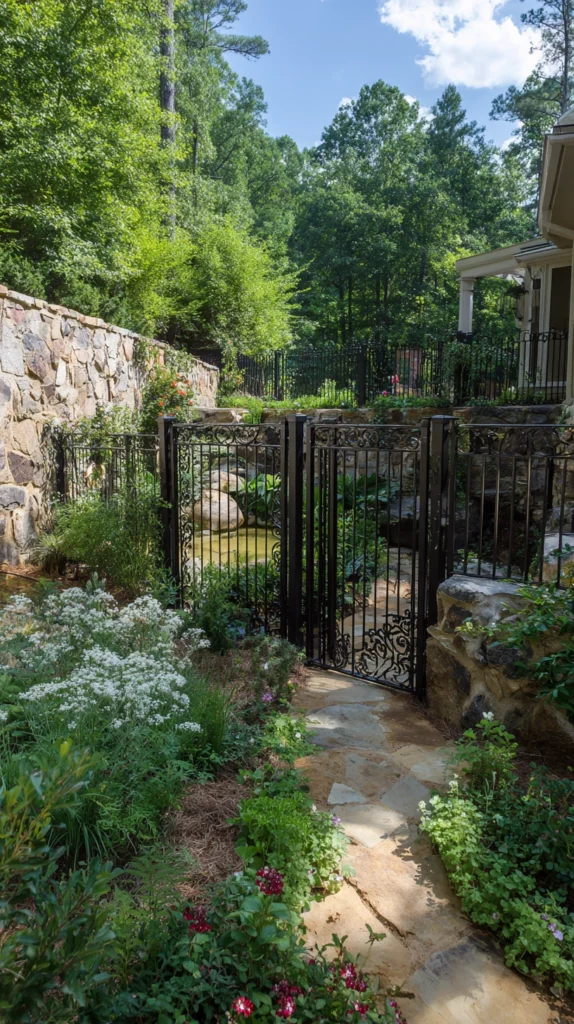
The outdoor tortoise enclosure, designed with equal weight given to the garden aesthetic and the animal welfare — a structure that a garden visitor would consider beautiful as a garden feature before learning its function as tortoise housing — represents the highest aspiration of the outdoor tortoise keeper who cares about both their animal and their garden.
A show enclosure uses quality materials throughout: natural stone raised beds, a gate with decorative ironwork, planted borders of Mediterranean herbs and wildflowers, artfully positioned rocks and slate pieces that create both visual interest and functional basking habitat.
The tortoise in such an enclosure becomes a living element of a garden composition — their movements through the landscape visible and charming from the garden’s main vantage points — and the enclosure contributes positively to the garden’s visual character rather than compromising it as a purely utilitarian structure.
14. A Tortoise Enclosure with Weather Monitoring
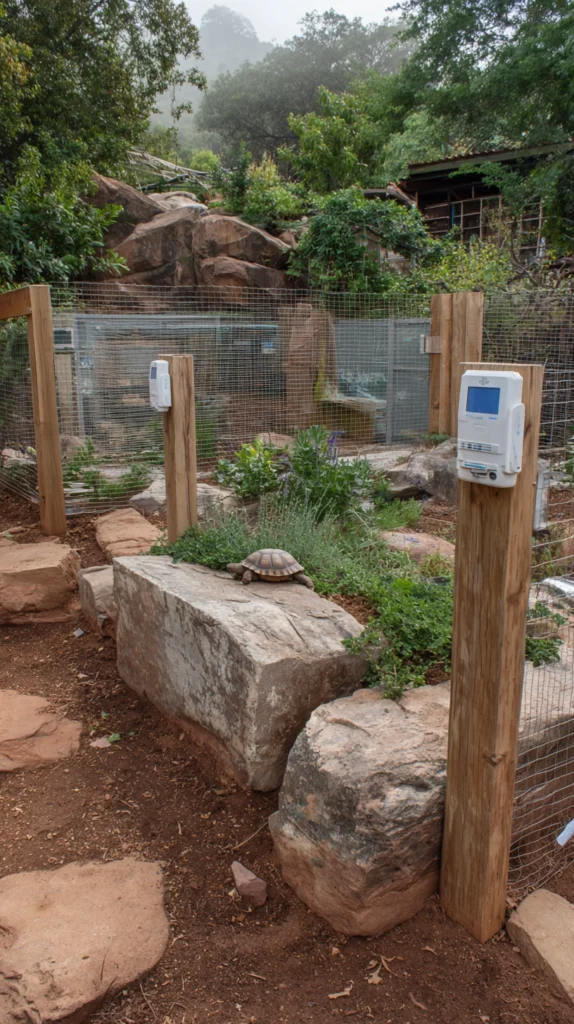
The responsible outdoor tortoise keeper monitors the enclosure’s environmental conditions with sufficient regularity and precision to make informed management decisions — when to bring the tortoises in before a cold snap, when conditions are warm enough to allow access to the outdoor run, when the substrate moisture level requires intervention.
A simple weather monitoring station positioned within or adjacent to the enclosure — a minimum/maximum thermometer, a soil temperature probe, a rain gauge, and ideally a UV index meter — provides the environmental data that informed management requires.
More sophisticated keepers install remote monitoring systems — wireless temperature and humidity sensors connected to a smartphone app — that allow the enclosure’s conditions to be checked at any time without physical attendance at the enclosure, providing early warning of extreme conditions that require management action before the animals are affected.
15. A Tortoise Enclosure Designed for the Long Term
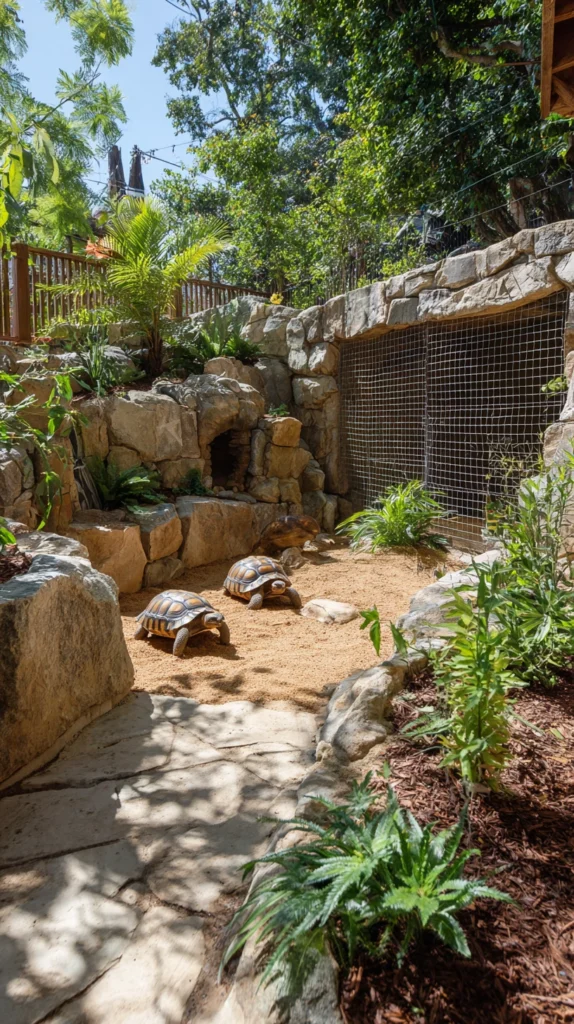
The final outdoor tortoise enclosure idea is not a design feature or a structural element but a design philosophy: the commitment to building the enclosure with the tortoise’s full natural lifespan in mind rather than for the immediate needs of a recently acquired animal.
Tortoises are among the longest-lived of all domestic animals — Mediterranean species commonly live sixty to eighty years, and some individuals live considerably longer, which means that the enclosure built for a juvenile tortoise today will be in use for a period of time that will extend across multiple decades of the keeper’s life and potentially beyond it.
Building with this timescale in mind means choosing materials of genuine durability — natural stone rather than pressure-treated timber that will rot within twenty years, high-gauge galvanized mesh rather than lightweight wire that will corrode within a decade — and designing a structure of sufficient size for the adult animal rather than only for the juvenile that currently inhabits it.
The tortoise enclosure built for the long term is a genuine garden investment that improves with age, as the planting matures, the stone develops its patina, and the tortoise grows into the landscape that has been created with genuine care for its lifelong welfare.