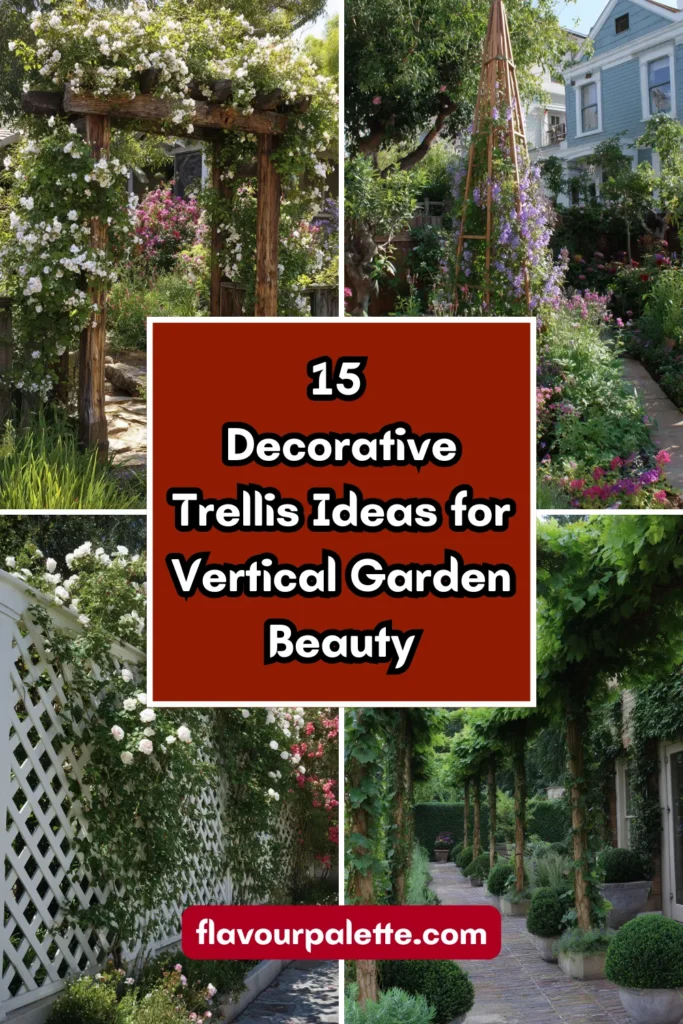
15 Decorative Trellis Ideas for Vertical Garden Beauty
There is a particular kind of gardening magic that happens on a vertical plane. While most of us think of gardens as horizontal spaces — beds to be dug, lawns to be mown, borders to be planted — the vertical dimension of a garden is often its most underused and most rewarding. A wall, a fence, a bare post, an empty expanse of brick: these are not limitations but opportunities, waiting for the right structure to transform them into something living, beautiful, and deeply satisfying.
The trellis is that structure. Humble in its basic form but extraordinary in its potential, a trellis takes the two-dimensional surface of a wall or fence and turns it into a canvas for climbing plants, trailing vines, and vertical garden compositions that can stop people in their tracks.
Beyond the purely practical function of supporting climbing plants, a decorative trellis is a design element in its own right. Its shape, material, finish, and scale all contribute to the character of a garden in the same way that furniture and art contribute to the character of a room.
The right trellis can make a small garden feel grand, a bare wall feel alive, a suburban fence feel like the boundary of something secret and beautiful. Here are 15 decorative trellis ideas for vertical garden beauty that will transform the way you think about the upward dimension of your outdoor space.
1. The Classic Diamond Lattice Trellis
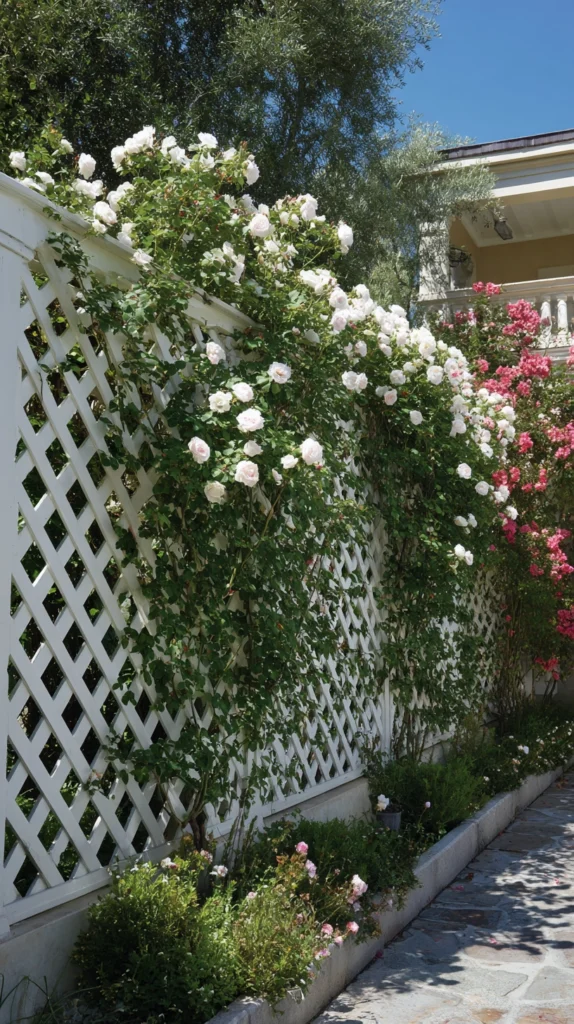
The diamond lattice is the trellis in its most recognizable and enduring form — criss-crossed timber or metal strips creating a repeating pattern of diamond shapes across a flat panel. Its longevity as a garden feature is not coincidental. The diamond lattice is genuinely beautiful in its geometric regularity, and it provides an ideal climbing structure for an enormous range of plants, from roses and clematis to jasmine and sweet peas.
Painted in white against a dark garden wall, it has a crisp, formal elegance. Left in natural timber, it has a rustic warmth. Painted in a deep heritage color — forest green, navy, or black — it recedes into the background and lets the plants take full visual precedence.
2. Fan-Shaped Trellis for Corner Planting

The fan trellis — a semicircular or fully circular design with slats radiating outward from a central point like the ribs of a fan — is one of the most beautiful and structurally interesting trellis forms available. It is particularly well-suited to corner planting, where a flat panel would look awkward, and a fan shape fills the space naturally and elegantly.
A climbing rose trained up a fan trellis develops into a spectacular display as the canes follow the radiating lines outward, covering the entire fan with blooms by midsummer. Fan trellises also work beautifully as standalone decorative features on plain walls, even before planting has had time to establish.
3. Espalier Trellis for Fruit Trees

Espalier is the ancient practice of training trees to grow flat against a wall or along a series of horizontal wires and supports, and it is one of the most beautiful and productive uses of a vertical surface in the garden.
An espalier trellis — consisting of a series of horizontal rails fixed to a wall at regular intervals — provides the framework for training apple, pear, fig, or quince trees into flat, symmetrical forms that are both ornamental and fruit-bearing.
The trained branches create strong graphic lines against the wall surface, beautiful in winter when bare and spectacular in spring when covered in blossom. An espalier fruit tree on a south-facing wall is one of the great achievements of kitchen garden design.
4. Rustic Willow and Hazel Trellis
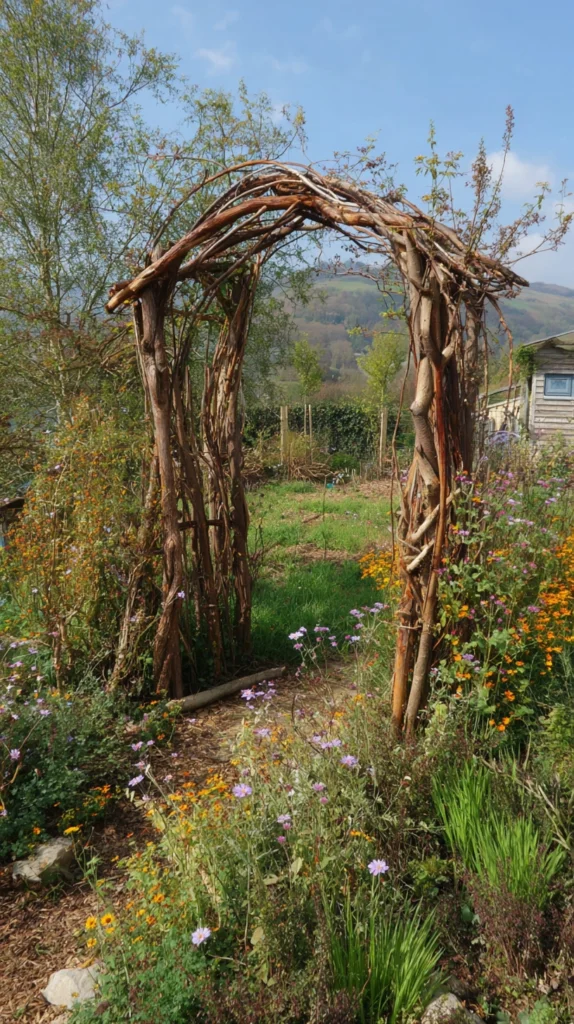
Not every trellis needs to be a manufactured product. Some of the most beautiful and characterful vertical garden structures are made from natural materials gathered or sourced with minimal processing. Willow and hazel branches woven into panels or constructed into free-standing trellis frames have a loose, organic quality that suits cottage gardens, wildflower borders, and naturalistic planting schemes perfectly.
The slight irregularity of the natural wood — no two branches the same diameter, no two joints at precisely the same angle — gives these structures a handmade warmth that manufactured panels cannot replicate. As they weather, they develop a silver-grey patina that becomes more beautiful with each passing season.
5. Painted Trellis as a Garden Focal Point
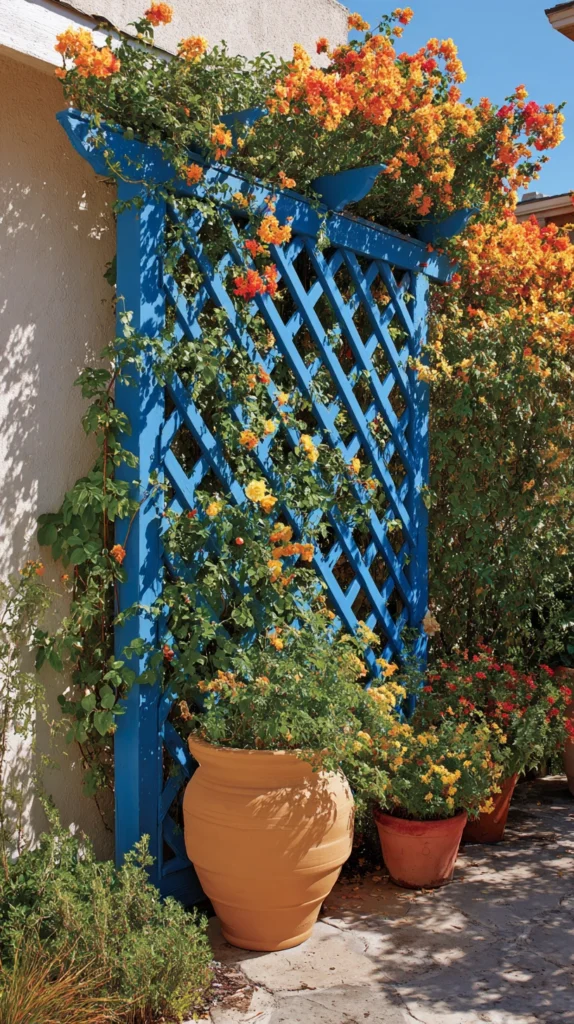
A trellis doesn’t need to wait for plants to become beautiful. A painted trellis — particularly one in a bold, unexpected color — can function as a garden focal point in its own right, with planting treated as an enhancement rather than a necessity. Consider painting a large diamond lattice panel in deep cobalt blue, warm terracotta, or rich sage green and positioning it against a plain wall as you would hang a piece of art.
Even without a single plant attached to it, the painted trellis creates color, structure, and visual interest. As climbing plants begin to establish themselves and weave through the lattice, the painted color glimpsed between leaves and stems adds depth and contrast to the composition.
6. Arch Trellis as a Garden Threshold
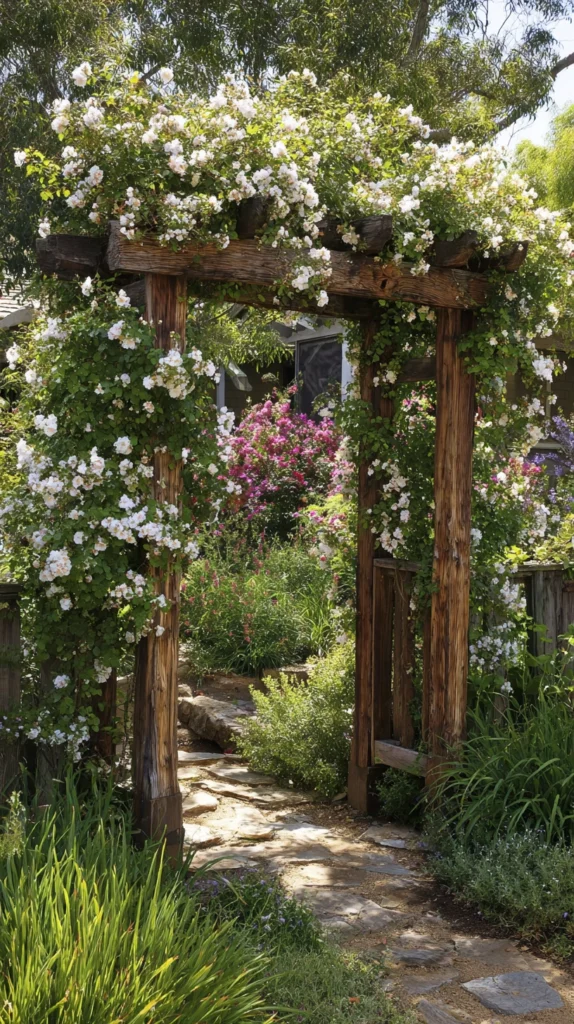
A trellis arch is one of the most romantic and theatrically effective structures in garden design. Positioned at the entrance to a garden, at the transition between two outdoor spaces, or at the end of a path, an arch trellis creates a threshold — a moment of passage that marks the transition from one place to another and gives the garden a sense of narrative structure.
Planted with climbing roses, the arch becomes something almost fairytale in its beauty: a tunnel of bloom and fragrance that rewards every approach. For a more relaxed effect, plant with jasmine, honeysuckle, or clematis, each of which brings its own scent and floral character to the structure.
7. Modern Metal Grid Trellis

For gardens with a contemporary aesthetic, the rustic charm of timber lattice and willow panels may feel out of keeping with the surrounding architecture and design. A modern metal grid trellis — flat steel or powder-coated iron panels in a clean, uniform grid pattern — offers the structural and horticultural benefits of a trellis while maintaining a sleek, architectural quality that suits modern outdoor spaces.
These panels work particularly well fixed directly to rendered walls in urban gardens, where the geometry of the grid echoes the geometry of the surrounding architecture. Planted with a single species of climber — a dense ivy, a wisteria, or a climbing hydrangea — the modern metal trellis achieves a sophisticated monochromatic effect that is quietly spectacular.
8. Trellis Privacy Screen
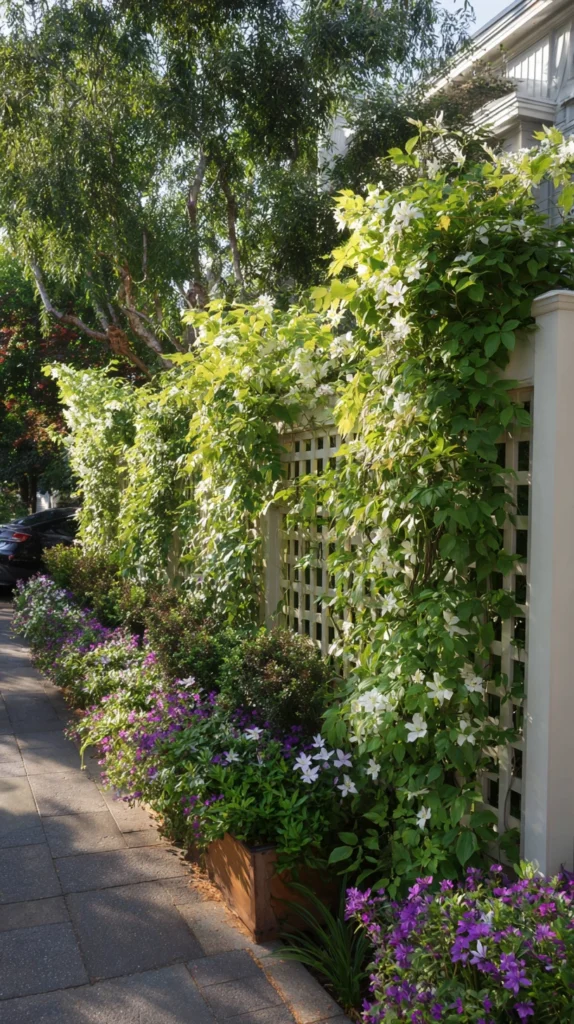
One of the most practical and aesthetically rewarding applications of the trellis is as a privacy screen — a planted boundary that softens the hard edge of a fence or wall and creates a living green barrier between your garden and the world beyond it.
A series of trellis panels fixed above an existing fence line, planted with fast-growing climbers like clematis, climbing hydrangea, or chocolate vine, will establish a dense green screen within one to two seasons.
The effect is far more beautiful than a solid fence panel and considerably more interesting than a hedge, particularly when the climbers are in flower. A trellis privacy screen transforms the boundary of a garden from a limitation into a feature.
9. Obelisk Trellis as a Planting Focal Point
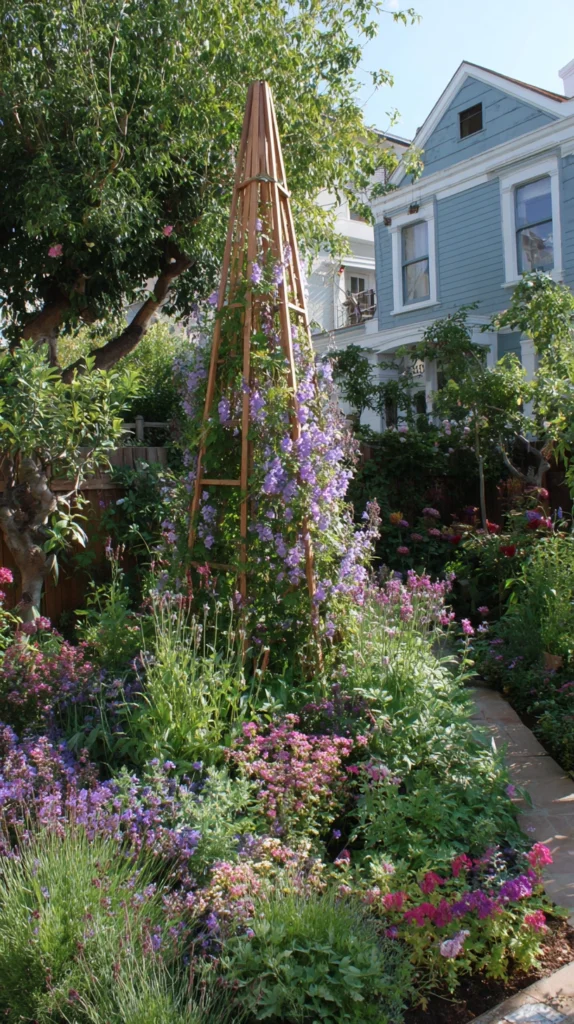
The garden obelisk — a tall, tapering trellis structure that stands as a freestanding column in a border or container — is one of the most elegant and versatile vertical garden features available. Unlike wall-mounted trellis panels, an obelisk creates vertical interest in the middle of a planting scheme, drawing the eye upward and giving climbing plants a three-dimensional structure to work with.
A metal or timber obelisk planted with a climbing rose, a sweet pea, or a flowering clematis becomes the focal point of a border in summer, its tapering form covered in blooms and fragrance. In winter, when the plants have died back, the bare obelisk retains its structural elegance and gives the garden a sculptural quality.
10. Bamboo Trellis for an Exotic Garden Feel
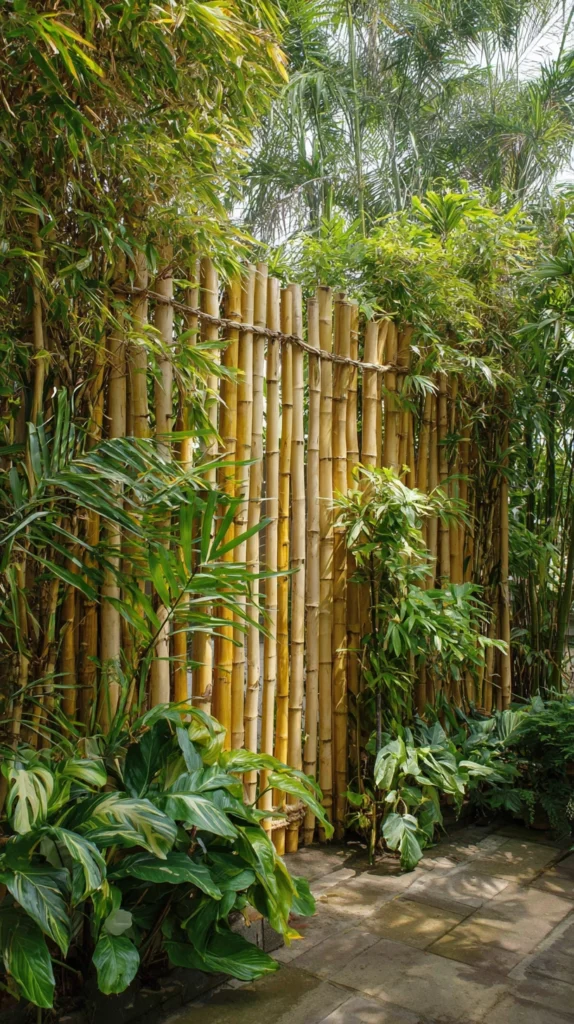
Bamboo is one of the most beautiful and sustainable materials available for garden structures, and a bamboo trellis brings an exotic, Eastern quality to a garden that suits tropical planting schemes, zen-inspired gardens, and naturalistic outdoor spaces with equal ease. Bamboo canes can be lashed together in grid or fan formations using natural twine to create panels of great beauty and considerable strength.
The warm golden tones of dried bamboo against green foliage are particularly striking, and the material weathers gracefully over time. Planted with passionflower, kiwi vine, or climbing nasturtium, a bamboo trellis creates a vertical display that feels genuinely transported from another part of the world.
11. Rope and Post Trellis for Relaxed Elegance
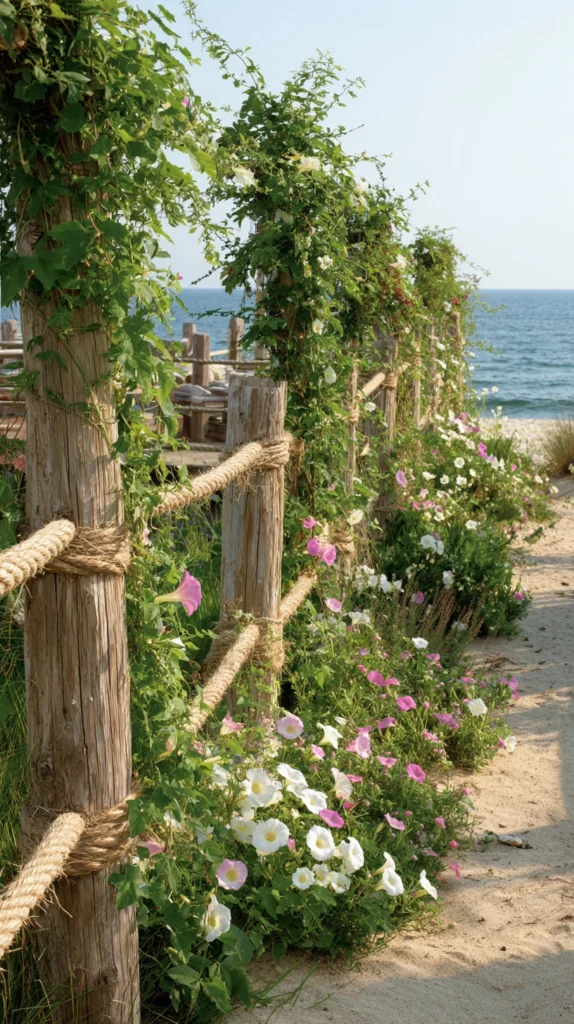
A rope trellis — lengths of natural hemp or jute rope strung between posts or fixed to a wall in horizontal or diagonal lines — has a relaxed, seaside quality that suits coastal gardens, informal terraces, and naturalistic planting schemes.
The soft, organic texture of rope against climbing plants creates a more delicate and informal effect than a rigid timber or metal panel, and the flexibility of the rope allows it to be arranged in almost any configuration. This kind of trellis suits light climbers like sweet peas, nasturtiums, and morning glory particularly well — plants that wind their way through the rope with an effortless natural grace that looks as though it has arranged itself.
12. Trellis Ceiling for an Outdoor Room
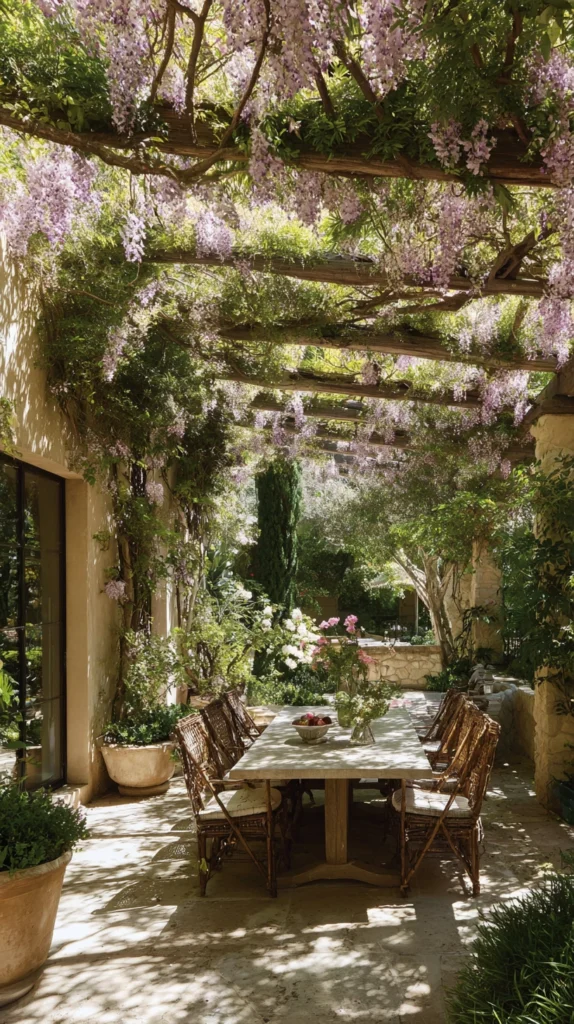
The concept of the outdoor room — a defined, furnished outdoor space that functions as an extension of the interior — has become increasingly central to garden design, and a trellis overhead structure is one of the defining features of the most successful examples.
A pergola-style trellis ceiling, planted with wisteria, grapevine, or climbing rose, creates a living canopy above an outdoor dining or seating area that is spectacular in bloom and deeply pleasant to sit beneath at any time of year. The dappled light that filters through a planted trellis ceiling has a quality found nowhere else — warm, shifting, and deeply connected to the natural world moving above you.
13. Mirrored Trellis Panel for Small Spaces
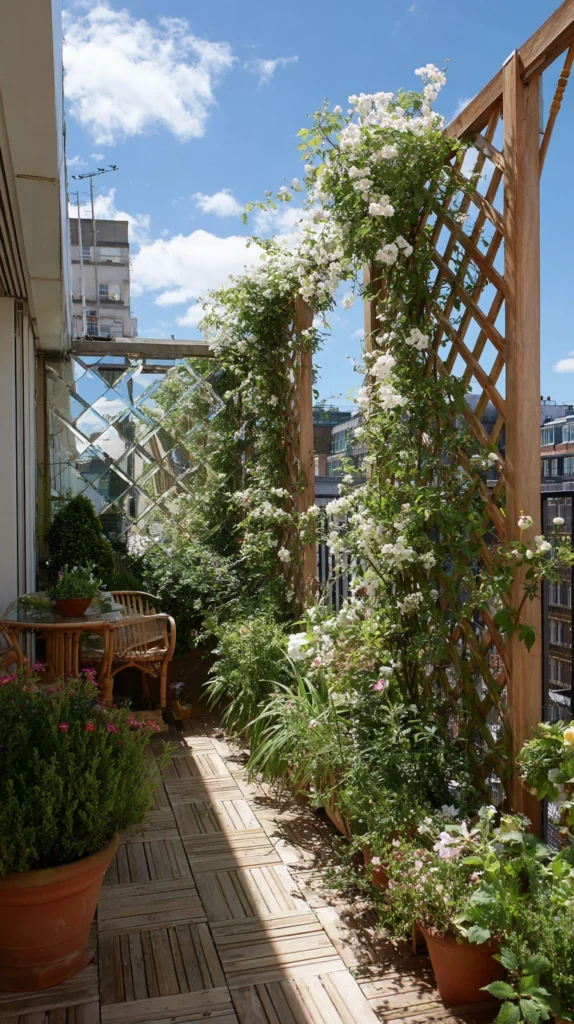
In small urban gardens, courtyard spaces, and compact terraces, the challenge of creating a sense of space and depth is a constant one. A mirrored trellis panel — a lattice frame backed with mirror or reflective glass — addresses this challenge with elegant ingenuity, creating the illusion of a garden continuing beyond the wall while simultaneously functioning as a climbing structure for plants.
The combination of reflected sky, reflected foliage, and the plants actually growing across the trellis surface creates a layered, complex visual effect that makes small spaces feel considerably larger and more mysterious.
Framed in painted timber and positioned opposite a planting scheme of particular beauty, a mirrored trellis panel becomes one of the most interesting features a small garden can contain.
14. Herringbone Trellis for Traditional Gardens
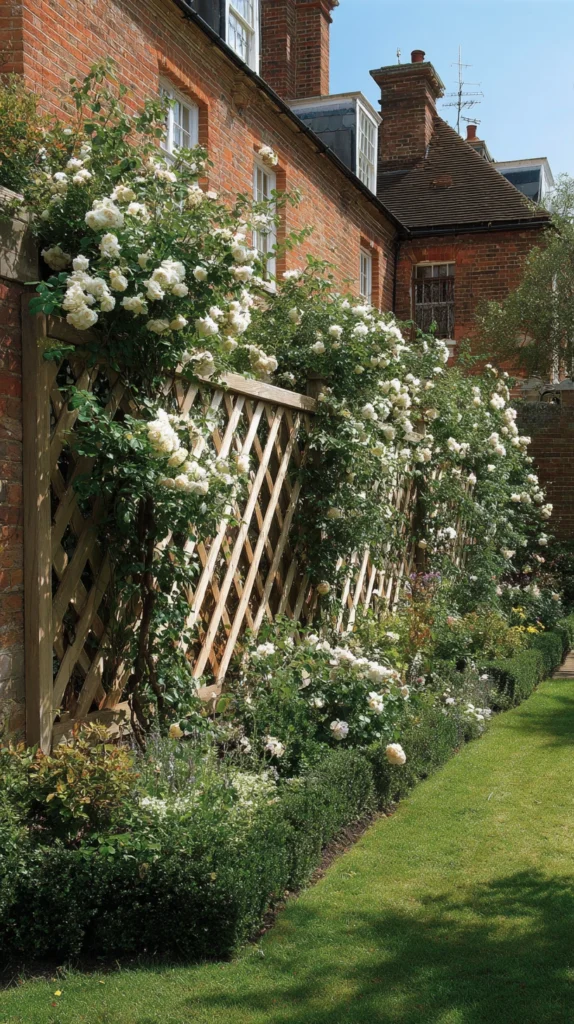
Where the diamond lattice is the classic choice for a traditional garden, the herringbone trellis — timber slats arranged in a V-shaped chevron pattern rather than a diagonal grid — offers a subtly different and equally beautiful alternative.
The herringbone pattern has a strong graphic quality and a slight formality that suits walled gardens, kitchen gardens, and period properties particularly well.
Fixed to a warm brick wall and planted with an espalier fruit tree or a trained climbing rose, a herringbone trellis panel creates a backdrop of extraordinary architectural beauty that improves with every season as the plants develop and mature along the lines of the structure.
15. Living Trellis of Pleached Trees
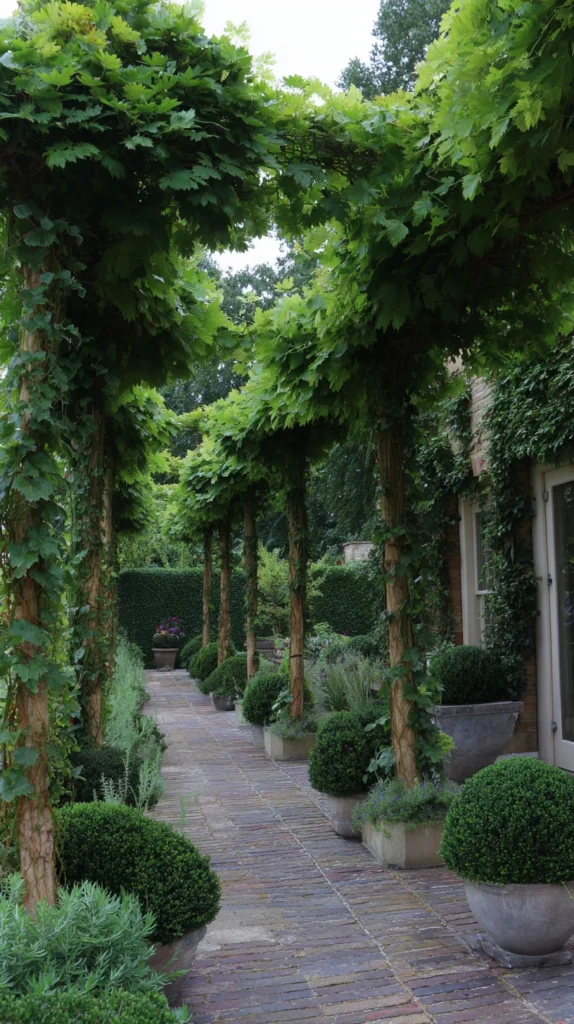
The pleached tree — a tree trained to grow on a single flat plane by tying its branches to a framework of canes and wires — is the most ambitious and most spectacular form of vertical garden structure.
A row of pleached hornbeam, lime, or beech creates what is effectively a living trellis: a wall of foliage and branches that provides privacy, defines space, and achieves a formal elegance that is unmatched by any manufactured structure.
Pleaching is a long-term project that rewards patience — the trees take several years to fully establish their trained form — but the result is one of the most beautiful and distinctive features available to the ambitious garden maker. A double row of pleached trees forming a tunnel or allée is among the most theatrical experiences a garden can offer.
Choosing the Right Trellis for Your Garden
The trellis you choose should respond to three things: the architecture and character of your garden, the plants you intend to grow, and the practical conditions of the site. A trellis in a formal walled garden calls for a different response than one in a relaxed cottage border or a sleek urban terrace.
The material, the pattern, the scale, and the finish should all feel consistent with the garden’s overall personality while addressing the specific opportunity presented by the vertical surface in question.
What all trellises share, regardless of form or material, is the ability to transform. A bare wall becomes a vertical garden. A plain fence becomes a flowering boundary. An empty corner becomes a focal point. A flat garden becomes a space with height, drama, and the particular beauty that comes from plants growing upward toward the light, which is, after all, exactly what the best gardens encourage everything within them to do.